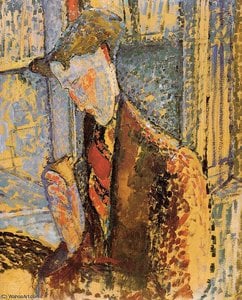
On the Train, Albert Müller and Kirchner: A Window Into Expressionist Turmoil
Ernst Ludwig Kirchner’s “On the Train, Albert Müller and Kirchner” (1925-26) isn't merely a depiction of two men traveling; it’s a visceral plunge into the anxieties and psychological complexities that defined German Expressionism. This painting, now available as a meticulously hand-painted reproduction from WahooArt.com, offers a compelling glimpse into the turbulent artistic landscape of the early 20th century, revealing a world saturated with unease, alienation, and a desperate search for meaning amidst rapid modernization.
The scene unfolds within the claustrophobic confines of a train carriage – a space simultaneously isolating and connecting. Kirchner masterfully utilizes flattened perspective, abandoning traditional notions of spatial depth in favor of an immediate, almost confrontational presentation. The figures of Albert Müller and Kirchner themselves are rendered with angularity and simplification; their bodies aren’t portraits of individual likenesses but rather conduits for raw emotion. Müller, reclining somewhat languidly, contrasts sharply with Kirchner's more upright posture, suggesting a subtle tension within the pair – perhaps mirroring the broader societal anxieties reflected in the artwork.
A Symphony of Discordant Color
Kirchner’s palette is anything but naturalistic; it’s deliberately jarring and emotionally charged. Bold greens, blues, reds, yellows, and purples collide with a forceful intensity, creating an atmosphere thick with unease. These aren't colors meant to soothe the eye, but rather to provoke a response – a feeling of disorientation and perhaps even discomfort. The application is equally striking: thick, visible brushstrokes, or impasto, build up layers of paint, adding a remarkable textural quality to the canvas. The use of color isn’t about representation; it's about conveying an internal state, mirroring the characters’ psychological turmoil.
Lines and Shadows: Constructing Tension
Strong, angular lines dominate the composition, defining the figures’ forms with a sharp precision that amplifies their distorted shapes. Rectilinear elements – the carriage itself, the window frame – contribute to a sense of confinement and tension, mirroring the psychological entrapment suggested by the setting. Kirchner employs abrupt transitions between colors and angles, further intensifying this feeling of unease. The painting isn't about capturing a realistic scene; it’s about constructing an emotional experience through carefully orchestrated visual elements.
Symbolism and the Journey Within
The train itself becomes a potent symbol – a vehicle hurtling towards an unknown destination, representing both progress and potential isolation. Considering Kirchner’s own struggles with mental health and his disillusionment with modern society, “On the Train” can be interpreted as a reflection of this internal journey. The figures' proximity suggests a shared experience of anxiety, while their averted gazes hint at a lack of genuine connection. The blurred background, representing the passing landscape glimpsed through the window, reinforces the sense of detachment and the fleeting nature of experience.
A Legacy of Expressionism
Kirchner’s “On the Train” stands as a pivotal work within the Expressionist movement, showcasing its commitment to subjective emotion and psychological exploration. It's a testament to his ability to translate inner turmoil into a powerful visual language. WahooArt.com’s hand-painted reproductions capture not only the painting’s striking aesthetic but also the emotional depth that lies at its core – offering art lovers a chance to experience this seminal work in exquisite detail and bring its evocative power into their homes or offices.



 Vaata sisu
 Lülita trükkitoodetele
 Jaga teost
 Jaga
Jaga
 Detailid
 Õppekate juhend

 Laadi alla
 Sarnased teosed
 Röntgenuuring
 Slaidietendus
 Statistika

 Loe lähemalt