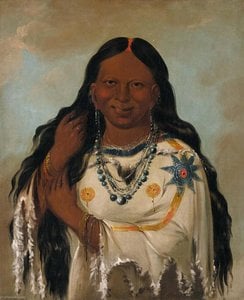
Elizabeth Lochrie, born July 1, 1890 in Butte, Montana was the artist commissioned for the mural The Fur Traders located at the post office in the St. Anthony, Idaho. At a very early age Elizabeth’s artistic talents were evident to her mother, May Davey, an accomplished musician and teacher, and made every effort to ensure her daughter had a good education. Lochrie was also heavily influenced by her father Frank Davey, a civil engineer, who was adventurous in cultivating a personal relationship with area tribes like the Blackfeet, Lochrie would inherit both parental traits. Her formal artistic training began in 1903-1905 with Vonnie Owings, a local instructor who had studied in San Francisco and Chicago before returning to Deer Lodge, Montana to teach. Upon graduation from the Pratt Art Institute in Brooklyn, NY, in 1911, Elizabeth returned home to Montana to teach art and raise her family. Much of her early work consisted of commercial art for local publications, paintings of the never-ending mountainous terrain, and portraits of the Blackfeet tribal members she had come to revere. Although classically trained while at the Pratt Institute, returning to Montana would allow her to break away from the restraints of popular styles and develop her own style known as ’Regionalism,’ which focused on the common themes of industrial, social, and human development of the United States. In her later years she would continue to paint portraits of Native Americans and become a sought after lecturer regarding tribal histories and recognized for her philanthropic efforts in defense of them until her death in 1981.In the 1930’s, after already completing a series of murals commissioned by the State of Montana, she was invited by Department of Treasury to submit pieces of her work for inclusion in the WPA-era mural project, three of which are still on display in Idaho and Montana. The mural The Fur Traders is representative of Idaho’s first permanent American fur trading post, Ft. Henry, was established in 1810 on the Snake River near St. Anthony’s, also the site of the first annual rendezvous between traders and Indians in the region. The painting reflects one of the most important and early scenes defining relationships between Native people and those from European cultures; trade and the convergence of cultures. The main body of the painting is a scene familiar to the beginnings of the economic and social development of Idaho and Wyoming, focused on trade between the Natives American tribes in the area, most notably the Shoshone, and the mountain men or trappers.The Snake River Watershed runs east and west through parts of Wyoming, Montana, Idaho, Utah, Oregon, and Washington throughout the Great Basin culture area providing the nomadic Shoshone with an extensive trade network of different tribal groups and non-Indian traders. The Shoshone or “Snake” Indians were originally named for the shape of their riverine homelands and snake-like motion they made with their hand, representing the salmon in the river. Salmon, made up a large part of their diet, this hand signal distinguished individual bands they belonged to. The Shoshone have four different ways of differentiating themselves; the Agaidukas, the salmon eaters “lemhi Shoshone” of the Salmon/Snake River; the Pohgues, “People of the Sage” in the Fort Hall area and made up of Shoshone/Bannock mixed bloods; the Kogohues “Green River Shoshones” who are also mixed bloods, and the Tukadukas, or “sheep eaters,” who live in the mountains of the Teton and Yellowstone ranges. The Louisiana Purchase in 1803 extended the U.S. land base to Idaho resulting in the Lewis and Clark Expedition in 1804-1806 in an effort to navigating navigate the Missouri River to Oregon Territory and the Pacific Ocean. After the Lewis and Clark Expedition, other explorers like John Colter and Jedediah Smith came through the Teton and Yellowstone ranges opening the way for settlement across the mountain pass in the valleys of Fremont County, Idaho where St. Anthony is located. The European demand for beaver fur top hats expanded the fur trade to the point of animal extinction in areas like the Snake River area. The Treaty of 1818 opened British lands further into Oregon and Washington and exposed the territories for even more new economic opportunities of competing British and American interests. The Hudson Bay Company was ordered by the British crown to send out brigades of trappers known as Snake River Brigades to exhaust the animal populations and use natural boundaries, like the Rocky Mountains, to serve as a buffer to dissuade people from moving and settling into newly opened territory. By 1830s the demand for animal furs, beaver in particular, had dwindled in favor of the use of silk. In Hudson Bay Company’s drive to monopolize trade in the area they either built or bought-out other traders establishing forts all along the western end of the Oregon Trail following the Snake R../..



 Vaata sisu
 Telli käsitsi maalitud reproduktsioon
 Jaga teost
 Jaga
Jaga
 Detailid
 Juhend

 Laadi alla
 Sarnased teosed
 Röntgenuuring
 Slaidietendus
 Statistika

 Loe lähemalt






































 Klaasivalik on saadaval ainult kuni 110 cm suuruses teostes