The Alpine Visionary: The Life and Legacy of Edward Harrison Compton
In the heart of Upper Bavaria, where the shadows of the Alps stretch across the serene waters of Lake Starnberg, a legacy of light and stone was born. Edward Harrison Compton, arriving in 1881, did not merely inherit a name; he inherited a way of seeing the world. As the son of the renowned mountain painter Edward Theodore Compton, his early years were steeped in the very essence of the high altitudes. His childhood was an apprenticeship of the soul, spent traversing rugged peaks and observing the ephemeral dance of light upon glaciers alongside his father. This profound connection to the mountains established a foundation that would later define him as a master of the Bergmaler—the mountain painter—style, blending technical precision with a deep, romantic reverence for the natural world.
Compton’s artistic journey was one of both expansion and adaptation. While his roots were firmly planted in the German tradition, his education at the Central School of Arts and Crafts in London introduced him to the vibrant currents of Impressionism and Neo-Romanticism. These movements, which prioritized the emotional resonance of a moment over mere topographical accuracy, breathed new life into his classical training. He learned to capture not just the physical weight of a rock face, and the crystalline structure of snow, but the atmospheric tension of a gathering storm and the luminous, fleeting glow of a setting sun. His work became a bridge between the meticulous detail of the Victorian era and the expressive, emotive freedom of the modern age.
Mastery of Medium and the Resilience of Spirit
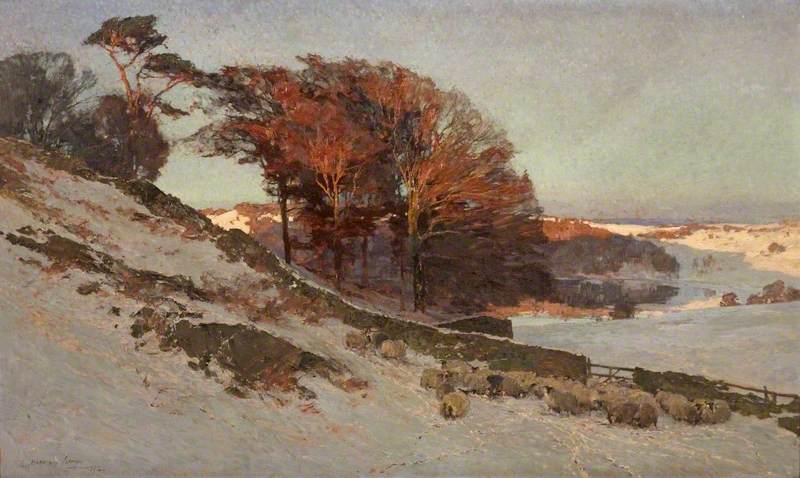
While many of his contemporaries sought the permanence and heavy texture of oils to depict the grandeur of the Alps, Compton found his true voice in the delicate transparency of watercolor. He understood that the mountains are never static; they are composed of mist, light, and shifting shadows. Through watercolor, he achieved a luminous tonal gradation that allowed him to render the crisp, biting air of the Dolomites and the soft, verdant valleys of England with equal mastery. His palette was a testament to his observation, utilizing vibrant hues to evoke the dazzling sunlight of high altitudes and subtle, muted tones to capture the profound stillness of a winter landscape.
However, the trajectory of his life was irrevocably altered by a profound personal challenge. At the age of twenty-eight, an attack of polio stripped him of the physical mobility required for his most ambitious alpine climbs. Yet, where the path to the highest peaks was closed, his artistic vision expanded toward new horizons. Forced to seek more accessible landscapes, Compton turned his gaze toward the rugged coasts of Sicily, the rolling hills of Northern Italy, and the evocative scenery of Westmorland in Cumbria. This period of transition proved that his talent was not tethered to a specific altitude, but rather to his ability to find the sublime in any landscape he encountered. His resilience transformed him from a specialist of the peaks into a versatile chronicler of the earth's diverse beauty.
A Lasting Impression on the Art of Illustration and Landscape
Beyond the standalone canvas, Compton’s influence extended into the very fabric of travel literature. He possessed a rare ability to translate the grandeur of a landscape into the intimate format of book illustration, providing the visual heartbeat for several prestigious publications by A & C Black. His illustrations for works such as Tyrol and The Dolomites did more than decorate pages; they invited readers to experience the majesty of the mountains through his eyes. This intersection of fine art and narrative illustration ensured that his aesthetic reached a much broader audience, cementing his status as a storyteller of the natural world.
Today, the work of Edward Harrison Compton stands as a vital record of a bygone era of exploration and romanticism. His legacy is preserved not only in galleries but in the enduring emotional impact of his scenes—works that continue to evoke the crispness of mountain air and the timelessness of the peaks. Through his mastery of watercolor and his ability to find beauty in both the monumental and the accessible, he remains a definitive figure in the history of landscape painting, reminding us that true vision transcends even the most daunting physical boundaries.


 Vaata sisu
 Lülita trükkitoodetele
 Jaga teost
 Jaga
Jaga
 Detailid
 Juhend

 Laadi alla
 Sarnased teosed
 Röntgenuuring
 Slaidietendus
 Statistika

 Loe lähemalt


