The Visceral Vision of Christopher Robert Browning
Christopher Robert Browning stands as a profound voice within the neo-expressionist movement, an artist whose canvases serve as conduits for the raw, unbridered currents of human emotion. Born in 1951 amidst the disciplined atmosphere of Camp Lejeune, North Carolina, Browning’s early life was shaped by a unique duality: the structured environment of military life and a deeply nurturing domestic sphere. As the son of a physician, his upbringing was grounded in stability, yet it was his mother who acted as the primary architect of his creative spirit, fostering an early and unyielding passion for visual expression. This foundational support allowed him to transition from the quiet observations of childhood into a rigorous academic pursuit of the arts, eventually leading him to the University of Illinois at Urbana-Champaign and later to the prestigious UC Davis, where he earned his MFA in 1976.
It was during these formative years in the mid-1970s that Browning began to absorb the turbulent energies of Abstract Expressionism, a movement that would forever inform his approach to the physical act of painting. His work does not merely represent reality; it seeks to excavate it. By embracing the tenets of neo-expressionism, Browning moved away from the detached intellectualism of conceptual art, choosing instead to embrace the tactile and the primal. He found inspiration in the heavy, textured legacies of masters such as Anselm Kiefer and Georg Baselitz, adopting their use of thick impasto and dramatic, gestural brushstrokes to create surfaces that feel alive with movement and struggle.
Symbolism and the Language of Emotion
The power of Browning’s oeuvre lies in its ability to balance abstraction with a hauntingly recognizable symbolism. His paintings often transport the viewer to fantastical, dreamlike landscapes where the boundaries between the physical world and the psychological realm dissolve. Within these nebulous spaces, he populates his compositions with enigmatic figures and archetypal motifs that resonate with deep-seated mythological themes. The presence of serpents, for instance, serves as a recurring motif, weaving through his work to suggest themes of transformation, danger, and the cyclical nature of life.
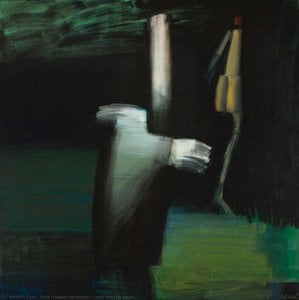
In masterpieces such as Reach, painted in 1994, one can witness the artist’s mastery over light and ambiguity. In this work, Browning utilizes a limited but potent color palette—often dominated by deep blues and stark blacks—to create an atmosphere of intense drama. The figures within the piece are deliberately blurred, stripped of precise identity to become vessels for universal human experiences like connection and fleeting movement. Through the use of heavy texture and dramatic backlighting, he achieves a sense of immediacy, pulling the spectator into a moment that feels both suspended in time and bursting with kinetic energy.
Legacy and Artistic Significance
Browning’s contribution to contemporary art is defined by his refusal to look away from the complexities of the human condition. His ability to synthesize the heavy textures of expressionism with the fluid, atmospheric qualities of impressionism has carved out a unique niche in the history of American painting. His work has been recognized by some of the world's most esteemed institutions, including:
- The Museum of Modern Art (MoMA)
- The San Francisco Museum of Modern Art (SFMOMA)
- The National Gallery
Beyond the technical brilliance of his brushwork, Browning’s historical significance resides in his role as a bridge between the mid-century abstract traditions and the more figurative, emotionally charged explorations of the late twentieth century. He remains an artist whose work continues to provoke introspection, inviting every viewer to confront the beautiful, chaotic, and often mysterious depths of their own inner landscape.



 Vaata sisu
 Telli käsitsi maalitud reproduktsioon
 Jaga teost
 Jaga
Jaga
 Detailid
 Õppekate juhend

 Laadi alla
 Sarnased teosed
 Röntgenuuring
 Slaidietendus
 Statistika


 Loe lähemalt






































 Klaasivalik on saadaval ainult kuni 110 cm suuruses teostes