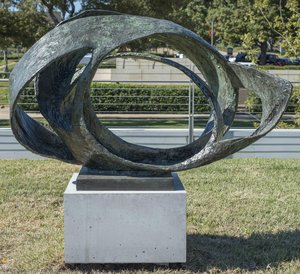
Involute II: A Dance of Form and Void by Barbara Hepworth
Dame Barbara Hepworth’s Involute II, created in 1956, is more than just a sculpture; it's an invitation to contemplate the relationship between form, space, and the very essence of movement. This remarkable bronze piece, currently available as a meticulously hand-painted reproduction from WahooArt.com, embodies Hepworth’s signature approach – a profound exploration of abstraction rooted in a deep understanding of natural forms. The sculpture itself is deceptively simple: a large, smoothly rendered sphere pierced by a carefully considered hole. Yet, within this apparent minimalism lies a complex interplay of visual and emotional resonance.
Hepworth's fascination with the ‘hole’ – introduced in her work as early as 1931 – wasn’t merely a stylistic choice; it represented a fundamental shift in sculptural thinking. She sought to move beyond static representation, embracing instead the concept of an internal space, a void that simultaneously defines and disrupts the external form. Involute II exemplifies this perfectly. The sphere itself suggests wholeness, containment, and perhaps even the cosmos – while the aperture invites us to consider what lies beyond, creating a dynamic tension between interiority and exteriority.
The Language of Form: Hepworth’s Technique
Hepworth's technique was characterized by an extraordinary combination of direct carving and indirect methods. She began with rough blocks of stone or wood, meticulously shaping them using hand tools before transferring the forms to a plaster model. This process allowed her to refine the initial idea while retaining a tactile connection to the material. The bronze casting itself demanded immense skill – achieving the smooth, polished surface of Involute II required careful control over temperature and pressure during the molten metal process. The subtle variations in texture, achieved through abrasives and polishing, are testament to her dedication to capturing the nuances of form.
Notably, Hepworth’s work was deeply influenced by her time in St Ives, Cornwall, where she collaborated with Ben Nicholson and other artists. This environment fostered a spirit of experimentation and a shared interest in exploring new ways of representing reality through abstraction. The Cornish landscape – its rugged coastline, swirling seas, and dramatic light – undoubtedly informed Hepworth’s artistic vision, contributing to the sense of dynamism and movement that permeates her sculptures.
Symbolism and Emotional Impact
The title itself, “Involute,” refers to a mathematical term describing a spiral curve—a concept that resonates powerfully with the sculpture's form. The spiraling shape evokes notions of growth, evolution, and the cyclical nature of life. The hole, then, isn’t simply an absence; it’s an active element, suggesting potential, transformation, and a connection to something beyond our immediate perception. It invites contemplation on themes of openness, vulnerability, and the search for meaning.
Involute II is not merely a visually striking object; it's a deeply evocative work that speaks to the human condition. Its smooth surfaces and subtle textures invite tactile engagement, while its open form encourages introspection. As a reproduction from WahooArt.com, this piece retains the essence of Hepworth’s original vision – offering a beautiful and thought-provoking addition to any collection or interior space. The hand-painted detail ensures that every curve and texture is faithfully reproduced, capturing the spirit and artistry of this iconic sculpture.
Bringing Involute II into Your Space
Consider how Involute II might interact with your existing décor. Its neutral tones and flowing form will complement a wide range of styles, from minimalist modern to mid-century contemporary. The sculpture’s inherent dynamism can serve as a focal point in a room, drawing the eye and stimulating conversation. Whether displayed on a pedestal or integrated into a larger composition, Involute II is sure to become a cherished piece – a testament to Barbara Hepworth's enduring legacy and her profound understanding of the power of abstract form.
Küsimused ja vastused
Kas „Involute II“, autor Barbara Hepworth on maalid, joonis või etsing?
Teos „Involute II“, autor Barbara Hepworth on klassifitseeritud kui Sculpture. See kategooria kirjeldab originaalteose kunstivormi.
Millissele etapile Barbara Hepworth karjääris kuulub teos "Involute II" (1956)?
Aasta 1956 asetab teose "Involute II" Barbara Hepworth loomingulise arengu perioodi Mid-Century Modern etappusesse.
Millissele perioodile Barbara Hepworth karjäärist kuulub teos "Involute II"?
Teos "Involute II" kuulub Barbara Hepworth loomingulise karjääri perioodi Mid-Century Modern. See klassifikatsioon seostab teose kunstniku loovliku arenguga.



 Lülita trükkitoodetele
 Jaga teost
 Jaga
Jaga
 Detailid
 Õppekate juhend

 Laadi alla
 Sarnased teosed
 Slaidietendus
 Statistika


 Loe lähemalt






































 Klaasivalik on saadaval ainult kuni 110 cm suuruses teostes