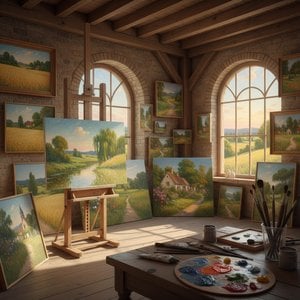
A Life Immersed in the Dorset Landscape: The World of Alfred William Watkin
Alfred William Watkin (1854-1933) wasn't a painter who sought dramatic innovation or radical departures from tradition. Instead, he dedicated his life to capturing the quiet beauty and subtle nuances of his native Dorset, England. Born into a rural environment, Watkin’s artistic journey was one of deep observation and affectionate rendering of the landscapes that surrounded him – the rolling hills, the rugged coastline, the meandering rivers, and the pastoral scenes of everyday life. He wasn't driven by ambition for widespread fame but by an intrinsic need to translate his personal connection with nature onto canvas. This dedication resulted in a body of work that offers a poignant glimpse into a vanishing England, a world before rapid industrialization irrevocably altered its character. While not widely known during his lifetime, Watkin’s paintings have experienced a resurgence in popularity as collectors and art enthusiasts rediscover the charm and authenticity of his vision.
Early Influences and Artistic Development
Watkin's early life was steeped in the traditions of rural England. His father was a farmer, and the rhythms of agricultural life profoundly shaped his aesthetic sensibility. Though largely self-taught, Watkin benefited from the burgeoning art scene in Dorset during the late 19th century. The influence of the Barbizon school is discernible in his early works – a focus on realistic depictions of nature, an emphasis on tonal values, and a preference for working *en plein air*. He also absorbed lessons from contemporary British landscape painters like John Constable and Thomas Gainsborough, though he never fully embraced their more dramatic or idealized styles. Instead, Watkin developed a uniquely personal approach characterized by meticulous detail, soft lighting, and a restrained palette. His initial subjects were often the immediate surroundings of his family farm – cows grazing in fields, haystacks bathed in golden sunlight, and local villages nestled amongst the hills. As he matured as an artist, Watkin expanded his range to include coastal scenes, river landscapes, and more expansive views of the Dorset countryside.
Themes and Techniques: A Celebration of Rural England
Watkin’s paintings are united by a consistent thematic focus – a celebration of rural England and its enduring beauty. He was particularly drawn to the interplay of light and shadow, using subtle gradations of tone to create atmosphere and evoke mood. His technique was characterized by careful observation and meticulous detail. He often worked in watercolor, a medium that allowed him to capture the delicate nuances of color and texture. However, he also produced oil paintings, which enabled him to achieve greater depth and richness of tone.
Recurring motifs in his work include:
- Cows – often depicted as peaceful symbols of rural life.
- Rivers – representing the flow of time and the connection between land and water.
- Coastal scenes – capturing the rugged beauty of the Dorset coastline.
- Harbors and villages – depicting the everyday lives of local communities.
Watkin’s paintings are not simply topographical representations; they are imbued with a sense of nostalgia and affection for the landscapes he depicted. He wasn't interested in grand vistas or dramatic events but rather in capturing the quiet beauty of ordinary moments. His work offers a poignant glimpse into a vanishing world, a time before rapid industrialization irrevocably altered the character of rural England.
Legacy and Historical Significance
Although Watkin did not achieve widespread recognition during his lifetime, his paintings have experienced a resurgence in popularity in recent years. This renewed interest is due in part to a growing appreciation for the charm and authenticity of his vision. In an age dominated by abstract expressionism and conceptual art, Watkin’s realistic depictions of nature offer a refreshing alternative – a reminder of the enduring beauty of the natural world. His work provides valuable insight into the social and cultural history of rural England during the late 19th and early 20th centuries. He documented a way of life that was rapidly disappearing, preserving it for future generations.
Watkin’s paintings are now sought after by collectors and art enthusiasts who appreciate his meticulous technique, subtle palette, and affectionate rendering of the landscapes he loved. His legacy lies not in groundbreaking innovation but in his unwavering dedication to capturing the quiet beauty and enduring spirit of Dorset, a world that continues to captivate and inspire.



 Vaata sisu
 Lülita trükkitoodetele
 Jaga teost
 Jaga
Jaga
 Detailid
 Juhend

 Laadi alla
 Sarnased teosed
 Röntgenuuring
 Slaidietendus
 Statistika


 Loe lähemalt






































 Klaasivalik on saadaval ainult kuni 110 cm suuruses teostes