Ver en contextoVer en contexto Vista previa en RAVista previa en RA Comprar pintura hecha a mano Comprar pintura hecha a manoSwitch to Digital Image Switch to Digital Image EnviarEnviar
DetallesDetalles Añadir a favoritos Añadir a favoritos DescargarDescargar SimilaresSimilares RadiografíaRadiografía Presentación de diapositivasPresentación de diapositivas StatsStats

Composición con Rojo, Azul y Amarillo

Descubre la composición magistral de Piet Mondrian ‘Composición con Rojo, Azul y Amarillo’. Esta obra maestra del neoplasticismo refleja armonía geométrica y belleza atemporal.

Explore la obra de Piet Mondrian (1872-1944), un pionero del arte abstracto y el movimiento De Stijl. Descubre sus icónicos cuadros geométricos, su estilo Neoplasticismo y su influencia duradera en el diseño moderno, la arquitectura y el arte del siglo XX.

Giclée / Impresión de arte

Impresiones giclée o en lienzo de calidad de museo con producción rápida y opciones de acabado flexibles. (Comprar pintura hecha a mano Comprar pintura hecha a manoSwitch to Digital Image Switch to Digital Image)

P118B $10
P118H $10
P118W $10
P438Z $10
P508JH $12
P508YH $12
P805H $10
P805Z $10
P919BZ $10
P919G $10
P919XJ $10
P959ZH $10
P968JZ $12
W106C $8
W218G $10
W218JH $8
W218Y $10
W307PJ $10
W316G $10
W316PJ $8
W316Y $10
W398PJ $8
W4111J $10
W500HY $15
W500JH $15
W692G $12
W849H $8
W940BG $15
W953PJ $8

Estándar
a medida
CM
INCH

Elija entre nuestros tamaños predefinidos que respetan las proporciones originales de la obra.

ancho
altura

Puede introducir sus propias dimensiones para adaptarse a un marco o espacio específico. Si el tamaño seleccionado no coincide con las proporciones de la imagen original, recortaremos la obra de arte o extenderemos la imagen con un borde con efecto espejo o de color sólido. Se enviará una maqueta digital para su aprobación antes de que comience la producción.
Tenga en cuenta que la vista previa en pantalla no refleja el recorte o la extensión real. Solo la maqueta mostrará con precisión la composición final.
Aunque existen tamaños personalizados, recomendamos seleccionar una dimensión de la lista predefinida para preservar las proporciones originales.

Envío a todo el mundo () en 2 semanas en lugar de las 4/5 semanas estándar. (8 septiembre)

why_choose_icon
Envío exprés gratuito a todo el mundo
why_choose_icon
Lienzo de lino de alta calidad
why_choose_icon
Seguro de envío total
why_choose_icon
Garantía de reembolso de impuestos aduaneros
why_choose_icon
Garantía de fidelidad cromática exacta
why_choose_icon
Política de devolución de 100 días (solo por defectos)
why_choose_icon
Garantía de devolución del 100% del dinero
why_choose_icon
Descuento por cantidad

Precio total

$ 68

reproduction

Composición con Rojo, Azul y Amarillo

Giclée / Impresión de arte

Dimensiones de la reproducción

-

Precio total final

$ 68

Datos clave

  • Location: Kunsthaus Zürich
  • Notable elements or techniques: Geometric abstraction; Primary colors
  • Medium: Oil on canvas
  • Artistic style: Minimalist
  • Dimensions: 45 x 45 cm
  • Movement: Neoplasticism
  • Subject or theme: Abstract Composition

Test de arte

Cada pregunta tiene una única respuesta correcta.

Pregunta 1:
What artistic movement is Piet Mondrian primarily associated with?
Pregunta 2:
Which color dominates the composition of ‘Composition with Red, Blue and Yellow’?
Pregunta 3:
What geometric elements are prominently featured in this painting?
Pregunta 4:
Around what year was ‘Composition with Red, Blue and Yellow’ created?
Pregunta 5:
How does Mondrian describe the relationship between color and form in his art?

Composition with Red, Blue and Yellow

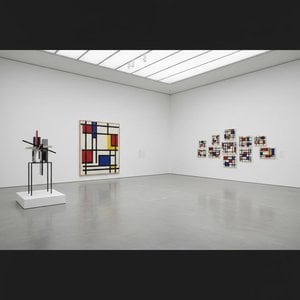
Composition with Red, Blue and Yellow stands as an emblem of abstract art’s revolutionary spirit, born from the fertile soil of Piet Mondrian’s artistic vision around 1930. This monumental canvas immediately captivates the eye with its dominant red rectangle—a bold declaration of color that commands attention. However, it is more than just a splash of hue; it embodies the core principles of Neoplasticism, Mondrian's meticulously crafted style that sought to distill painting down to its purest essence.

The painting’s framework is defined by two expansive strips—horizontal bands—that bisect the canvas and delineate its boundaries. These strips are further subdivided into smaller squares, creating a complex geometric grid that reflects Mondrian's unwavering belief in mathematical harmony as the foundation of artistic expression. At the bottom left corner, intersecting black bars disrupt this orderly arrangement, introducing asymmetry and dynamism – elements deliberately opposed to the static equilibrium championed by Mondrian.

Complementing the red rectangle are two distinct zones of color: deep blue and lemon yellow. Separated by horizontal surfaces of pale grey, these hues engage in a visual dialogue that underscores Mondrian’s fascination with relational opposites—a cornerstone of his aesthetic philosophy. Like Kandinsky, Mondrian initially drew inspiration from landscape painting, recognizing its inherent richness and complexity. Yet he swiftly abandoned representational imagery for abstraction, embarking on a transformative journey toward pure geometric forms.

The construction of the picture relied entirely on vertical and horizontal lines—the fundamental building blocks of Neoplasticism—and the deliberate use of primary colors: red, blue, and yellow. Mondrian’s ambition wasn't merely to depict visual reality; he aimed to express a deeper truth – the ‘universal’ – through the absolute harmony achieved by individual pictorial elements. As Stephen Bayley eloquently stated, “Mondrian has come to mean Modernism. His name and his work sum up the High Modernist ideal.”

This painting exemplifies Mondrian's unwavering commitment to relational opposites, asymmetry, and pure planes of color. He believed that abstraction offered a more profound understanding of reality than illusionistic depictions of objects in the visible world. The resulting composition is both balanced and imbued with tension—a reflection of the dynamic forces he perceived governing nature and human experience.

Considered alongside other works from Mondrian’s oeuvre, *Composition with Red, Blue and Yellow* reveals a stylistic evolution marked by an increasing simplification of form and color. The influence of Cubism is palpable in its fragmented perspective—a departure from traditional representation—yet Mondrian transcends this movement's limitations by prioritizing geometric abstraction.

The painting’s enduring appeal lies not only in its visual impact but also in its intellectual depth. It represents a pivotal moment in the history of art, signaling the triumph of rational thought over sensory experience and establishing Mondrian as one of the foremost figures of De Stijl—a Dutch artistic movement advocating geometric abstraction.

Ultimately, *Composition with Red, Blue and Yellow* transcends mere decoration; it embodies a profound philosophical statement about the nature of beauty and the pursuit of universal harmony. Its timeless elegance continues to inspire artists and designers alike, cementing Mondrian’s legacy as an icon of modern art.


Biografía del artista

**vida temprana y carrera en los Países Bajos (1872-1911)**

pieter cornelis mondriaan, conocido a partir de 1911 como piet mondrian, fue un pintor y teórico del arte holandés nacido el 7 de marzo de 1872, en Amersfoort, Países Bajos. Comenzó su carrera como maestro en educación primaria mientras practicaba la pintura, inicialmente en el estilo impresionista holandés de la Escuela de Ámsterdam.
  • Su obra temprana, caracterizada por paisajes naturalistas, se puede ver en pinturas como the red mill y trees in moonrise, que se exhibieron en el kunstmuseum den haag.
  • La búsqueda de Mondrian por parte de un estilo personal lo llevó a explorar diversos movimientos artísticos, incluyendo el puntillismo y el fauvismo.
  • Su primera exposición en 1893 marcó el comienzo de su prolífica carrera.

**la evolución del estilo de Mondrian**

de figurativo a abstracto La dirección artística de Mondrian se desplazó hacia un estilo cada vez más abstracto, culminando en una forma no representacional que llamó neoplasticismo. Esta 'arte plástico puro' tenía como objetivo crear 'belleza universal', limitando su vocabulario formal a los colores primarios (rojo, azul y amarillo), valores (negro, blanco y gris) y direcciones (horizontal y vertical).

**legado e influencia**

El legado de Mondrian se extiende más allá de su propia obra, influyendo en estilos y movimientos importantes como la pintura de campo de color, el expresionismo abstracto y el minimalismo. El historiador del diseño stephen bayley señaló que Mondrian se ha convertido en un símbolo para todo lo que el modernismo pretendía ser.
  • Explore más de la obra de Mondrian en WahooArt.com.
  • Aprenda sobre el movimiento De Stijl y su influencia en el arte moderno en wikipedia.
  • Descubra otros artistas influyentes como vincent van gogh y su impacto en el mundo del arte.

**obras clave y exposiciones**

* piet mondrian: apple blossom (cubismo) (ver en WahooArt.com) * piet mondrian: still life with vase of spices ii (cubismo) (ver en WahooArt.com) * piet mondrian: passionflower (73 x 48 cm, kunstmuseum den haag, post impressionismo, acuarela) (ver en WahooArt.com)
Piet Mondrian

Piet Mondrian

1872 - 1944 , Países Bajos

Datos clave

  • Artistas Que Influyeron:
    • Hague School
    • Puntillismo
    • Fauvismo
    • Cubismo
  • Estilo Artístico: Neoplasticismo, De Stijl
  • Fecha De Nacimiento: 7 de marzo de 1872
  • Influenciado A Artistas:
    • Expresionismo abstracto
    • Minimalismo
    • Color Field painting
  • Lugar De Nacimiento: Amersfoort, Países Bajos
  • Nacionalidad: Holandés
  • Nombre Completo: Piet Mondrian
  • Obras Notables:
    • Nueva York I
    • Composición con Rojo, Azul y Amarillo
    • Broadway Boogie Woogie
    • Tableau no. 2
Explore obras de arte organizadas por temas, estilos y características.