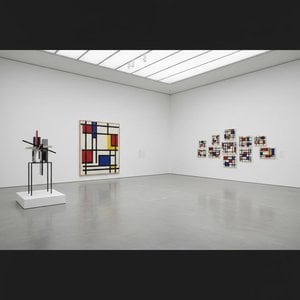
Composition with Red, Blue and Yellow
Composition with Red, Blue and Yellow stands as an emblem of abstract art’s revolutionary spirit, born from the fertile soil of Piet Mondrian’s artistic vision around 1930. This monumental canvas immediately captivates the eye with its dominant red rectangle—a bold declaration of color that commands attention. However, it is more than just a splash of hue; it embodies the core principles of Neoplasticism, Mondrian's meticulously crafted style that sought to distill painting down to its purest essence.
The painting’s framework is defined by two expansive strips—horizontal bands—that bisect the canvas and delineate its boundaries. These strips are further subdivided into smaller squares, creating a complex geometric grid that reflects Mondrian's unwavering belief in mathematical harmony as the foundation of artistic expression. At the bottom left corner, intersecting black bars disrupt this orderly arrangement, introducing asymmetry and dynamism – elements deliberately opposed to the static equilibrium championed by Mondrian.
Complementing the red rectangle are two distinct zones of color: deep blue and lemon yellow. Separated by horizontal surfaces of pale grey, these hues engage in a visual dialogue that underscores Mondrian’s fascination with relational opposites—a cornerstone of his aesthetic philosophy. Like Kandinsky, Mondrian initially drew inspiration from landscape painting, recognizing its inherent richness and complexity. Yet he swiftly abandoned representational imagery for abstraction, embarking on a transformative journey toward pure geometric forms.
The construction of the picture relied entirely on vertical and horizontal lines—the fundamental building blocks of Neoplasticism—and the deliberate use of primary colors: red, blue, and yellow. Mondrian’s ambition wasn't merely to depict visual reality; he aimed to express a deeper truth – the ‘universal’ – through the absolute harmony achieved by individual pictorial elements. As Stephen Bayley eloquently stated, “Mondrian has come to mean Modernism. His name and his work sum up the High Modernist ideal.”
This painting exemplifies Mondrian's unwavering commitment to relational opposites, asymmetry, and pure planes of color. He believed that abstraction offered a more profound understanding of reality than illusionistic depictions of objects in the visible world. The resulting composition is both balanced and imbued with tension—a reflection of the dynamic forces he perceived governing nature and human experience.
Considered alongside other works from Mondrian’s oeuvre, *Composition with Red, Blue and Yellow* reveals a stylistic evolution marked by an increasing simplification of form and color. The influence of Cubism is palpable in its fragmented perspective—a departure from traditional representation—yet Mondrian transcends this movement's limitations by prioritizing geometric abstraction.
The painting’s enduring appeal lies not only in its visual impact but also in its intellectual depth. It represents a pivotal moment in the history of art, signaling the triumph of rational thought over sensory experience and establishing Mondrian as one of the foremost figures of De Stijl—a Dutch artistic movement advocating geometric abstraction.
Ultimately, *Composition with Red, Blue and Yellow* transcends mere decoration; it embodies a profound philosophical statement about the nature of beauty and the pursuit of universal harmony. Its timeless elegance continues to inspire artists and designers alike, cementing Mondrian’s legacy as an icon of modern art.



 Vista previa
 Cambiar a formato impreso
 Compartir
 Compartir
 Ver detalles

 Descargar
 Ver artículos similares
 Radiografía
 Presentación de diapositivas
 Estadísticas


 Leer más






































 La opción de vidrio solo está disponible en tamaños inferiores a 110 cm.