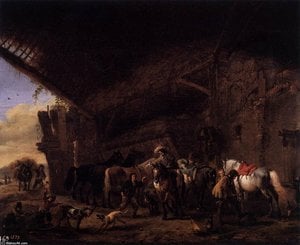
A Journey Through Golden Age Serenity
In the quiet expanse of Philips Wouwerman’s "Path through the Dunes," viewers are invited to step into a world where time seems to suspend itself within the rolling contours of the Dutch landscape. Painted during the height of the Dutch Golden Age, between approximately 1650 and 1668, this masterpiece is far more than a mere topographical record; it is an evocative window into a bygone era of tranquility. The composition centers on a winding path that meanders through sun-drenched dunes, acting as a visual guide that draws the eye deep into the heart of the scene. As one follows this trail, a solitary figure emerges—a subtle, human heartbeat within the vastness of nature—reminding us of our own small yet profound place within the grandeur of the earth.
The atmosphere of the painting is defined by a masterful interplay of light and shadow. Wouwerman, a virtuoso of the era, utilizes a dramatic sky filled with soft, drifting clouds to cast a shifting mosaic of light across the landscape. This luminosity breathes life into the textures of the dunes, where the artist’s loose, confident brushstrokes capture the tactile quality of sand, scrub, and wild vegetation. The horizon is graced by a tranquil body of water, reflecting the overcast heavens and providing a sense of infinite depth that expands the viewer's perspective far beyond the immediate foreground.
Mastery of Technique and Earthy Elegance
To behold this work is to witness the technical brilliance of one of Haarlem’s most celebrated sons. Wouwerman’s approach to the medium of oil on oak allows for a remarkable level of detail that remains grounded in a naturalistic realism. Unlike the more idealized landscapes of his contemporaries, Wouwerman embraced an earthy palette dominated by ochre yellows, deep browns, and muted greens. These tones do not merely represent the landscape; they embody its very essence, creating a harmonious visual experience that feels both organic and timeless.
The artist’s technique is particularly noteworthy in his ability to balance precision with movement. While he possesses a keen eye for the minute details of trees and shrubs, his brushwork remains fluid enough to convey the subtle dynamism of a coastal breeze. This duality creates a sense of "atmospheric perspective," where the distant horizon feels soft and ethereal, contrasting beautifully with the more textured, tangible elements of the path in the foreground. For the collector or interior designer, this painting offers a sophisticated balance of complexity and calm, making it an ideal centerpiece for spaces that require a touch of historical prestige and organic warmth.
An Invitation to Timeless Reflection
Beyond its technical merits, "Path through the Dunes" carries a profound emotional resonance. It evokes a sense of nostalgia for a simpler, more contemplative existence. The painting does not demand attention through loud colors or chaotic action; instead, it seduces the viewer through subtlety and grace. There is a certain melancholy in the solitary figure’s journey, yet it is balanced by the enduring peace of the landscape itself. It is a work that speaks to the soul, offering a sanctuary of stillness in an increasingly frenetic modern world.
For those seeking to adorn a curated collection or a refined living space, a high-quality reproduction of this Wouwerman classic serves as more than decoration. It acts as an invitation to pause, to breathe, and to wander through the dunes of history. Whether placed in a sunlit study or a grand gallery, the painting brings with it the enduring spirit of the Dutch Golden Age—a legacy of observation, emotion, and unparalleled artistic innovation.
Preguntas y respuestas
¿A qué estilo pertenece "Path through the Dunes"?
"Path through the Dunes" es una obra de Dutch Golden Age. El movimiento indica la tradición artística de la que forma parte la obra.
¿Puedo ver una vista de rayos X de "Path through the Dunes" de Philips Wouwermans?
La vista de rayos X de "Path through the Dunes" de Philips Wouwermans se encuentra en la página Rayos X de la obra: un examen interactivo de la imagen a través de once capas ópticas.
¿Qué técnica y estilo caracterizan a "Path through the Dunes" de Philips Wouwermans?
"Path through the Dunes" de Philips Wouwermans combina la técnica de Oil con el estilo Dutch Golden Age. La técnica y el movimiento describen la elaboración y el estilo de la obra.



 Vista previa
 Encargar reproducción pintada a mano
 Compartir
 Compartir
 Ver detalles
 Guía
Guía

 Descargar
 Ver artículos similares
 Radiografía
 Presentación de diapositivas
 Estadísticas


 Leer más






































 La opción de vidrio solo está disponible en tamaños inferiores a 110 cm.