A Serene Encounter with Nature
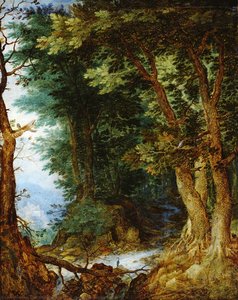
In the quietude of Paisagem [Landscape], created in 1900 by the master Pedro Weingärtner, we are invited into a world where time seems to decelerate. This evocative work captures a sun-drenched moment within a lush forest, where light filters through a dense canopy to illuminate a tranquil clearing. At the heart of this composition sits a modest building, nestled harmoniously among the trees, serving as a silent witness to the passage of time. The scene is not merely a depiction of flora and architecture, but a carefully orchestrated stage where nature and humanity exist in a delicate, peaceful equilibrium. Scattered throughout the landscape are benches, inviting the viewer to mentally step into the frame and find a place of rest amidst the verdant surroundings.
The presence of two solitary figures—one positioned near the left periphery and another closer to the right—infuses the stillness with a gentle pulse of life. These figures do not dominate the landscape; rather, they are integrated into its rhythm, suggesting a profound connection between the human spirit and the natural world. Their placement creates a subtle narrative tension, a sense of shared experience within a vast, breathing ecosystem. For the collector or interior designer, this painting offers more than just visual beauty; it provides a window into a state of mindfulness, making it an ideal centerpiece for spaces dedicated to reflection, study, or quiet relaxation.
The Mastery of Light and Realism
Technically, Paisagem stands as a testament to Weingärtner’s rigorous academic training in the prestigious academies of Germany and France. His ability to manipulate light is nothing short of extraordinary; he employs a technique that allows sunlight to appear almost tactile, as it dances across the leaves and settles upon the forest floor. This mastery of chiaroscuro—the interplay of light and shadow—creates a sense of three-dimensional depth that draws the eye deep into the woodland thicket. The brushwork, while precise enough to maintain the integrity of the realistic style, possesses a soft, atmospheric quality that evokes the romanticism characteristic of his most celebrated works.
The color palette is a sophisticated arrangement of earthy greens, deep browns, and luminous golds, all working in concert to establish a warm, inviting atmosphere. This careful selection of tones ensures that the painting remains timeless, capable of complementing a wide variety of interior aesthetics, from classical traditionalism to more contemporary, organic modernism. To possess a reproduction of this work is to bring a piece of late 19th-century European academic excellence into a modern home, offering an enduring sense of prestige and tranquility.
A Legacy of Brazilian Impressionism
To understand the emotional weight of this landscape, one must consider the historical context of Pedro Weingärtner’s life. As a pioneer who bridged the gap between the rugged landscapes of his native Brazil and the refined academic traditions of Europe, his work carries a unique cultural duality. Paisagem embodies this synthesis—the structural discipline of the German school blended with a romantic sensibility that celebrates the ephemeral beauty of a single moment in time. It is a piece that speaks to the universal human desire for sanctuary.
For those seeking to curate an art collection that inspires peace and intellectual curiosity, this landscape serves as a foundational element. It does not shout for attention; instead, it whispers of ancient forests, quiet afternoons, and the eternal beauty of the natural world. Whether placed in a grand salon or a private library, the painting acts as an emotional anchor, grounding the surrounding space with its profound sense of serenity and historical depth.


![Paisagem [landscape] — Pedro Weingärtner](/media/artworks/images-full/cf/4a/cf4a1f98af8d5aefdcb632c23c267a42.jpg)
 Vista previa
 Encargar reproducción pintada a mano
 Compartir
 Compartir
 Ver detalles
 Guía
Guía

 Descargar
 Ver artículos similares
 Radiografía
 Presentación de diapositivas
 Estadísticas


 Leer más






































 La opción de vidrio solo está disponible en tamaños inferiores a 110 cm.