Primeros años y formación
Jean-Baptiste Greuze, un pintor francés, nació el 21 de agosto de 1725 en Tournus, Borgoña. Su padre, maestro techador, inicialmente desalentó las inclinaciones artísticas de su hijo, pero eventualmente, Grandon, un artista lyones, animó a Greuze a perseguir su pasión. En 1750, Greuze se mudó a París para estudiar bajo Charles-Joseph Natoire en la Real Academia de Pintura y Escultura.
Ascenso a la fama
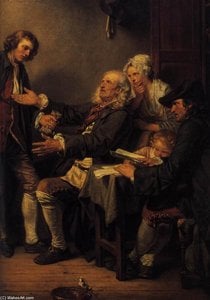
El gran avance de Greuze llegó en 1755 con su pintura *Le Père de Famille Expliquant la Bible à ses Enfants*, que fue comprada por un entusiasta del arte adinerado, Ange-Laurent Lalive de Jully. Esto llevó al reconocimiento de Greuze entre los filósofos y la comunidad artística. Luego viajó a Italia con Abbé Gougenot, donde pasó aproximadamente un año, inspirando sus futuras obras.
Estilo artístico y obras notables
El estilo de Greuze se caracteriza por su enfoque en escenas de género, capturando la esencia de la vida cotidiana. Algunas obras notables incluyen:
- *Una niña con un canario muerto* (Scottish National Gallery, Edimburgo), que muestra la capacidad de Greuze para evocar emociones.
- *Saboyano con una muñeca bailarina* (Albertina, Viena), destacando su habilidad para capturar el espíritu de sus sujetos.
- *Niño con un huevo roto*, c. 1756 (Albertina, Viena), demostrando la temprana maestría de Greuze en la pintura de género.
Legado y vida posterior
El éxito de Greuze alcanzó su punto máximo en 1765, con trece obras expuestas en el Salón, incluyendo *La Jeune Fille qui Pleure son Oiseau Mort*, *La Bonne Mère* y *Le Mauvais Fils Puni* (Louvre). Sin embargo, su intento de transición a la pintura histórica fue recibido con críticas. Greuze falleció el 4 de marzo de 1805 en el Louvre, después de una vida marcada tanto por triunfos artísticos como por dificultades financieras.
Influencias y desarrollo artístico
La obra de Greuze se desarrolló en un período de transición dentro del arte francés. Aunque inicialmente influenciado por el estilo rococó, con su énfasis en la elegancia y la sensualidad, Greuze evolucionó hacia una representación más realista y moralizante de la vida cotidiana. Se puede observar la influencia de los maestros holandeses en su atención al detalle y su enfoque en escenas domésticas. Su interés por retratar las emociones humanas, a menudo con un toque de melancolía o dramatismo, lo distingue de sus contemporáneos rococó. Su intento posterior de incursionar en la pintura histórica, aunque no fue bien recibido, refleja su deseo de ampliar su repertorio y alcanzar el prestigio asociado con este género.
Significado histórico
Jean-Baptiste Greuze es recordado como un pintor clave del siglo XVIII francés, que ayudó a definir el género de la pintura de costumbres. Su capacidad para capturar momentos íntimos y transmitir mensajes morales a través de sus obras lo convirtió en un artista popular entre la burguesía de su época. Aunque su intento de pintar historia no tuvo éxito, su legado como maestro de la pintura de género sigue siendo significativo. Su obra representa una transición importante del rococó hacia el neoclasicismo, y su influencia se puede apreciar en generaciones posteriores de artistas franceses.



 Ver en contexto
 Comprar pintura hecha a mano
 Enviar
 Compartir
 Detalles

 Descargar
 Similares
 Radiografía
 Presentación de diapositivas
 Estadísticas


 Ver más






































 La opción de vidrio solo está disponible en tamaños inferiores a 110 cm.