x
Ver en contextoVer en contexto Vista previa en RAVista previa en RA Comprar pintura hecha a mano Comprar pintura hecha a manoComprar imagen Comprar imagen EnviarEnviar
DetallesDetalles Añadir a favoritos Añadir a favoritos DescargarDescargar SimilaresSimilares RadiografíaRadiografía Presentación de diapositivasPresentación de diapositivas

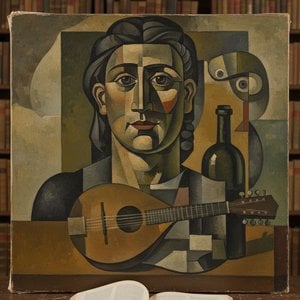
A Black Pedestal

Explore Georges Braque's 'The Pedestal' (1938), a stunning example of Analytical Cubism. This fragmented still life features musical instruments in muted tones, offering a unique blend of abstraction and contemplation. Hand-painted reproductions avai

Explore la vida y el arte de Georges Braque (1882-1963), una figura clave en la pintura del siglo XX. Pionero del Cubismo junto a Picasso, conocido por el Fauvismo, el collage y formas geométricas innovadoras. Descubre su legado en WahooArt!

Giclée / Impresión de arte

Impresiones giclée o en lienzo de calidad de museo con producción rápida y opciones de acabado flexibles. (Comprar pintura hecha a mano Comprar pintura hecha a manoComprar imagen Comprar imagen)

P118B $10
P118H $10
P118W $10
P438Z $10
P508JH $12
P508YH $12
P805H $10
P805Z $10
P919BZ $10
P919G $10
P919XJ $10
P959ZH $10
P968JZ $12
W106C $8
W218G $10
W218JH $8
W218Y $10
W307PJ $10
W316G $10
W316PJ $8
W316Y $10
W398PJ $8
W4111J $10
W500HY $15
W500JH $15
W692G $12
W849H $8
W940BG $15
W953PJ $8

Estándar
a medida
CM
INCH

Elija entre nuestros tamaños predefinidos que respetan las proporciones originales de la obra.

ancho
altura

Puede introducir sus propias dimensiones para adaptarse a un marco o espacio específico. Si el tamaño seleccionado no coincide con las proporciones de la imagen original, recortaremos la obra de arte o extenderemos la imagen con un borde con efecto espejo o de color sólido. Se enviará una maqueta digital para su aprobación antes de que comience la producción.
Tenga en cuenta que la vista previa en pantalla no refleja el recorte o la extensión real. Solo la maqueta mostrará con precisión la composición final.
Aunque existen tamaños personalizados, recomendamos seleccionar una dimensión de la lista predefinida para preservar las proporciones originales.

Envío a todo el mundo () en 2 semanas en lugar de las 4/5 semanas estándar. (1 septiembre)

why_choose_icon
Envío exprés gratuito a todo el mundo
why_choose_icon
Lienzo de lino de alta calidad
why_choose_icon
Seguro de envío total
why_choose_icon
Garantía de reembolso de impuestos aduaneros
why_choose_icon
Garantía de fidelidad cromática exacta
why_choose_icon
Política de devolución de 60 días (solo por defectos)
why_choose_icon
Garantía de devolución del 100% del dinero
why_choose_icon
Descuento por cantidad

Precio total

$ 68

reproduction

A Black Pedestal

Giclée / Impresión de arte

Dimensiones de la reproducción

-

Precio total final

$ 68

Datos clave

  • Subject or theme: Still Life
  • Movement: Cubism
  • Notable elements or techniques: Fragmented geometric shapes
  • Medium: Oil on Canvas
  • Year: 1919
  • Artistic style: Analytical Cubism
  • Influences: Paul Cézanne

Test de arte

Cada pregunta tiene una única respuesta correcta.

Pregunta 1:
What artistic movement is Georges Braque’s ‘A Black Pedestal’ primarily associated with?
Pregunta 2:
The painting depicts a still life featuring musical instruments. What is the dominant stylistic approach employed by Braque in this piece?
Pregunta 3:
What material was used to create ‘A Black Pedestal’?
Pregunta 4:
The painting’s composition emphasizes disorder and chaos. What artistic technique contributes to this effect?
Pregunta 5:
Georges Braque collaborated closely with Pablo Picasso during the Cubist period. How did their artistic styles differ?

The Architecture of Silence: Deconstructing Braque’s Vision

To encounter Georges Braque’s “A Black Pedestal” is to step into a world where the boundaries between object and space begin to dissolve. Painted during a period of profound artistic maturity, this work serves as a masterful window into the heart of Cubism—a movement that sought not to mirror the world, but to reconstruct it through an intellectual lens. At first glance, the composition presents a stark, commanding black pedestal, yet this central anchor supports much more than mere physical weight; it holds a collection of musical instruments—a violin, cello, clarinet, and trumpet—rendered in a way that defies traditional perspective. The painting does not merely show us these objects; it invites us to experience their fragmented essence, pulling the viewer into a rhythmic dance of planes and muted tonal harmonies.

The brilliance of this piece lies in its ability to transform the mundane into the monumental. Braque, whose early life was shaped by the practical precision of his family’s trade as house painters and decorators, brings an unparalleled sensitivity to structure and form. In “A Black Pedestal,” we see the legacy of Analytical Cubism at its most potent. Rather than relying on the fleeting light of Impressionism, Braque employs a meticulous dissection of reality. He breaks down the solid forms of the instruments and the pedestal into constituent geometric planes, creating a sense of depth that is paradoxically flat and multidimensional. This technique forces the eye to wander, reconstructing the scene piece by piece, much like a melody being assembled from individual notes.

A Symphony of Form and Fragmented Reality

Beyond its technical prowess, the artwork carries a profound emotional and symbolic resonance. The choice of musical instruments is far from accidental; music, like Cubism, relies on the relationship between distinct parts to create a cohesive whole. There is a quiet, almost meditative tension within the composition—a sense of "ordered chaos" where the arrangement of a chair, a bowl, or a spoon feels both spontaneous and mathematically precise. The muted color palette, dominated by earthy tones and deep blacks, strips away the distraction of vibrant color to focus our attention on the structural rhythm of the piece. This restraint creates an atmosphere of sophisticated introspection, making it a work that demands slow, contemplative viewing.

For the discerning collector or the interior designer, “A Black Pedestal” offers more than just aesthetic beauty; it provides a focal point of intellectual depth. Its large-scale presence (75 x 129 cm) and commanding subject matter make it an ideal centerpiece for modern, minimalist, or avant-garde interiors. A high-quality reproduction of this masterpiece allows the complex interplay of light and shadow to breathe within a contemporary space, adding a layer of historical gravity and artistic sophistication. It is a piece that does not merely decorate a wall; it initiates a dialogue between the history of modernism and the contemporary soul, reminding us that even in fragmentation, there is a profound and enduring harmony.


Biografía del artista

**vida temprana y formación**

georges braque, un destacado pintor francés, collageador, dibujante, grabador y escultor, nació el 13 de mayo de 1882 en Argelo, Val-d'Oise. Creció en Le Havre y inicialmente se formó para ser pintor de casas y decorador, como su padre y abuelo. Sin embargo, las inclinaciones artísticas de Braque lo llevaron a estudiar pintura en la École des Beaux-Arts en Le Havre de 1897 a 1899.

**evolución artística y fauvismo**

En 1902, después de completar su aprendizaje con un decorador en París, Braque asistió a la Academia Humbert hasta 1904. Este período marcó su introducción al fauvismo, un estilo caracterizado por colores vibrantes y respuestas emocionales. Influenciado por las obras de henri matisse y andré derain, Braque adoptó un enfoque fauvista, como se ve en su pintura the patience (fauvismo, óleo sobre lienzo).

**contribución al cubismo**

La colaboración de Braque con pablo picasso desde 1908 hasta 1912 llevó al desarrollo del cubismo. Sus obras cubistas analíticas, como georges braque: the patience y pablo picasso: clarinet(cubismo analítico, óleo sobre lienzo), se consideran hitos en la historia del arte.

**legado y obras notables**

* Houses at l'Estaque: un testimonio del uso innovador de la geometría y la perspectiva simultánea de Braque. * The Patience(fauvismo, óleo sobre lienzo): demuestra el estilo fauvista de Braque. * Clarinet(cubismo analítico, óleo sobre lienzo): una obra cubista colaborativa con Picasso.

**museos y colecciones**

* Musée d'Orsay: presenta una extensa colección de arte impresionista y postimpresionista, incluyendo obras de Braque. * Musée de l'Orangerie: exhibe una amplia gama de obras de arte, incluyendo las de Braque y otros artistas notables. **Georges Braque's estilo innovador y su colaboración con Pablo Picasso continúan inspirando a artistas y entusiastas del arte.**
Georges Braque

Georges Braque

1882 - 1963 , Francia

Datos clave

  • Artistas Influenciados Por Este Artista: ['Pablo Picasso']
  • Artistas Que Influyeron:
    • Henri Matisse
    • André Derain
    • Paul Cézanne
  • Fecha De Muerte: 31 de agosto de 1963
  • Fecha De Nacimiento: 13 de mayo de 1882
  • Lugar De Nacimiento: Argenteuil, Francia
  • Movimiento Artístico: Cubismo, Fauvismo
  • Nacionalidad: Francés
  • Nombre Completo: Georges Braque
  • Obras Notables:
    • Casas en L'Estaque
    • La paciencia (Fauvismo)
    • Violin y Paleta
    • Mandola
Explore obras de arte organizadas por temas, estilos y características.