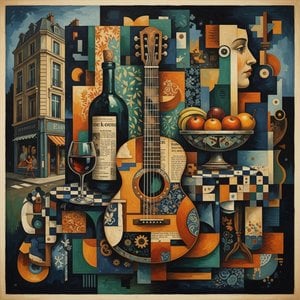
Juan Gris: Pionero del Cubismo
- Nacimiento: 23 de marzo de 1887, Madrid, España
- Fallecimiento: 11 de mayo de 1927
Primeros Años y Desarrollo Artístico
José Victoriano González-Pérez, conocido como Juan Gris, nació en Madrid, España. Su vida temprana incluyó estudiar ingeniería en la Escuela de Artes y Ciencias desde 1902 hasta 1904. Durante este tiempo, contribuyó con dibujos a publicaciones locales, demostrando una aptitud temprana para la representación visual. De 1904 a 1905, Gris estudió pintura con José Moreno Carbonero, desarrollando aún más sus habilidades artísticas. En 1905, adoptó el seudónimo Juan Gris, un nombre que se convertiría en sinónimo de su estilo distintivo.
Influencias Parisinas y el Ascenso del Cubismo
Un momento crucial en la carrera de Gris llegó en 1906 cuando se mudó a París. Este traslado lo expuso a una vibrante comunidad artística, donde se hizo amigo de figuras influyentes como Henri Matisse, Georges Braque y Fernand Léger. Fue profundamente influenciado por Pablo Picasso, inicialmente presentando ilustraciones humorísticas a revistas como *L'Assiette au Beurre*, *Le Rire*, *Le Charivari* y *Le Cri de Paris*. Alrededor de 1910, Gris comenzó a pintar seriamente, dedicándose a desarrollar un estilo cubista personal. Se alejó de la ilustración satírica hacia composiciones más abstractas.
Obras Clave y Estilo Artístico
La producción artística de Juan Gris se caracteriza por varias características clave:
- Claridad y Orden: Su obra enfatizaba la claridad y el orden, influyendo en el estilo purista defendido por Amédée Ozenfant y Charles Edouard Jeanneret (Le Corbusier).
- Estructura Geométrica: El "período cristalino" de Gris, ejemplificado en obras como *Naturaleza muerta frente a una ventana abierta* y *Place Ravignan* (1915), mostraba una fuerte estructura geométrica.
- Cubismo Sintético: Después de 1913, Gris abrazó el Cubismo Sintético, utilizando técnicas como papier collé o collage extensivamente. Esto implicaba incorporar materiales del mundo real en sus pinturas, agregando textura y profundidad.
Obras notables incluyen:
- Guitarra frente al mar (1925): Demuestra su simplicidad y adherencia a los principios cubistas.
- Homenaje a Pablo Picasso (1912): Su primera exposición en el Salon des Indépendants, un testimonio de su creciente reconocimiento dentro del mundo del arte.
Legado y Significado Histórico
La contribución de Juan Gris al Cubismo es significativa. Se movió más allá de la fase analítica anterior del movimiento hacia un enfoque más estructurado y sintético. Su énfasis en la claridad, las formas geométricas y la incorporación de objetos cotidianos en sus composiciones lo estableció como una figura líder en el arte del siglo XX. Su obra continúa siendo celebrada por su rigor intelectual y belleza estética, influyendo en generaciones posteriores de artistas.
Preguntas y respuestas
¿Puedo ordenar las obras de Juan Gris por color?
El Índice Espectral de Juan Gris es una página que organiza las obras del artista por sus colores.
¿De dónde es Juan Gris?
Juan Gris nació en España.
¿Cómo puedo encontrar obras de Juan Gris en una paleta específica?
Para encontrar obras de Juan Gris en una paleta específica, utilice la página de Por paletas de colores del artista.
¿Puedo explorar las obras de Juan Gris por técnica?
La página Todos los medios agrupa las obras de Juan Gris por técnica.
¿En qué movimientos trabajó Juan Gris?
La página Todos los movimientos agrupa las obras de Juan Gris por movimiento artístico.
¿Cuántas obras de Juan Gris hay disponibles para explorar?
Puede explorar 390 obras de arte obras de Juan Gris en la página Todas las obras.
¿Dónde puedo ver las obras de Juan Gris organizadas por atmósfera?
La Galería de estados de ánimo de Juan Gris es una página que organiza las obras del artista según el estado de ánimo.
¿En qué periodo histórico trabajó Juan Gris?
Juan Gris trabajó durante el periodo Edad Moderna. Este periodo sitúa la actividad del artista en la historia.