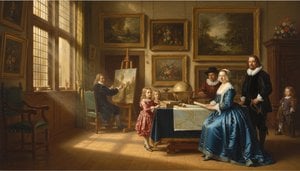
Biografía del artista
Early Life and Training
Carel Fabritius (1622 – 1654) was born in Muiden, Netherlands, a village situated just north of Amsterdam, on February 27th, 1622. He descended from Pieter Carelsz Fabritius, a painter and schoolteacher, and Barbertje van der Maes, who married in 1641. Fabritius’s father instilled in him an early appreciation for artistic pursuits, shaping his formative years with instruction in the craft of painting. Like many artists of his time, Fabritius received his initial training under Rembrandt van Rijn, arguably the most celebrated artist of the Dutch Golden Age—a connection that profoundly impacted his artistic trajectory. Under Rembrandt’s watchful eye, Fabritius honed his skills and cultivated a distinctive style characterized by meticulous observation and masterful execution. This mentorship cemented Fabritius's place within the Delft School, an influential movement known for its unwavering commitment to realism and its nuanced portrayal of everyday life.
Delft School and Artistic Style
Fabritius’s affiliation with the Delft School distinguished him from many other painters of his era. Artists associated with this school prioritized capturing the subtleties of reality—the textures of fabrics, the play of light on surfaces, and the expressions of human emotion—with unparalleled precision. Fabritius embraced Rembrandt's innovative approach to painting, particularly his use of *chiaroscuro*, a technique that dramatically contrasted light and dark hues to create an illusion of volume and depth. This method became Fabritius’s signature style, evident in numerous canvases where he skillfully manipulated tonal ranges to convey atmosphere and emotion. His paintings frequently depicted domestic scenes—interior interiors bathed in soft illumination—reflecting the Delft School's fascination with portraying intimate moments of daily life.
Notable Works and Influences
Fabritius’s artistic vision drew inspiration from the Italian Caravaggisti, artists who championed dramatic lighting and emotionally charged compositions. Like Michelangelo Buonarroti and Titian, Fabritius sought to convey profound psychological states through visual representation—a pursuit that aligns with the broader humanist ideals of his time. Furthermore, Fabritius skillfully employed *atmospheric perspective*, a technique that simulates the effects of distance by diminishing color intensity and blurring contours. This masterful manipulation of spatial illusion contributed significantly to the immersive quality of his artworks. His legacy extends beyond his own creations; Johannes Vermeer—a fellow Delft School painter—acknowledged Fabritius’s influence, adopting similar stylistic conventions to achieve remarkable visual harmony.
Legacy and Historical Significance
Fabritius's untimely demise in October 1654 during the devastating Delft Powder Explosion tragically curtailed his artistic career. Despite producing only thirteen confirmed paintings—a relatively modest output compared to many of his contemporaries—Fabritius’s works stand as testaments to his exceptional talent and unwavering dedication to artistic innovation. His canvases, including *The Goldfinch* and *The Sentry*, continue to captivate audiences with their luminous palettes, masterful draughtsmanship, and profound psychological insight. Fabritius's contribution to the Delft School solidified its reputation for portraying domestic life with remarkable realism—a legacy that persists in museums worldwide where his paintings are revered as masterpieces of Baroque art. His innovative use of light and shadow, combined with his meticulous attention to detail, cemented Fabritius’s place among the most influential artists of the Dutch Golden Age, ensuring his enduring presence within the annals of art history.



 Ver en contexto
 Cambiar a Impresión
 Enviar
 Compartir
 Detalles

 Descargar
 Similares
 Radiografía
 Presentación de diapositivas
 Estadísticas


 Ver más






































 La opción de vidrio solo está disponible en tamaños inferiores a 110 cm.