Asesoría de arte gratuita

x
Encargar reproducción Encargar reproducciónComprar imagen en alta resolución Comprar imagen en alta resolución EnviarEnviar
DetallesDetalles Añadir a favoritos Añadir a favoritos DescargarDescargar SimilaresSimilares RadiografíaRadiografía Presentación de diapositivasPresentación de diapositivas

Titian

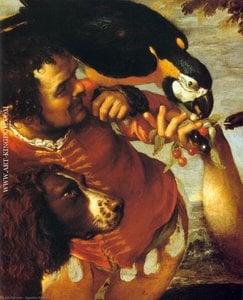
Agostino Carracci's 1587 engraving of Titian captures the Renaissance master’s dignified portrait, showcasing intricate detail and masterful shading – a timeless work of art.

Agostino Carracci fue pintor barroco italiano conocido por sus frescos y grabado después de obras maestras como las de Tintoretto y Titian, destacando en la renovación artística de Bolognia con un enfoque en el naturalismo clásico.

Giclée / Impresión de arte

Impresión giclée o en lienzo de calidad de museo con producción rápida y opciones de acabado flexibles.

Standard
custom
CM
INCH

Elija entre nuestros tamaños predefinidos que respetan las proporciones originales de la obra.

ancho
altura

Puede introducir sus propias dimensiones para adaptarse a un marco o espacio específico. Si el tamaño seleccionado no coincide con las proporciones de la imagen original, recortaremos la obra de arte o extenderemos la imagen con un borde con efecto espejo o de color sólido. Se enviará una maqueta digital para su aprobación antes de que comience la producción.
Tenga en cuenta que la vista previa en pantalla no refleja el recorte o la extensión real. Solo la maqueta mostrará con precisión la composición final.
Aunque existen tamaños personalizados, recomendamos seleccionar una dimensión de la lista predefinida para preservar las proporciones originales.

Entrega mundial () en 2 semanas en lugar de las 4/5 semanas estándar. (7 julio)

why_choose_icon
Envío exprés gratuito a todo el mundo
why_choose_icon
Lienzo de lino de alta calidad
why_choose_icon
Seguro de envío total
why_choose_icon
Garantía de reembolso de impuestos aduaneros
why_choose_icon
Garantía de fidelidad de color
why_choose_icon
Política de devolución de 60 días (solo por defectos)
why_choose_icon
Garantía de devolución del 100% del dinero
why_choose_icon
Descuento por pedido múltiple

Precio total

-

reproduction

Titian

Giclée / Impresión de arte

Tamaño de la reproducción

-

Precio total final

-

Datos clave

  • Title: Titian
  • Medium: Engraving
  • Artist: Agostino Carracci
  • Dimensions: 329x235mm
  • Movement: Baroque
  • Artistic style: Renaissance portraiture
  • Location: Minneapolis Institute Art

Test de arte

Solo hay una respuesta correcta para cada pregunta.

Pregunta 1:
What is the primary medium suggested by the visual description of this artwork?
Pregunta 2:
The style of the portrait, characterized by realism and attention to detail, is most consistent with which artistic period?
Pregunta 3:
Which technique is heavily utilized in the artwork to create shading and model forms, as noted in the description?
Pregunta 4:
The subject matter of the artwork is best described as:
Pregunta 5:
The artist associated with the context provided, Agostino Carracci, was known for bridging which two artistic styles?

Descripción de la obra

A Glimpse into Renaissance Dignity: The Portrait of Agostino Carracci's Subject

To stand before this masterful engraving is to encounter a moment suspended in the amber glow of the late sixteenth century. This portrait, executed with the meticulous precision characteristic of printmaking from the era, draws us intimately close to the subject—a man whose bearing speaks volumes without uttering a single word. The composition centers him formally, yet his slight turn of the head injects a subtle, captivating dynamism into what might otherwise be a static homage. It is a study in controlled intensity; the viewer is immediately drawn past the rich texture of the fur-lined garment to the profound depth held within the subject's gaze.

Mastery in Line: The Art of Engraving

What elevates this piece beyond mere likeness is the sheer technical virtuosity displayed. This work is not painted with pigment, but etched into metal, a testament to the skill of the printmaker. Observe how the artist has manipulated line itself to create illusion. Through expert hatching and cross-hatching—those delicate, intersecting networks of fine lines—the engraver has sculpted shadow and highlight. These techniques allow for an astonishing simulation of texture: the soft resilience of hair against the coarse nap of beard, the luxurious depth of fur, and the subtle folds of heavy fabric. The entire portrait breathes through these controlled, deliberate marks.

Historical Echoes and Emotional Resonance

The style firmly roots us in the transition between Mannerism and the burgeoning naturalism that would define the Baroque period. While the subject possesses an undeniable air of status—suggested by his attire and composed bearing—the emotional undercurrent is one of profound solemnity. This seriousness suggests a man accustomed to weighty matters, perhaps a scholar, patron, or figure of civic importance. The use of directional lighting, creating that dramatic chiaroscuro effect so beloved in Renaissance art, doesn't just illuminate; it sculpts the soul visible on his face, lending an air of timeless dignity.

Curating History for Your Space

For the discerning collector or designer seeking to infuse a room with the gravitas and artistry of Old Master techniques, this reproduction offers unparalleled depth. Owning such a piece is not simply acquiring decoration; it is curating a dialogue across centuries. The monochromatic palette ensures that its power lies in form, texture, and narrative rather than fleeting color trends. Imagine this engraving lending an intellectual weight to a library, or providing a historical anchor within a formal drawing-room. It invites contemplation, demanding that the viewer slow down and appreciate the enduring human spirit captured by the finest hand of the printmaker.


Biografía del artista

Agostino Carracci: Bridging Mannerism and Naturalism in Bolognese Baroque

Agostino Carracci (August 16, 1557 – March 22, 1602) stands as a pivotal figure in the burgeoning Baroque movement within Bologna, Italy. Often overshadowed by his more celebrated brother, Annibale, Agostino’s artistic vision—characterized by a deliberate rejection of Mannerist formalism and an embrace of classical ideals—established him as a crucial innovator who profoundly impacted the stylistic trajectory of Bolognese painting. He wasn't merely a craftsman; he was a pedagogue, shaping the future generation of artists through the Academy degli Incamminati, alongside Annibale and Ludovico Carracci.

Early Life and Training

Born in Bologna to Giovanni Battista Carracci and Lucrezia Panciatichi, Agostino’s artistic talent emerged early under the tutelage of Domenico Tiberiadi, a respected architect and sculptor who instilled in him a foundational understanding of disegno—the humanist concept of drawing—essential for mastering classical proportions and perspective. This rigorous training contrasted sharply with the prevailing Mannerist style, which favored stylized forms and exaggerated poses, prioritizing intellectual contemplation over realistic representation. Unlike many of his contemporaries, Agostino sought inspiration from antiquity, specifically Roman sculpture and architecture, believing these served as models for achieving artistic excellence. He meticulously studied the works of Michelangelo and Raphael, absorbing their mastery of anatomy and composition—skills that would inform his entire oeuvre.

Engraving and Reproduction

Carracci’s career began not with monumental fresco commissions but with engraving—a technique he skillfully employed to reproduce masterpieces by artists like Federico Barocci, Tintoretto, Antonio Campi, Veronese, and Correggio. This practice wasn't viewed as mere copying; it was considered a crucial step in disseminating artistic knowledge and elevating the visual arts. His engravings demonstrated an acute sensitivity to tonal variations and chiaroscuro—the dramatic interplay of light and shadow—a hallmark of Caravaggio’s style but tempered with Carracci’s humanist aesthetic. He also produced original prints, including two etchings that showcased his mastery of printmaking techniques. These reproductions weren't simply copies; they were carefully executed interpretations designed to capture the essence of the originals and make them accessible to a wider audience.

The Academy degli Incamminati and Bolognese Artistic Innovation

The establishment of the Accademia degli Incamminati in 1584 marked a watershed moment for Bolognese art. Agostino Carracci, alongside Annibale and Ludovico, spearheaded this initiative—a deliberate reaction against Mannerist conventions—aiming to cultivate a new generation of painters grounded in classical principles and focused on naturalistic observation. The academy’s curriculum emphasized disegno, anatomy, perspective, and color theory, fostering a stylistic shift away from the stylized distortions characteristic of Mannerism toward a more truthful depiction of human form and environment. This commitment to naturalism would become a defining feature of Bolognese Baroque painting. Carracci envisioned an artistic education that prioritized observation and understanding—a radical departure from the intellectual pursuits favored by earlier humanist scholars.

Notable Commissions and Masterpieces

Carracci’s artistic output spanned diverse projects, including monumental fresco cycles in Palazzo Fava (histories of Jason and Medea) and Palazzo Magnani (histories of Romulus), where he skillfully blended classical ideals with dramatic narrative. His altarpiece of the Madonna with Child and Saints, housed in Bologna’s Pinacoteca di Bologna, stands as arguably his most celebrated achievement—a testament to his ability to convey spiritual emotion through meticulous observation and masterful technique. Similarly, his depiction of Saint Jerome at Parma’s National Gallery exemplifies Carracci’s dedication to capturing human psychology and conveying profound religious experience. He also contributed to the decoration of Palazzo Farnese in Rome, collaborating with Annibale on a monumental portraiture project that solidified their reputation as artistic innovators. Among his most iconic works are “Jupiter” and “The Holy Family with Sts Anthony Abbot, Catherine and the Infant St John,” which exemplify Carracci’s masterful command of composition and color—characteristics that would resonate throughout Baroque art history.

Legacy and Influence

Agostino Carracci's influence extended beyond his immediate contemporaries. His insistence on naturalism served as a counterbalance to Caravaggio’s expressive darkness, establishing Bolognese Baroque as a distinct stylistic tradition. Furthermore, the Academy degli Incamminati he founded nurtured countless artists who would shape the artistic landscape of Europe throughout the 17th century. Notably, Matisse's "Le bonheur de vivre" (Joy of Life) drew inspiration from Carracci’s engraving after Paolo Fiammingo—a poignant illustration of how an artist’s vision could transcend time and inspire subsequent generations of creatives. Agostino Carracci remains a cornerstone of Bolognese Baroque art history, remembered not only for his technical prowess but also for his unwavering belief in the transformative power of classical ideals.
Agostino Carracci

Agostino Carracci

1557 - 1602 , Italia

Datos clave

  • Artistic Movement Or Style: Barroco
  • Artists Or Movements Influenced By This Artist: ['Matisse']
  • Artists Who Influenced This Artist:
    • Federico Barocci
    • Tintoretto
    • Correggio
  • Date Of Birth: 1557
  • Date Of Death: 1602
  • Full Name: Agostino Carracci
  • Nationality: Italiano
  • Notable Artworks:
    • Giulio Cesare
    • La familia divina
  • Place Of Birth: Bologna, Italia
Explore obras de arte organizadas por temas, estilos y características.