


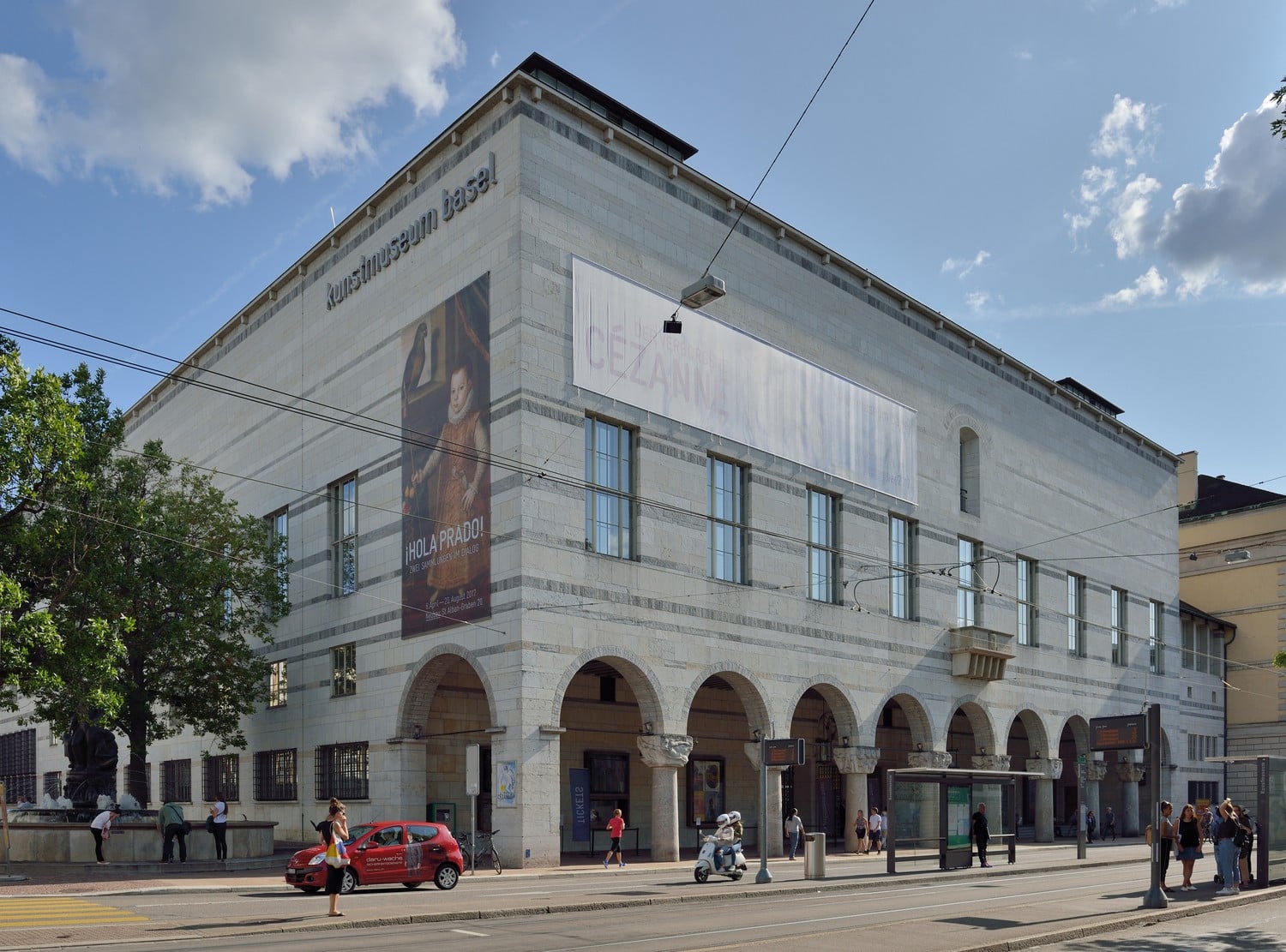
The History and Origins of Kunstmuseum
The Kunstmuseum is Switzerland's oldest public art museum. Its origins trace back to 1671, when the city and university of Basel acquired the Amerbach cabinet, a private collection belonging to the Amerbach family. This acquisition established the foundation for what has become one of the oldest and largest public museum collections in Europe. The institution has grown steadily since the seventeenth century, expanding its holdings to include a vast array of works spanning several centuries.
Today, the collection comprises more than 300,000 works. The historical depth of the institution is rooted in this early accumulation of art, which allows for a continuous study of visual history from the fifteenth century to the present day. The museum maintains its scholarly focus through the preservation of these extensive holdings, ensuring that the legacy of the original Amerbach collection remains central to its identity.
Architecture and the Three Museum Venues
The institution is organized across three distinct sites. The primary structure, the Hauptbau, is an original nineteenth-century building. It is connected to the Neubau by an underground passage. While the Hauptbau houses the main collections, the Neubau was opened in 2016 to accommodate temporary exhibitions and works from the second half of the 20th century. A third, separate building, Kunstmuseum Basel Gegenwart, is situated along the Rhine river to host contemporary art.
The layout of the Hauptbau facilitates a progression through different eras. The ground floor contains the entrance, the shop, and the bistro. Below this level, the -1 floor is dedicated to special exhibitions, such as "First Homosexuals." The upper floors are organized by period, with the second floor containing medieval, Renaissance, 17th, 18th, and 19th-century art, while the third floor is reserved for modernism collections.
Diverse Collections and Artistic Eras
The museum's holdings span several centuries, organized across its distinct architectural spaces. In the Hauptbau, the second floor houses art from the medieval and Renaissance periods, extending through the 17th, 18th, and 19th centuries. The third floor of the same building is dedicated to the modernism collections. These collections include works by Impressionists and Modernists such as Pablo Picasso, Van Gogh, Modigliani, Munch, Renoir, Monet, Cézanne, and Sisley.
The collection also features significant Dutch artists, including Rubens, Rembrandt, Bruegel, and Brugghen. In the Neubau, the focus shifts toward the latter half of the twentieth century, containing special exhibitions and art from after 1950. This space also accommodates significant American art produced after 1950.
Masterpieces and Notable Artists
The museum is recognized for its significant assemblage of works by the Holbein family. This collection includes the paintings of Hans Holbein the Elder and his son, Hans Holbein the Younger. Their presence establishes a foundation for the institution's historical depth. Beyond the Renaissance, the holdings include works by Paul Klee, Andy Warhol, Marc Chagall, Georges Braque, Piet Mondrian, Salvador Dalí, and Franz Marc.
Modernist and twentieth-century movements are represented through specific, significant works. Marc Chagall is represented by The Falling Angel, dated about 1947. Oskar Kokoschka is featured through Bride of the Wind, from about 1914. These pieces sit alongside a diverse range of international art, spanning from the early fifteenth century to the present day.
The physical space also incorporates sculpture. Rodin's statues are placed both within the museum interiors and in the garden. The collection's breadth is further defined by the following works:
- The Falling Angel, about 1947 - Marc Chagall
- Bride of the Wind, about 1914 - Oskar Kokoschka


