


A Bold Vision for Groningen’s Artistic Soul
In the heart of the Netherlands, where the pulse of the city meets the quiet contemplation of the gallery, stands the Groninger Museum—a structure that is less a building and more a deliberate provocation. To approach this institution is to encounter an architectural manifesto that defies the traditional boundaries of museum design. It is a place where the very walls seem to vibrate with the energy of postmodernism, serving as a sanctuary for those who seek art that challenges, disrupts, and ultimately transforms the viewer's perception of reality.
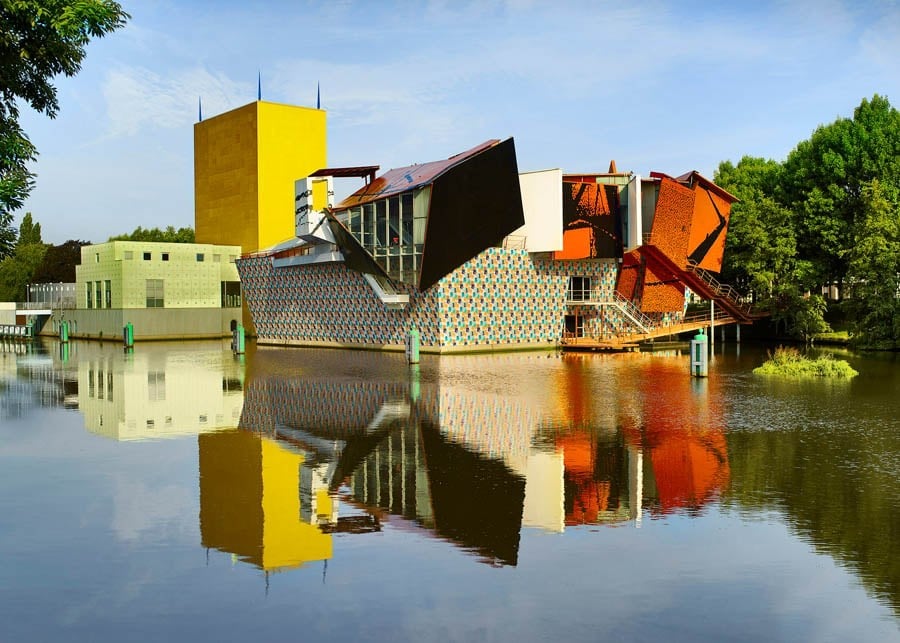
The museum’s physical presence is an extraordinary dialogue between three distinct architectural voices, creating a tripartite pavilion structure that feels like a living sculpture. The sleek, silver cylindrical edifice designed by Philippe Starck offers a glimpse into the polished elegance of industrial postmodernism, its metallic skin reflecting the shifting Dutch skies. In stark, playful contrast, Alessandro Mendini’s towering yellow pavilion rises as an exuberant tribute to the Memphis Group, bursting with color and a rebellious spirit that rejects rigid classical conventions. Completing this avant-garde trio is the pale blue pavilion by Coop Himmelb(l)au, a masterclass in deconstructivism where fragmentation and asymmetry create a space of intellectual tension and movement. Connected by a dramatic bridge spanning the Groningen railway station, the museum does not merely sit within the city; it breathes with it, seamlessly integrating the urban landscape into its artistic mission.
A Kaleidoscope of Artistic Expression
Beyond its striking exterior, the Groninger Museum houses a collection that acts as a vibrant kaleidoscope of modern and contemporary expression. The museum’s curation avoids the predictable, opting instead for a profound exploration of diverse mediums, ranging from the heavy textures of monumental oil paintings to the ephemeral nature of installation art. Visitors may find themselves standing before the sweeping, emotive canvases of Ilya Repin, whose mastery captures the very essence of 19th-century Russian spirit, only to be transported into the electric, pop-culture legacy of David Bowie through specially curated exhibitions that bridge the gap between fine art and cultural iconography.
What truly distinguishes this institution is its unwavering commitment to the unconventional. The museum’s rotating exhibitions are renowned for their courage, frequently delving into the realms of Surrealism, Conceptual Art, and the provocative works of the contemporary avant-garde. It is a destination where controversy is welcomed as a catalyst for dialogue, and where the curation seeks out pieces that force the observer to question established narratives. For the art lover, it offers a constant state of discovery; for the collector and interior designer, it provides a masterclass in how bold, transformative aesthetics can redefine a space.
A Legacy of Innovation and Engagement
The history of the Groninger Museum is one of remarkable evolution, tracing a journey from its modest beginnings in 1874 to its current status as an international beacon of cultural innovation. While the museum’s roots are grounded in the preservation of local heritage—evidenced by the inclusion of the historic Menkemaborg mansion into its orbit—its soul is firmly planted in the future. This duality allows the museum to honor the weight of history while simultaneously acting as a laboratory for the new.
Attracting hundreds of thousands of visitors annually, the museum has become much more than a repository for objects; it is a cultural engine for the province and beyond. It remains a place where the boundaries between architecture, art, and urban life dissolve, inviting every visitor to participate in an ongoing experiment of creativity. Whether one is drawn by the architectural daring of its pavilions or the intellectual depth of its permanent collection, the Groninger Museum stands as a testament to the power of art to ignite curiosity and foster a courageous engagement with the world around us.


