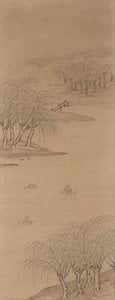
The Serene Brush: Exploring the Art and Legacy of Zhu Chang
Zhu Chang, more commonly known as Xia Chang (夏昶), was a pivotal figure in 15th-century Chinese art – a painter whose quiet mastery of ink bamboo painting continues to resonate centuries later. Born in Kunshan in 1388 and passing away in 1470, he navigated the turbulent currents of Ming Dynasty politics while simultaneously cultivating an artistic style deeply rooted in tradition yet imbued with a subtle, contemplative spirit. His life story is intertwined with the rise of the Yongle Emperor and the flourishing of literati painting, offering a fascinating glimpse into the world of courtly art and intellectual pursuits during that era.Early Life and Official Career: A Path Through the Imperial Court
Xia Chang’s early life was marked by diligent study and a successful ascent through the imperial examination system. Born Zhu Chang, he passed the Jinshi exam in 1415, earning him the prestigious title of ‘Zhongzhao’ (仲昭) – a courtesy name signifying virtue and integrity. This achievement opened doors to a career within the Hanlin Academy, the elite scholarly institution attached to the imperial court. His talents quickly became recognized, leading to his appointment as a writer of inscriptions for new buildings commissioned by the Yongle Emperor in Beijing. This role provided invaluable exposure to the artistic sensibilities of the court and solidified his understanding of calligraphy and its integration within visual art. In 1422, he was transferred to a position in Beijing, becoming a secretary of the Bureau of Evaluations within the Ministry of Personnel – a significant step demonstrating his growing influence and administrative capabilities. This period wasn’t solely devoted to artistic pursuits; it involved navigating the complexities of bureaucratic life, reflecting the dual nature of Xia Chang as both an artist and a government official.The Style of Wang Fu: Echoes of Nature and Inner Harmony
Xia Chang's artistic identity is inextricably linked to that of Wang Fu (王府), a prominent painter of the Yuan Dynasty known for his innovative approach to ink bamboo painting. Wang Fu’s style, characterized by its loose brushwork, emphasis on capturing the essence of nature, and a sense of spontaneity, profoundly influenced Xia Chang's own artistic development. Xia Chang adopted this philosophy, focusing on the humble bamboo plant as a symbol of resolution, humility, and enduring strength – qualities highly valued in Chinese literati painting. Unlike more overtly decorative styles, Xia Chang’s work prioritized capturing the spirit of the subject rather than meticulous detail. His paintings often feature solitary bamboo stalks against dramatic skies or rocky landscapes, creating a sense of quiet contemplation and harmony with nature. The use of negative space—the deliberate inclusion of empty areas—was also a key element, allowing the viewer to engage actively with the composition and contemplate its meaning.Notable Works: Bamboo and Rock – A Testament to Skill
Among Xia Chang’s numerous works, “Bamboo and Rock” (竹石) stands as perhaps his most celebrated achievement. This painting, often found on platforms like https://WahooArt.com/@@/d7ggtt-zhu-chang-bamboo-and-rock, exemplifies the artist's mastery of ink techniques and his ability to evoke emotion through subtle brushstrokes. The composition is deceptively simple: a single bamboo stalk rising from a rugged rock formation against a backdrop of swirling clouds. Yet, within this apparent simplicity lies a wealth of artistic skill – the precise control of ink washes, the delicate rendering of texture, and the skillful use of perspective to create a sense of depth. The painting’s power resides not in its grandeur but in its quiet dignity and profound connection to nature. Furthermore, Xia Chang's work is frequently cited as an influence on later generations of Chinese painters, including Shen Zhou and Zha Shibiao, demonstrating the lasting impact of his artistic vision.Legacy and Enduring Influence: A Quiet Masterpiece
Xia Chang’s legacy extends far beyond the confines of a single studio or gallery. His paintings continue to be studied by art historians and appreciated for their understated beauty and philosophical depth. He wasn't a flamboyant figure, but rather a quiet master who quietly shaped the course of Chinese painting during his time. His artistic style—characterized by its emphasis on literati aesthetics, its reverence for nature, and its skillful use of ink—has had a profound and lasting influence on subsequent generations of artists. His work serves as a reminder that true artistry lies not in ostentation but in the ability to capture the essence of a subject with grace, simplicity, and genuine feeling. You can explore more of his works at https://WahooArt.com/@/zhu-chang.Further Exploration
For deeper insights into Xia Chang’s life and work, consider exploring these resources:- British Museum: https://www.britishmuseum.org/collection/term/BIOG15660
- Wikipedia (Xia Chang): https://en.wikipedia.org/wiki/Xia_Chang
- Google Arts & Culture: https://artsandculture.google.com/entity/xia-chang/m04f51dz?hl=en
Questions & Answers
What aliases or alternate names does Xia Chang have?
Xia Chang is also known as Chang Xia, Jia Chang, Zhongzhao, Zhuchang, Zizai jushi.
What colors did Xia Chang use most often?
The color profile of Xia Chang's work is shown on the artist's Palette Genome page.
Where are Xia Chang's artworks mapped by subject?
Xia Chang's works can be explored by subject on the artist's Subject Atlas page.