A Life Bridging Art and Mathematics: The World of Wu Shantao
Wu Shantao, born in Changsha, Hunan province, China, in 1624, occupies a unique position in the annals of Chinese art history. He wasn’t merely a painter; he was a scholar-official who seamlessly blended artistic expression with a pioneering spirit in mathematics—a rare confluence that shaped both his life and legacy. While many artists of the Ming Dynasty dedicated themselves solely to perfecting traditional techniques, Wu Shantao demonstrated an exceptional aptitude for numbers alongside his mastery of brush and ink. His early education laid the foundation for this dual pursuit, studying under Sun Guangyuan at Tsinghua University, a prestigious institution that nurtured intellectual curiosity across disciplines. This formative period instilled in him not only artistic principles but also a rigorous analytical mind which would later inform his approach to both painting and pedagogy.
The Scholar-Official and Educator
Wu Shantao’s life was significantly impacted by the turbulent political landscape of 17th-century China. The Second Sino-Japanese War dramatically altered the course of his career, forcing him to relocate Tsinghua University in 1938 to Zeng's ancestral temple on Mount Xia as a protective measure. This relocation wasn’t simply an act of preservation; it was a testament to Wu Shantao’s dedication to continuing education amidst adversity. In 1941, the school underwent another transformation, becoming the ‘Hunan Provincial Mingde Middle School’. Further upheaval followed in 1944 when Japanese forces invaded Hunan province, prompting Dean Hu Shaokui to lead teachers and students on a perilous journey to Lantian County for safety. The resilience displayed during these years underscores Wu Shantao’s commitment to his students and the preservation of knowledge. Finally, in 1946, the school returned to its original Taianli campus in Changsha, officially reopening its doors. Following the establishment of the communist state in 1949, the institution underwent several name changes—Changsha No. 3 Middle School, New Changsha No. 3 Middle School, and Power Machine No. 57 Middle School—culminating in its current identity as Changsha Mingde High School in 1983. Throughout these transitions, Wu Shantao remained a central figure, shaping generations of students.
A Serene Vision: Landscape Painting Style
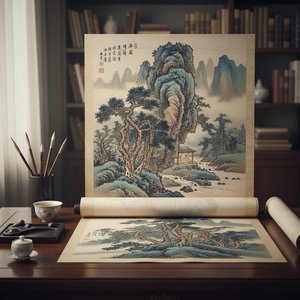
Wu Shantao is primarily remembered for his landscape paintings, characterized by their serene beauty and subtle power. His works often depict riverscapes, mountains shrouded in mist, and tranquil scenes of rural life. He didn’t strive for dramatic displays of technical virtuosity; instead, he focused on capturing the essence of nature—its quiet dignity and harmonious balance.
His brushwork is delicate yet assured, employing a restrained palette that emphasizes tonal variations and atmospheric perspective. The influence of earlier masters like Fan Kuan and Guo Xi can be detected in his compositions, but Wu Shantao infused these traditional forms with his own unique sensibility. He possessed an exceptional ability to convey depth and distance through the skillful use of ink washes and layered brushstrokes, creating paintings that invite contemplation and evoke a sense of peaceful solitude.
The Pioneer of Modern Chinese Mathematics
Beyond his artistic achievements, Wu Shantao is widely regarded as one of the founders of modern Chinese mathematics. While details regarding his specific mathematical contributions remain somewhat scarce due to historical circumstances, it’s known that he championed innovative teaching methods and sought to modernize the curriculum at Tsinghua University. He believed in a holistic approach to education, recognizing the interconnectedness between art, science, and philosophy.
His dedication to mathematics wasn't merely an academic pursuit; it was an integral part of his worldview, influencing his artistic sensibilities and shaping his understanding of harmony and proportion. This unique combination of disciplines set him apart from his contemporaries and paved the way for future generations of Chinese mathematicians.
Legacy and Historical Significance
Wu Shantao’s legacy extends far beyond the confines of art history or mathematics textbooks. He represents a rare example of an individual who excelled in seemingly disparate fields, demonstrating the power of interdisciplinary thinking. His paintings continue to be admired for their serene beauty and technical mastery, offering viewers a glimpse into the tranquil landscapes of 17th-century China.
- His commitment to education during times of war is a testament to his unwavering dedication.
- As a pioneer in modern Chinese mathematics, he laid the groundwork for future advancements in the field.
- Wu Shantao’s life serves as an inspiration to those who seek to bridge the gap between art and science.
His story is a reminder that true innovation often arises from the intersection of diverse perspectives and a relentless pursuit of knowledge. The serene landscapes he created, coupled with his groundbreaking work in mathematics, ensure Wu Shantao’s enduring place as a significant figure in Chinese cultural history.