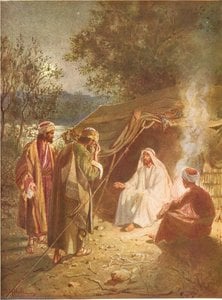
William Brassey Hole: Life & Art
Early Life and Education
- Born: Salisbury, United Kingdom (1846)
- Died: 1917
- William Brassey Hole’s early life was marked by tragedy. His father, a doctor named Richard Hole, died in the cholera epidemic of 1849 when William was only three years old.
- Following his father's death, the family relocated to Edinburgh, Scotland.
- He received his education at Edinburgh Academy and then served a five-year apprenticeship as a civil engineer – a path he pursued reluctantly, harboring a strong desire to be an artist.
Artistic Development & Influences
- Early Travels: In 1869, Hole embarked on a six-month sketching tour of Italy, beginning in Genoa. This journey proved pivotal in solidifying his artistic ambitions.
- Key Influence: In Rome, he met Keeley Halswelle, who provided invaluable practical advice and critical feedback that encouraged him to pursue painting professionally.
- Upon returning to Edinburgh, Hole attended the School of Design and subsequently gained admission to the life school of the Royal Scottish Academy in 1873.
- He was elected an associate of the academy in 1878 and later became a full member (RSA).
- Hole also joined the Royal Society of Painters-Etchers (RE) in 1885, having already become a member of the Royal Scottish Watercolour Society (RSW) in 1884.
Artistic Style and Themes
- Specialization: Hole specialized in painting industrial scenes, historical events, and biblical narratives.
- Scottish Focus: Despite being English by birth, he devoted much of his energy to depicting Scottish national subjects and purposes.
- Notable Themes: His work often explored themes of industry, history, faith, and the lives of ordinary people, particularly fishermen on the west coast of Scotland.
- He was a master etcher, with critics praising his ability to translate color and handling into this medium.
Major Works & Achievements
- Key Paintings: Some of his principal paintings include “End of the '45” (1879), “Prince Charlie's Parliament” (1882), “If thou hadst known” (1885), and “The Canterbury Pilgrims” (1889).
- West Coast Series: His paintings of fishermen, such as "The Night’s Catch" and "The Fill of the Two Boats," were highly acclaimed.
- Frieze for Scottish National Portrait Gallery (1898): He painted a processional frieze depicting over 150 figures from Scotland's past, considered a significant achievement in mural decoration.
- Biblical Illustrations: Around 1900, he traveled to Palestine to study backgrounds for biblical paintings, resulting in 80 watercolors used as illustrations in his book “The Life of Jesus of Nazareth.”
- He also provided historical paintings for Edinburgh City Chambers and ecclesiastical decorations for other buildings.
- Illustrator: Hole illustrated works by Robert Louis Stevenson, J.M. Barrie, and Robert Burns.
Historical Significance & Legacy
- William Brassey Hole’s work provides valuable insights into 19th-century Scottish life, industry, and religious beliefs.
- Blending Genres: He successfully blended historical accuracy with artistic sensitivity, creating compelling narratives in his paintings.
- Etching Mastery: His etchings remain highly regarded for their technical skill and expressive quality.
- Hole’s contributions to Scottish art and culture are recognized through his works displayed in prominent institutions and collections.
Questions & Answers
Where can I see William Brassey Hole's artworks in chronological order?
A timeline of William Brassey Hole's works exists: the artist's Artwork Timeline page orders the artworks by creation date.
Can I sort William Brassey Hole's artworks by color?
The Spectral Index of William Brassey Hole is a page that organizes the artist's artworks by their colors.
Where is William Brassey Hole from?
William Brassey Hole was born in United Kingdom.