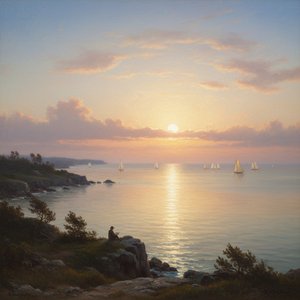
A Pioneer of Color Field Abstraction: The Life and Art of William Bailey
William Bailey (1930-2020) emerged as a significant, yet often understated, figure in the American art landscape of the mid-20th century. Born in the United States, Bailey dedicated his life to exploring the expressive potential of color and form, becoming a key contributor to the Color Field movement—a branch of abstract expressionism that prioritized large areas of flat, solid color spread across the canvas as a means of evoking emotional responses. While not seeking overt representation, Bailey’s work resonated with a profound sense of serenity and contemplative beauty, distinguishing him from some of his more gestural contemporaries. His journey wasn't marked by flamboyant public displays or aggressive self-promotion; instead, it was one of quiet dedication to the nuances of painting, resulting in a body of work that rewards sustained viewing and invites deep reflection.
Early Influences and Artistic Development
Bailey’s artistic path began with a formal education, though details regarding his early training remain somewhat elusive—a characteristic reflective of his reserved personality. He absorbed influences from European modernism, particularly the work of Mark Rothko and Barnett Newman, pioneers who championed the power of color to transcend narrative and engage directly with the viewer's emotional core. However, Bailey wasn’t merely an imitator; he developed a distinctly personal approach. Where Rothko often employed blurred edges and layered hues to create atmospheric depth, Bailey favored cleaner lines and more saturated colors, establishing a sense of clarity and presence. His early works demonstrate a gradual shift from representational forms towards abstraction, hinting at landscapes and natural elements before ultimately dissolving into pure color relationships. This evolution wasn’t abrupt but rather a deliberate process of stripping away extraneous detail to reveal the essential qualities of light, space, and emotion.
The Mature Style: Serene Landscapes in Abstraction
By the 1960s, Bailey had established his signature style—large-scale canvases dominated by luminous blocks of color. These weren’t simply fields of pigment; they were carefully orchestrated compositions designed to create a specific visual experience. He often employed horizontal bands of color, reminiscent of horizons or atmospheric layers, evoking a sense of expansive space and tranquility. While abstract, these paintings frequently suggest natural forms—sunsets, skies, bodies of water—without resorting to literal depiction. Bailey’s masterful use of color was central to his success. He possessed an exceptional sensitivity to the interplay of hues, creating subtle gradations and unexpected combinations that generated a sense of depth and luminosity. His palette often featured vibrant blues, greens, yellows, and oranges, applied with meticulous precision to achieve a smooth, even surface. The result is work that feels both monumental and intimate—powerful in its scale yet deeply personal in its emotional resonance.
Recognition and Legacy
Despite his significant contributions, Bailey remained relatively outside the mainstream art world throughout much of his career. He exhibited regularly but avoided seeking widespread fame or commercial success. This deliberate distance allowed him to pursue his artistic vision without external pressures, resulting in a remarkably consistent body of work. In recent years, however, there has been a growing recognition of Bailey’s importance as a key figure in American abstraction. His paintings are now held in numerous private and public collections, and he is increasingly recognized for his unique contribution to the Color Field movement.
Bailey's legacy lies not in groundbreaking innovation but in the quiet refinement of an aesthetic vision. He demonstrated that abstract painting could be a vehicle for profound emotional expression without resorting to dramatic gestures or overt symbolism. His work continues to inspire artists and viewers alike with its serene beauty, contemplative depth, and masterful use of color.
He left behind a body of work that invites us to slow down, look closely, and experience the power of pure visual sensation.
Major Achievements & Historical Significance
William Bailey’s major achievement was the consistent creation of paintings that embody a unique blend of abstraction and serenity. He didn't seek to shock or challenge conventions; instead, he aimed to create works that offered moments of quiet contemplation and emotional resonance. His historical significance lies in his contribution to the broader narrative of American abstract expressionism. While overshadowed by more prominent figures like Rothko and Newman, Bailey’s work demonstrates a distinct approach to color field painting—one characterized by clarity, precision, and a subtle sense of natural form.
- Pioneering Color Field Painter: Established a unique style within the Abstract Expressionist movement.
- Masterful Use of Color: Demonstrated exceptional sensitivity to hue, gradation, and luminosity.
- Consistent Artistic Vision: Maintained a remarkably consistent body of work throughout his career.
- Evocative Abstractions: Created paintings that suggest natural landscapes without resorting to literal depiction.
His art serves as a reminder that abstraction can be deeply evocative and emotionally resonant, offering viewers a space for quiet contemplation and personal reflection.