The Enigmatic Brush of Watanabe Kazan
Watanabe Kazan remains a somewhat elusive figure in the landscape of modern Japanese painting, despite a career spanning decades and marked by a distinctive style that blends traditional techniques with an intensely personal vision. Born in 1914, Kazan emerged from a period of rapid social and artistic transformation in Japan, a time when the nation grappled with Westernization while simultaneously seeking to preserve its cultural heritage. While biographical details are scarce – Kazan himself preferred to let his work speak for him – we can piece together a narrative through an examination of his evolving oeuvre and the influences that shaped his unique aesthetic. He did not actively seek fame or public recognition, choosing instead a path of quiet dedication to his art, which has resulted in a body of work celebrated for its meditative quality and subtle power.
Early Influences and the Foundation of a Style
Kazan’s artistic journey began with rigorous training in traditional *sumi-e* ink painting, a discipline deeply rooted in Zen Buddhism and emphasizing simplicity, spontaneity, and harmony with nature. This foundational education instilled in him not only technical mastery but also a profound respect for the expressive potential of monochrome washes and calligraphic brushstrokes. However, Kazan was not content to simply replicate established forms. He absorbed influences from various sources – the dramatic compositions of *ukiyo-e* woodblock prints, the vibrant colors of Western Impressionism encountered through exhibitions in Tokyo, and the philosophical undercurrents of Japanese literature and poetry. His early works demonstrate a clear dialogue with these diverse traditions, revealing a young artist searching for his own voice within a complex artistic landscape. He began to experiment with color, albeit cautiously at first, introducing muted tones alongside the traditional black ink, hinting at the stylistic innovations that would define his later career.
The Blossoming of a Unique Vision
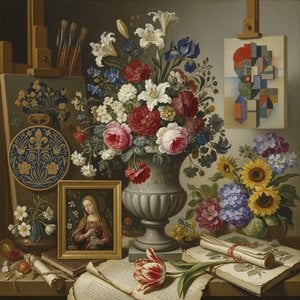
By the mid-20th century, Kazan had begun to develop a style that was unmistakably his own. He became particularly known for his depictions of flowers – not as botanical studies, but as symbolic representations of transience, beauty, and the cyclical nature of life. His flower paintings are characterized by a remarkable sense of intimacy and emotional depth. He often isolated single blossoms or small groupings against minimalist backgrounds, allowing their delicate forms and subtle colors to take center stage.
This deliberate reduction of detail was not an exercise in abstraction, but rather a means of intensifying the viewer’s focus on the essence of the subject. His technique involved layering washes of ink and color with extraordinary precision, creating luminous effects that evoke a sense of ethereal beauty. He frequently incorporated elements of calligraphy into his compositions, adding poetic inscriptions that further enhanced the symbolic resonance of his work.
Themes of Impermanence and Spiritual Reflection
Throughout his career, Kazan consistently explored themes of impermanence (*mujō*) – a central concept in Buddhist philosophy – and the fleeting nature of existence. His paintings are imbued with a sense of melancholy beauty, acknowledging the inevitability of decay while simultaneously celebrating the preciousness of each moment.
He often depicted flowers at various stages of bloom and decline, using these images to reflect on the human condition. Beyond this central theme, Kazan’s work also reveals a deep spiritual sensibility. His paintings are not merely representations of external reality; they are invitations to contemplation, encouraging viewers to connect with their inner selves and find meaning in the natural world. He rarely exhibited his works publicly, preferring instead to share them with a small circle of friends and fellow artists who appreciated their quiet power and profound emotional depth.
Legacy and Historical Significance
While Watanabe Kazan may not be as widely recognized as some of his contemporaries, his work has nonetheless exerted a significant influence on subsequent generations of Japanese painters. His ability to seamlessly blend traditional techniques with modern sensibilities, coupled with his deeply personal vision, has earned him a place among the most important artists of the 20th century.
- His paintings are now held in numerous private collections and museums throughout Japan and abroad.
- Kazan’s emphasis on simplicity, emotional depth, and spiritual reflection continues to resonate with contemporary audiences seeking art that transcends mere aesthetic appeal.
- He demonstrated a profound respect for the expressive potential of traditional materials and techniques, while simultaneously pushing the boundaries of artistic convention.
Kazan’s legacy lies not in grand pronouncements or revolutionary manifestos, but in the quiet beauty and enduring power of his paintings – works that invite us to slow down, contemplate the mysteries of existence, and find solace in the fleeting moments of life. He passed away in 2014 at the age of 100, leaving behind a remarkable body of work that continues to inspire and captivate art lovers around the world.