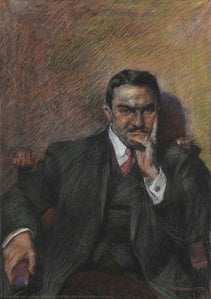
The Soul in Bronze and Brush: The Life of Umberto Milani
To encounter the work of Umberto Milani is to step into a profound dialogue between the scars of history and the resilience of the human spirit. Born in Naples, Milani’s early existence was shadowed by the heavy mantle of loss; the death of his father, a veteran of the Great War, left him an orphan amidst the echoes of conflict. This foundational trauma did not merely shape his biography but became the very marrow of his artistic identity. His formative years at the Accademia di Anima di Belle Arti Napoli allowed him to refine a sensibility that was simultaneously anchored in classical tradition and hungry for the radical shifts of modernity. He moved through the art world not just as an observer, but as a witness, absorbing the kinetic energy of Futurism—specifically the rhythmic, explosive movement found in the works of Umberto Boccioni—and the psychological depths offered by Surrealism.
Milani’s creative evolution was marked by an extraordinary ability to translate intangible emotions into tangible forms. In his sculptural breakthroughs, such as the monumental Forme unique della continuità nello spazio completed in 1938, he achieved a masterful synthesis of space and motion. This work, while echoing Boccioni’s aesthetic principles, infused the bronze with a unique preoccupation with the fleeting nature of experience. His sculptures often presented human figures that were intentionally fragmented or distorted, serving as visceral metaphors for vulnerability and the psychological complexities of a world caught in the throes of upheaval. Through his hands, metal became a medium for expressing the fractured psyche of an era.
Resilience Amidst Shadows and Censorship
The mid-twentieth century presented profound challenges to Milani’s artistic integrity. Living under the oppressive weight of Fascist rule, he found himself at odds with the prevailing political climate due to his staunch pacifist convictions and his refusal to remain silent against the regime of Mussolini. This period of censorship did not stifle his creativity but rather forced it into more subtle, subversive channels. Throughout the Second World War, Milani continued to produce works that acted as quiet acts of defiance, embedding messages of humanistic resilience within his compositions. His art became a sanctuary for the truths that could not be spoken aloud, utilizing abstraction and texture to convey a sense of enduring strength.
Beyond the heavy themes of war and trauma, Milani possessed a remarkable capacity for capturing the luminous, ephemeral beauty of Mediterranean life. In paintings such as Sotto il pergolato a Napoli, he demonstrated a masterful command of light and color, transporting viewers to sun-drenched corners of his native Naples. These works offer a breathtaking contrast to his more somber sculptures, showcasing an Impressionistic quality where the warmth of the sun meets the cool shade of a vine-covered trellis. In these moments, Milani captures the simple, profound joys of companionship and leisure, proving that his artistic vision was as much about celebrating life's light as it was about mourning its shadows.
Legacy and Artistic Contributions
The historical significance of Umberto Milani lies in his ability to bridge the gap between disparate movements and emotional states. He was a pivotal figure in the Italian avant-garde, notably co-founding the "Gruppo dei dieci" alongside artists such as Giuseppe Scalvini and F. Sebastiani. His presence in major international exhibitions—from the Exposition universelle et internationale in Paris to the prestigious Biennale di Venezia—cemented his reputation as a vital voice in modern Italian art. His contributions were recognized by masters of design and curation, such as Carlo Scarpa, who helped curate dedicated spaces for his work at the Venice Biennale.
Today, Milani’s oeuvre remains a testament to the power of art to process collective grief and celebrate individual endurance. His legacy is defined by several key artistic pillars:
- The Synthesis of Movement: His ability to merge the dynamic energy of Futurism with the introspective depth of Surrealism.
- Humanist Expression: A lifelong commitment to exploring themes of vulnerability, trauma, and the human condition through fragmented forms.
- Technical Versatility: An extraordinary range that spanned from monumental bronze sculpture to textured, abstract expressionist painting and mixed-media collage.
- Cultural Witness: The use of art as a tool for pacifism and a subtle critique of political oppression during the Fascist era.
Through his mastery of both the heavy weight of bronze and the delicate interplay of light on canvas, Umberto Milani remains an essential figure for anyone seeking to understand the complex, beautiful, and often turbulent heart of twentieth-century Italian art.
Questions & Answers
What moods do Umberto Milani's artworks express?
Umberto Milani's works can be browsed by mood on the artist's Mood Room page, which arranges the artworks by their recorded moods.
What colors did Umberto Milani use most often?
The color profile of Umberto Milani's work is shown on the artist's Palette Genome page.
Can I browse Umberto Milani's works by medium?
Umberto Milani's works can be browsed by medium on the artist's All Medium page.