Palma Vecchio, 1480 – 1528

The 100 Most Famous Paintings by Palma Vecchio

The painting that made Palma Vecchio famous is Madonna and Child (1515); it hangs in the Hermitage Museum, Saint Petersburg. Portrait of a Man (1512) and Judith (1525) follow it in the hearts of collectors and museum visitors. Of the 107 works by Palma Vecchio in our catalogue, these 100 are the most admired, each presented with its date, its museum and what sets it apart.

Ranked by our popularity score, which combines the searches, visits and orders for each work. Updated October 2026. Every masterpiece on this page can be ordered as a museum-quality, hand-painted oil reproduction or a fine art print, at the size you choose.

Portrait of Palma Vecchio
Palma Vecchio · 1480 – 1528
Born · died
1480 – 1528, Serina
Movement
High renaissance
Works in our catalogue
107
Most famous
Madonna and Child (1515)
Most works at
Kunsthistorisches Museum

Palma Vecchio: the ten masterpieces

Madonna and Child (1515) by Palma Vecchio
1

Madonna and Child

1515 · Oil On Canvas · Hermitage Museum, Saint Petersburg

To stand before this depiction of the Madonna and Child is to be drawn into a moment suspended outside the rush of time—a sanctuary painted by the masterful hand of Palma Vecchio. This work, dating from 1515, transcends mere portraiture; it is an eloquent meditation on maternal love, divine connection, and the profound mystery of creation. The composition centers on the Virgin Mary, portrayed with a tender intimacy as she…

The Adoration of the Shepherds with a Donor by Palma Vecchio
4

The Adoration of the Shepherds with a Donor

Oil On Canvas

The air in the painting feels heavy with the scent of damp earth and hay. In a rural landscape of rolling hills and distant, pale buildings, a small light gathers around the Holy Family. Mary holds the infant Jesus close, her form a soft curve against the shadows. Beside them, Joseph stands as a steady presence. A shepherd boy kneels in the dirt, his posture a study in humility before…

Lucretia (1520) by Palma Vecchio
5

Lucretia

1520 · Oil · Kunsthistorisches Museum, Vienna

The air feels heavy, thick with the scent of velvet and the silent weight of an impending end. Lucretia sits before us, her pale skin luminous against a backdrop of deep, swallowing shadows. A sharp, diagonal line of a dagger presses against her chest, creating a point of tension that vibrates through the stillness. Her reddish-blonde hair flows in soft, organic waves, framing a face caught in a moment of…

Portrait of a Gentleman (1520) by Palma Vecchio
6

Portrait of a Gentleman

1520 · Oil On Panel · Philadelphia Museum of Art, Philadelphia

In this 1520 portrait, we are met with a man whose steady gaze bridges the distance between his era and our own. He is positioned slightly off-center, a choice that lends a sense of naturalism to his posture, as if he has just paused in thought to acknowledge our presence. The composition is a medium close-up, focusing our attention on the quiet dignity of his features. His long, flowing brown…

John the Baptist (1527) by Palma Vecchio
7

John the Baptist

1527 · Oil On Panel · Kunsthistorisches Museum, Vienna

A single light source enters from the upper left, carving a face out of the heavy darkness. This is the world of Palma Vecchio, where deep browns and muted greens emerge from a nearly black background. The man, identified as John the Baptist, looks directly at the viewer with a piercing, steady gaze. His reddish-brown hair falls in soft, organic waves around a face marked by contemplation. A thin, dark…

John the Evangelist (1528) by Palma Vecchio
8

John the Evangelist

1528 · Oil On Canvas · Kunsthistorisches Museum, Vienna

An elderly man sits within a heavy shadow. His face, etched by time, turns toward an unseen light from the upper left. A thick, white beard flows over a deep green tunic. Over one shoulder, a red cloak rests with the weight of heavy wool. The skin of his hands and brow catches the glow, pulling him out from the dark, atmospheric background.

The Holy Family with St Mary Magdalen (1514) by Palma Vecchio
9

The Holy Family with St Mary Magdalen

1514 · Oil On Panel · The Ashmolean Museum of Art And Archaeology, Oxford

In this 1514 oil on panel, we find ourselves drawn into a private, outdoor moment of the Holy Family. The composition is intimate, centered on a man holding a child while a woman stands nearby, her hands resting upon a vase. This arrangement creates a sense of domesticity within a sacred context. The background, filled with the soft presence of trees, suggests a natural setting that allows the figures to…

Young Woman in Profile (1512) by Palma Vecchio
10

Young Woman in Profile

1512 · Oil · Kunsthistorisches Museum, Vienna

The portrait presents a young woman in a strict profile view, her head and shoulders occupying the majority of the frame. She is positioned against a dark, circular backdrop that creates a halo-like effect around her silhouette. The subject's skin is rendered in warm, fleshy tones, transitioning through soft shadows that define the structure of her face and neck. This technique, known as sfumato, allows for a gradual blending of…

More Palma Vecchio masterpieces, 11 to 100

John the Baptist (1528) by Palma Vecchio
#12

John the Baptist

1528 · Kunsthistorisches Museum

The figure of John the Baptist emerges from the shadows of history in this religious painting by Palma Vecchio. He stands alone, a solitary presence caught in a…

Bring it home →
Saint Sebastian (1527) by Palma Vecchio
#13

Saint Sebastian

1527 · Kunsthistorisches Museum

This religious work, titled Saint Sebastian, was executed by the Venetian painter Palma Vecchio around 1527. The painting focuses on the Roman martyr, a figure venerated for his…

Order a reproduction →
The Raising of Lazarus (1514) by Palma Vecchio
#14

The Raising of Lazarus

1514 · Philadelphia Museum of Art

is a dramatic Renaissance oil painting that captures a crowded and dynamic biblical scene. The composition focuses on a central group of figures gathered around a stone tomb,…

Order a reproduction →
The Three Sisters (1520) by Palma Vecchio
#15

The Three Sisters

1520 · Gemäldegalerie Alte Meister

“The Three Sisters” by Palma Vecchio, painted around 1520, stands as a captivating example of Venetian High Renaissance portraiture. This half-length composition depicts three young women, widely believed…

Commission a hand-painted copy →
Saint Magdalene (1504) by Palma Vecchio
#17

Saint Magdalene

1504 · Bavarian State Painting Collections

Saint Magdalene by Palma Vecchio is a bust-length portrait presented in a close-up composition. The female figure is positioned slightly off-center, her body angled toward the viewer while…

Bring it home →
The Triumph of Caesar (1510) by Palma Vecchio
#19

The Triumph of Caesar

1510 · Lowe Gallery

is a large-scale Renaissance oil painting by the Venetian artist Palma Vecchio. Executed around 1510, the work captures a Roman triumphal procession through a densely populated ceremonial scene.

Order a reproduction →
Daphnis (1514) by Palma Vecchio
#21

Daphnis

1514 · Bavarian State Painting Collections

Daphnis, attributed to Palma Vecchio, presents a mythological depiction of the shepherd boy Daphnis. Created around 1513/15, the work draws upon the pastoral traditions of antiquity. The subject…

Bring it home →
Allegory (1510) by Palma Vecchio
#22

Allegory

1510 · Philadelphia Museum of Art

The painting titled Allegory is a work by the Venetian painter Palma Vecchio. Created around 1510, this oil painting belongs to the Italian High Renaissance. The artist, born…

Order a reproduction →
Venus and Cupid (1511) by Palma Vecchio
#23

Venus and Cupid

1511 · Statens Museum For Kunst

is a work by the Venetian painter Palma Vecchio. Created in 1511, the painting belongs to the Italian High Renaissance. The artist, born in Serina, Italy, was a…

Bring it home →
The Holy Family (1515) by Palma Vecchio
#24

The Holy Family

1515 · Gemäldegalerie

In Palma Vecchio's The Holy Family, the arrangement of figures creates a quiet, centered gravity. The Virgin Mary forms the heart of the scene, kneeling in a posture…

Bring it home →
The Virgin and Child (1502) by Palma Vecchio
#25

The Virgin and Child

1502 · Gemäldegalerie

A serene and intimate scene unfolds within a High Renaissance composition, where the Virgin Mary is captured in a moment of private study. Seated toward the right of…

Bring it home →
The Holy Family (1514) by Palma Vecchio
#26

The Holy Family

1514 · National Museum in Kraków

The Holy Family is an oil on panel painting by the Venetian artist Palma Vecchio. Executed in 1514, this work presents a religious scene centered on the Madonna,…

Commission a hand-painted copy →
Visitation (1522) by Palma Vecchio
#30

Visitation

1522 · Kunsthistorisches Museum

The air in the painting feels heavy with the weight of a quiet afternoon. Two women meet in the center of the frame, their bodies leaning into one…

Order a reproduction →
Mars, Venus and Cupid (1520) by Palma Vecchio
#33

Mars, Venus and Cupid

1520

This Renaissance-style oil painting presents a mythological scene featuring three central figures: a muscular man, a woman, and a small winged child. The figures are situated within a…

Bring it home →
Young Woman in Green Dress (1513) by Palma Vecchio
#36

Young Woman in Green Dress

1513 · Kunsthistorisches Museum

This portrait, titled Young Woman in Green Dress, in the hand a box, was executed by the Venetian painter Palma Vecchio. Created around 1513, the work offers a…

Order a reproduction →
Sacred Conversation (detail) (1525) by Palma Vecchio
#37

Sacred Conversation (detail)

1525 · Gallerie dell'Accademia di Venezia

The air feels heavy with a silent, holy stillness as the Virgin Mary cradles the infant Jesus. She sits draped in a deep blue gown, her presence the…

Bring it home →
Portrait of Paola Priuli (1527) by Palma Vecchio
#41

Portrait of Paola Priuli

1527 · Fondazione Querini Stampalia

In the soft, luminous glow of the High Renaissance, few portraits capture the intersection of aristocratic poise and intimate vitality as masterfully as Palma Vecchio’s Portrait of Paola…

Bring it home →
Sacred Conversation (1522) by Palma Vecchio
#43

Sacred Conversation

1522 · Kunsthistorisches Museum

In the quiet, hallowed atmosphere of Sacred Conversation, the viewer is transported directly into the heart of the Venetian High Renaissance. Painted around 1522 by the master Jacopo…

Commission a hand-painted copy →
Sacred Conversation (1525) by Palma Vecchio
#53

Sacred Conversation

1525 · Gallerie dell'Accademia di Venezia

In the quiet, luminous atmosphere of Palma Vecchio’s Sacred Conversation, dated to 1525, the viewer is invited into a moment of profound spiritual intimacy. This masterpiece serves as…

Order a reproduction →
De heilige familie by Palma Vecchio
#54

De heilige familie

Rijksmuseum

The air within the scene feels heavy with a soft, twilight stillness. A group of five figures gathers in a serene, classical arrangement, their presence anchored by the…

Order a reproduction →
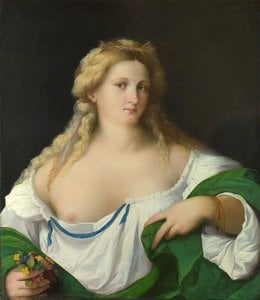
A Blonde Woman by Palma Vecchio
#67

A Blonde Woman

National Gallery

A single figure dominates the composition, her pale skin and long blonde hair emerging from a dark, indeterminate background. She gazes toward the viewer with a sidelong, pensive…

Bring it home →
A Blonde Woman (1520) by Palma Vecchio
#68

A Blonde Woman

1520 · National Gallery

To stand before Palma Vecchio's "A Blonde Woman" is to encounter a moment suspended in time—a breath held just before revelation. This portrait, dating from 1520, transcends a…

Order a reproduction →
Portrait of a Woman (La Bella) (1518) by Palma Vecchio
#84

Portrait of a Woman (La Bella)

1518 · Thyssen-Bornemisza Museum

The painting presents a portrait of a woman positioned in the center of the frame. She is depicted with long hair that cascades down her back, and she…

Bring it home →
Venus (1520) by Palma Vecchio
#85

Venus

1520 · Gemäldegalerie

The painting Venus by Palma Il Vecchio is a masterpiece of Renaissance art, showcasing the artist's skill in capturing the beauty and elegance of the female form. Created…

Bring it home →
Assumption of Mary (1512) by Palma Vecchio
#94

Assumption of Mary

1512 · Gallerie dell'Accademia di Venezia

In this oil on panel from 1512, we witness a moment of profound transition. The Virgin Mary occupies the center of the composition, her arms outstretched as she…

Commission a hand-painted copy →

Palma Vecchio's paintings by period

The subjects Palma Vecchio painted most

The four subjects that return most often among these masterpieces, with the finest example of each.

Where to see Palma Vecchio's paintings

The 8 museums that hold the most of the paintings on this page.

Museum City Works by Palma Vecchio Paintings from this list
Kunsthistorisches Museum, ViennaKunsthistorisches Museum Vienna 13 Lucretia, John the Baptist, John the Evangelist
Szépművészeti Múzeum, BudapestSzépművészeti Múzeum Budapest 7 Madonna and Child with the Infant Saint John and a Bishop Saint, The Holy Family with a Female Saint and Saint Francis of Assisi, Portrait of a Young Woman
Gallerie dell'Accademia di Venezia, VeniceGallerie dell'Accademia di Venezia Venice 6 Sacred Conversation (detail), Sacred Conversation (detail), Sacred Conversation
Gemäldegalerie, BerlinGemäldegalerie Berlin 5 The Holy Family, The Virgin and Child, Portrait of a young woman with bare chest
National Gallery, LondonNational Gallery London 4 A Blonde Woman, A Blonde Woman, Saint George and a Female Saint
Hermitage Museum, Saint PetersburgHermitage Museum Saint Petersburg 3 Madonna and Child, Portrait of a Man, Christ and the Woman Taken in Adultery
Galleria degli Uffizi, FlorenceGalleria degli Uffizi Florence 3 Judith, Judith with the Head of Holofernes, The Holy Family with Mary Magdalene and the infant saint John
Philadelphia Museum of Art, PhiladelphiaPhiladelphia Museum of Art Philadelphia 3 Portrait of a Gentleman, The Raising of Lazarus, Allegory

Palma Vecchio, decade by decade: the defining painting of each

  1. 1500s
    Saint Magdalene (1504) by Palma Vecchio
    Rank 17 / 100

    Saint Magdalene

    Age 20 – 29 · Bavarian State Painting Collections

    Saint Magdalene by Palma Vecchio is a bust-length portrait presented in a close-up composition. The female figure is positioned slightly off-center, her body angled toward the viewer while…

  2. 1510s
    Madonna and Child (1515) by Palma Vecchio
    No. 1 of 100

    Madonna and Child

    Age 30 – 39 · Hermitage Museum

    To stand before this depiction of the Madonna and Child is to be drawn into a moment suspended outside the rush of time—a sanctuary painted by the masterful…

  3. 1520s
    Judith (1525) by Palma Vecchio
    No. 3 of 100

    Judith

    Age 40 – 48 · Galleria degli Uffizi

Palma Vecchio's masterpieces: questions and answers

Which painting is Palma Vecchio best known for?Show the answer

Madonna and Child (1515), Hermitage Museum, Saint Petersburg. Next come Portrait of a Man (1512) and Judith (1525).

How old was Palma Vecchio when painting Madonna and Child?Show the answer

35 years old: Madonna and Child dates from 1515 and Palma Vecchio was born in 1480.

What are Palma Vecchio's ten greatest paintings?Show the answer

Madonna and Child, Portrait of a Man, Judith, The Adoration of the Shepherds with a Donor, Lucretia, Portrait of a Gentleman, John the Baptist, John the Evangelist, The Holy Family with St Mary Magdalen and Young Woman in Profile. The ranking above gives the year and the museum of each.

How many works did Palma Vecchio paint?Show the answer

Our catalogue lists 107 works by Palma Vecchio, dated from 1502 to 1528.

In which museums can I see Palma Vecchio's masterpieces?Show the answer

Most of them are in Kunsthistorisches Museum (Vienna), Szépművészeti Múzeum (Budapest) and Gallerie dell'Accademia di Venezia (Venice). The table above lists the museums one by one.

When did Palma Vecchio paint the masterpieces?Show the answer

In 1520s: 37 of the 100 works on this page date from then, among them Judith.

What are the first and last famous paintings of Palma Vecchio?Show the answer

The earliest on this page is The Virgin and Child (1502), the latest John the Evangelist (1528).

What were Palma Vecchio's favourite subjects?Show the answer

Woman (30), Man (23) and Landscape (22), among the 100 works on this page.

Which technique did Palma Vecchio favour?Show the answer

Oil On Canvas: 18 of the 100 works on this page.

What art movement is Palma Vecchio part of?Show the answer

High renaissance, as the paintings on this page show.

Which masterpieces by Palma Vecchio hang at the Kunsthistorisches Museum?Show the answer

Lucretia, John the Baptist and John the Evangelist are among the 12 works on this page held by the Kunsthistorisches Museum, Vienna.

Can I own a reproduction of a Palma Vecchio masterpiece?Show the answer

Yes. Every painting on this page can be ordered as a museum-quality, hand-painted oil reproduction or a fine art print, in the size you choose, from the painting's own page.

The life of Palma Vecchio

A Venetian Master of Sensuality: The Life and Art of Palma Vecchio

Jacopo Negretti, known to history as Palma Vecchio – “Palma the Elder” – emerged from the artistic landscape of early 16th-century Venice as a pivotal figure bridging the High Renaissance and the burgeoning Mannerist styles. Born around 1480 in Serina Alta near Bergamo, his career unfolded entirely within the vibrant Republic of Venice, a city already steeped in artistic innovation. While documented records are sparse regarding his earliest training, it’s believed he may have initially apprenticed under Andrea Previtali before gravitating towards the revolutionary approaches of Giovanni Bellini, and ultimately, the captivating worlds created by Giorgione and Titian. Palma's arrival in Venice coincided with a period of intense artistic competition; alongside Lorenzo Lotto, he quickly established himself as a formidable talent, absorbing the lessons of his predecessors while forging his own distinctive path.

Early Influences and the Development of a Unique Style

The initial stages of Palma’s career reveal a clear debt to Giovanni Bellini's refined technique and devotional style. However, it was the groundbreaking work of Giorgione – with its poetic atmosphere and enigmatic narratives – that truly ignited his artistic imagination. He swiftly embraced Giorgione’s use of color, light, and composition, infusing his own paintings with a similar sense of lyrical beauty. Yet, Palma wasn't merely an imitator; he possessed a unique gift for rendering the human form with a sensual grace and a captivating realism that set him apart. As Titian rose to prominence, Palma continued to evolve, demonstrating a remarkable ability to synthesize diverse influences into a harmonious and compelling visual language. This period saw the emergence of two primary themes in his oeuvre: the *sacra conversazione*, or holy conversation scenes, and half-length portraits of idealized women, often speculated to be depictions of Venice’s celebrated courtesans.

The Allure of Myth and the Venetian Portrait

Palma Vecchio became renowned for his ability to imbue classical mythology with a distinctly Venetian sensibility. His pastoral scenes are not simply recreations of ancient tales; they are vibrant celebrations of beauty, love, and earthly pleasure, set against lush landscapes teeming with life. These works catered to the tastes of wealthy Venetian patrons who sought art that reflected their sophisticated lifestyles and appreciation for sensual delights. Simultaneously, his portraits – particularly those of women – captivated audiences with their exquisite detail and psychological depth. He developed a signature type: blonde beauties possessing an alluring gaze and a subtle air of mystery. The identity of these sitters remains largely unknown, fueling speculation about their connection to the city’s demimonde. His mastery of color—transparent glazes that created luminous effects—was particularly celebrated, though sadly, many of these delicate layers deteriorated over time. The sheer painterly capacity in his handling of paint and color is often cited as a defining characteristic of his work.

Major Achievements and Artistic Legacy

Among Palma’s most significant achievements are the six paintings commissioned for the church of Santa Maria Formosa in Venice, centered around the *St. Barbara Altarpiece*. This monumental composition showcases his skill in depicting complex narratives and harmonious groupings of figures. His later works demonstrate a mastery of *contrapposto* – the elegant balance of opposing forces in a figure’s pose – and a refined palette that exudes dignity and grace. While he initially embraced influences from Central Italy, including Michelangelo, Palma ultimately forged a style uniquely his own. He was commissioned to paint a main altar at Sant'Elena in Venice in 1525, marking a significant milestone in his career. However, his sudden death in 1528 at the age of approximately 47 left numerous works unfinished, completed by his workshop and pupils. Despite this premature end, Palma Vecchio’s influence on Venetian painting was profound. He served as an important link between the High Renaissance masters like Titian and Giorgione and the emerging Mannerist generation, inspiring artists such as Bonifazio Pitati and Giovanni Busi.

Historical Significance and Rediscovery

For centuries, Palma Vecchio's work remained somewhat overshadowed by his more celebrated contemporaries. However, in recent decades, there has been a growing appreciation for his unique contributions to Venetian art. Scholars have reassessed attributions previously assigned to Giorgione and Titian, recognizing the distinctive qualities of Palma’s style. His paintings are now celebrated for their sensual beauty, technical brilliance, and ability to capture the spirit of Renaissance Venice. He represents a fascinating intersection of artistic influences, bridging the gap between generations and offering a compelling glimpse into the cultural values and aesthetic sensibilities of his time. Palma Vecchio stands as a testament to the enduring power of Venetian painting—a master whose work continues to captivate and inspire audiences today.

All 107 works by Palma Vecchio →