Max Slevogt, 1868 – 1932

Max Slevogt Paintings: The 100 Most Famous Works, Ranked

Max Slevogt's most famous painting is The Quarry at Albersweiler (1912). With The Singer Francisco d'Andrade as Don Giovanni in Mozart's Opera (1912) and Frau Voll mit Tochter (1895), it completes the three works everyone recognises. Our catalogue lists 102 works by Max Slevogt; the 100 below are the ones the world looks at most, each with its year, the museum that holds it and why it matters.

Ranked by our popularity score, which combines the searches, visits and orders for each work. Updated October 2026. Every masterpiece on this page can be ordered as a museum-quality, hand-painted oil reproduction or a fine art print, at the size you choose.

Portrait of Max Slevogt
Max Slevogt · 1868 – 1932
Born · died
1868 – 1932, Landshut
Movement
Impressionism
Works in our catalogue
102
Most famous
The Quarry at Albersweiler (1912)
Most works at
Bavarian State Painting Collections

The 10 most famous Max Slevogt paintings

The Quarry at Albersweiler (1912) by Max Slevogt
1

The Quarry at Albersweiler

1912

A Glimpse into Industrial Transformation: Max Slevogt’s *The Quarry at Albersweiler* (1912) Max Slevogt's *The Quarry at Albersweiler*, painted in 1912, is more than just a landscape; it’s a compelling visual document of a changing world. Measuring 72 x 101 cm and executed with oil on canvas, the painting captures a pivotal moment where human industry begins to dramatically reshape the natural environment. While seemingly serene at first glance, a…

The Singer Francisco d'Andrade as Don Giovanni in Mozart's Opera (1912) by Max Slevogt
2

The Singer Francisco d'Andrade as Don Giovanni in Mozart's Opera

1912 · Oil On Canvas · Alte Nationalgalerie, Berlin

The canvas captures a moment of profound tension from Mozart's opera, specifically the graveyard scene where Don Giovanni invites the statue of the Commendatore to supper. Francisco d'Andrade, marking his thirtieth year on stage, is rendered with a sense of disembodied, floating quality. He is draped in a voluminous white cloak that flows toward the right, creating a stark contrast against a dark, moody background of muted blues and blacks.…

Frau Voll mit Tochter (1895) by Max Slevogt
3

Frau Voll mit Tochter

1895 · Oil · Alte Nationalgalerie, Berlin

Two figures emerge from a heavy, indistinct darkness. On the left, a woman gazes outward with a weary, solemn expression, her face etched with subtle shadows and fine lines. Her hair is pulled back tightly, a stark contrast to the soft, pale skin of her features. Beside her, a younger girl leans her head toward the older woman, her expression pensive and tired. A single patch of bright blue fabric…

Prince Regent Luitpold in the Ermine Cloak (1908) by Max Slevogt
4

Prince Regent Luitpold in the Ermine Cloak

1908 · Oil On Canvas · Bavarian State Painting Collections, Munich

In this 1908 oil on canvas, an elderly man, identified as Prince Regent Luitpold, is positioned against a dark, undifferentiated background. The subject is rendered in a vertical composition, standing slightly off-center. He wears a heavy blue mantle, which is lined with white ermine fur. The lighting originates from the upper left, casting illumination across the subject's face, the white fabric of his shirt, and the folds of the blue…

Theater Curtain (1931) by Max Slevogt
6

Theater Curtain

1931 · Painting · Bavarian State Painting Collections, Munich

The composition presents a formal, pyramidal arrangement of a multi-generational family, captured in a moment of staged stillness. Subjects are organized into two distinct rows: a seated group in the foreground and a standing assembly in the background. The scene is rendered in monochromatic sepia and warm reddish-brown tones, suggesting the chemical aging of a vintage photographic process. Soft, directional lighting defines the contours of facial features and the heavy…

Lady Adventure (1894) by Max Slevogt
7

Lady Adventure

1894 · Oil On Canvas · Städel Museum, Frankfurt

The oil on canvas presents a close-up view of two figures locked in a physical encounter. A figure clad in silver-toned metallic armor is intertwined with a nude female form. The composition follows a diagonal axis, creating a sense of movement through the interlocking limbs. Dark, moody tones of deep black and murky green dominate the background, which remains largely obscured by shadow. High-contrast lighting, or chiaroscuro, catches the edges…

Sailboats on the Alster River in the Evening (1905) by Max Slevogt
9

Sailboats on the Alster River in the Evening

1905 · Oil On Canvas

In the gentle transition from day to dusk, Max Slevogt’s Sailboats on the Alster River in the Evening captures a moment of profound serenity and communal joy. This 1905 masterpiece serves as a window into a bygone era of leisure, where the rhythmic movement of sailboats across the water mirrors the quiet pulse of life along the riverbanks. As the evening light begins to soften, Slevogt masterfully orchestrates a scene…

Max Slevogt, paintings 11 to 100

The Libyan Desert (1914) by Max Slevogt
#33

The Libyan Desert

1914

The painting The Libyan Desert is a stunning work of art created by the renowned artist Max Slevogt in 1914. This beautiful piece is a testament to the…

Bring it home →
Sailing into Syracuse Harbor (1914) by Max Slevogt
#35

Sailing into Syracuse Harbor

1914 · Bayerische Staatsgemaldesammlungen

Introduction to Max Slevogt and Sailing Into Syracuse Harbor Max Slevogt (1868-1932) represents a pivotal moment in German Impressionist painting, securing his place as a master of landscape…

Bring it home →
Summer House Garden (1912) by Max Slevogt
#78

Summer House Garden

1912

The Summer House Garden painting, created in 1912 by renowned German artist Max Slevogt, is a stunning representation of Impressionist art. This beautiful piece measures 62 x 77…

Order a reproduction →
Palatinate Landscape (1923) by Max Slevogt
#81

Palatinate Landscape

1923

In the quietude of 1923, Max Slevogt captured a moment that transcends time in his masterpiece, Palatinate Landscape. This evocative oil on canvas is far more than a…

Order a reproduction →
Palatinate Landscape (1921) by Max Slevogt
#85

Palatinate Landscape

1921 · Staatliche Kunsthalle

Max Slevogt's 1921 painting, “Palatinate Landscape,” isn’t merely a depiction of a forest; it’s an immersion into the heart of German Impressionism and a poignant reflection on the…

Order a reproduction →
Garden Steps in Neukastel (1916) by Max Slevogt
#86

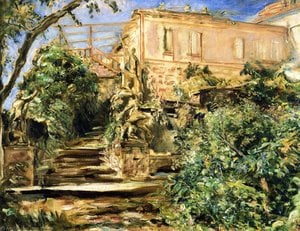
Garden Steps in Neukastel

1916

The Max Slevogt painting, Garden Steps in Neukastel, is a beautiful depiction of a serene garden setting. Created in 1916, this oil on canvas piece is a prime…

Bring it home →

Max Slevogt's paintings by period

The subjects Max Slevogt painted most

The four subjects that return most often among these masterpieces, with the finest example of each.

Where to see Max Slevogt's paintings

The 8 museums that hold the most of the paintings on this page.

Museum City Works by Max Slevogt Paintings from this list
Bavarian State Painting Collections, MunichBavarian State Painting Collections Munich 18 Prince Regent Luitpold in the Ermine Cloak, Theater Curtain, Angela von Tschudi
Staatliche Kunstsammlungen Dresden, DresdenStaatliche Kunstsammlungen Dresden Dresden 6 Sudanese women, Pirates, Sandstorm in the Libyan Desert
Lenbachhaus, MunichLenbachhaus Munich 5 Danae, Luise Papenhagen, Self-Portrait with Black Hat
Alte Nationalgalerie, BerlinAlte Nationalgalerie Berlin 4 The Singer Francisco d'Andrade as Don Giovanni in Mozart's Opera, Frau Voll mit Tochter, Requiem for the St. Georgsknights
National Museum in Warsaw, WarsawNational Museum in Warsaw Warsaw 3 Faun and a girl, Grape harvest., Landscape with a view of Landau
Westfälishes Landesmuseum, MunsterWestfälishes Landesmuseum Munster 3 Man on a Forest Path, Flower Garden I in Neu Cladow, Still life with Melon
Städel Museum, FrankfurtStädel Museum Frankfurt 2 Lady Adventure, Blossoming Lilac
Museum Kunstpalast, DuesseldorfMuseum Kunstpalast Duesseldorf 2 Female Nude from the Back, Neukastel - View of the Madenburg

Max Slevogt's most famous painting of each decade

  1. 1890s
    Frau Voll mit Tochter (1895) by Max Slevogt
    #3 of 100

    Frau Voll mit Tochter

    Age 22 – 31 · Alte Nationalgalerie

    Two figures emerge from a heavy, indistinct darkness. On the left, a woman gazes outward with a weary, solemn expression, her face etched with subtle shadows and fine…

  2. 1900s
    Prince Regent Luitpold in the Ermine Cloak (1908) by Max Slevogt
    #4 of 100

    Prince Regent Luitpold in the Ermine Cloak

    Age 32 – 41 · Bavarian State Painting Collections

    In this 1908 oil on canvas, an elderly man, identified as Prince Regent Luitpold, is positioned against a dark, undifferentiated background. The subject is rendered in a vertical…

  3. 1910s
    The Quarry at Albersweiler (1912) by Max Slevogt
    Rank 1 / 100

    The Quarry at Albersweiler

    Age 42 – 51

    A Glimpse into Industrial Transformation: Max Slevogt’s *The Quarry at Albersweiler* (1912) Max Slevogt's *The Quarry at Albersweiler*, painted in 1912, is more than just a landscape; it’s…

  4. 1920s
  5. 1930s
    Theater Curtain (1931) by Max Slevogt
    #6 of 100

    Theater Curtain

    Age 62 – 64 · Bavarian State Painting Collections

    The composition presents a formal, pyramidal arrangement of a multi-generational family, captured in a moment of staged stillness. Subjects are organized into two distinct rows: a seated group…

Questions about Max Slevogt's paintings

What is Max Slevogt's most famous painting?Show the answer

The Quarry at Albersweiler (1912). Next come The Singer Francisco d'Andrade as Don Giovanni in Mozart's Opera (1912) and Frau Voll mit Tochter (1895).

How old was Max Slevogt when The Quarry at Albersweiler was painted?Show the answer

44 years old: The Quarry at Albersweiler dates from 1912 and Max Slevogt was born in 1868.

What are the top 10 paintings by Max Slevogt?Show the answer

The Quarry at Albersweiler, The Singer Francisco d'Andrade as Don Giovanni in Mozart's Opera, Frau Voll mit Tochter, Prince Regent Luitpold in the Ermine Cloak, Requiem for the St. Georgsknights, Theater Curtain, Lady Adventure, Angela von Tschudi, Sailboats on the Alster River in the Evening and Scheherazade (Telling the Stories from 1001 Nights to the Caliph). The ranking above gives the year and the museum of each.

How many paintings did Max Slevogt make?Show the answer

Our catalogue lists 102 works by Max Slevogt, dated from 1893 to 1931.

Where are Max Slevogt's most famous paintings?Show the answer

Most of them are in Bavarian State Painting Collections (Munich), Staatliche Kunstsammlungen Dresden (Dresden) and Lenbachhaus (Munich). The table above lists the museums one by one.

When did Max Slevogt paint the most famous works?Show the answer

In 1910s: 33 of the 100 works on this page date from then, among them The Quarry at Albersweiler.

What are Max Slevogt's earliest and latest famous paintings?Show the answer

The earliest on this page is Red Arbor with Thundercounds (1893), the latest Theater Curtain (1931).

What did Max Slevogt paint most often?Show the answer

Landscape (11), People (6) and Gardens and parks (5), among the 100 works on this page.

What medium did Max Slevogt use most?Show the answer

Oil On Canvas: 15 of the 100 works on this page.

Which art movement does Max Slevogt belong to?Show the answer

Impressionism, as the paintings on this page show.

Which Max Slevogt paintings can I see at the Bavarian State Painting Collections?Show the answer

Prince Regent Luitpold in the Ermine Cloak, Theater Curtain and Angela von Tschudi are among the 18 works on this page held by the Bavarian State Painting Collections, Munich.

Can I buy a reproduction of a Max Slevogt painting?Show the answer

Yes. Every painting on this page can be ordered as a museum-quality, hand-painted oil reproduction or a fine art print, in the size you choose, from the painting's own page.

About Max Slevogt

The Luminous Legacy of Max Slevogt

Max Slevogt stands as a cornerstone figure in German Impressionist painting, recognized for his masterful depictions of landscapes and his ability to capture the fleeting beauty of nature with remarkable sensitivity. Born in Landshaw, Bavaria, in 1868, he embarked on an artistic journey that would see him evolve from dark, academic tonal sketches into vibrant canvases brimming with light and color—a stylistic shift emblematic of the broader movement reshaping European art at the turn of the century. His early years were spent honing his skills at the Munich Academy, where he initially explored darker palettes and techniques influenced by the prevailing academic style of the era.

However, a pivotal visit to Paris in 1889 ignited a profound transformation within his artistic soul. Exposed to the revolutionary ideas championed by masters like Édouard Manet, Slevogt’s vision was propelled toward a bolder approach that prioritized direct observation of the natural world. This encounter with the French avant-garde breathed life into his brushwork, encouraging him to embrace plein air painting and to seek out the ephemeral dance of light upon the landscape. His work began to pulse with an atmospheric vitality, moving away from rigid studio compositions toward a more spontaneous and sensory engagement with reality.

A Mastery of Light and Landscape

While Slevogt's prolific output spanned various genres including illustration, portraiture, and genre scenes, landscapes consistently dominated his magnificent oeuvre. He achieved particular renown for his evocative portrayals of Bavaria’s alpine regions, particularly Neukastel, which became his lifelong home and served as an enduring source of inspiration. His canvases are celebrated for their ability to capture the subtle nuances of light and shadow, demonstrating a meticulous attention to texture and color that distinguishes him from many of his contemporaries.

The artist's technical evolution is marked by several key characteristics:

  • Dynamic Brushwork: A transition from controlled, academic strokes to more fluid, energetic applications of paint.
  • Chromatic Brilliance: An increasing reliance on a vibrant palette to convey the warmth of sunlight and the coolness of twilight.
  • Atmospheric Depth: The use of soft edges and light diffusion to recreate the feeling of moisture, mist, and air within a scene.

Beyond the serene beauty of his landscapes, Slevogt possessed a remarkable capacity for capturing the weight of human history. His later works reflect a deeper, more somber engagement with the world, including evocative depictions of Egypt and the harrowing horrors of World War I. This ability to pivot from the idyllic to the profound demonstrates the emotional range that defines his greatness.

Cultural Influence and Historical Significance

Beyond his individual artistic accomplishments, Slevogt’s involvement in cultural institutions further cemented his position within the intellectual landscape of Weimar Germany. As a prominent member of the Berlin Secession and the Prussian Academy of Arts, he was at the heart of the era's most significant aesthetic debates. He embraced the avant-garde spirit while maintaining a steadfast commitment to traditional artistic principles, allowing him to bridge the gap between classical training and modern innovation.

His versatility even extended into the performing arts; notably, he designed scenery for Mozart's Don Giovanni, showcasing his ability to translate his painterly vision into theatrical space. Through his work in magazines like Simplicissimus and his enduring influence on German Impressionism, Max Slevogt left an indelible mark on the history of art. He remains a celebrated figure whose work continues to resonate with anyone moved by the interplay of light, color, and the eternal spirit of nature.

All 102 works by Max Slevogt →