Masaccio, 1401 – 1428

Masaccio Paintings: The 97 Most Famous Works, Ranked

Masaccio's most famous painting is The Trinity (1428). With The Tribute Money (1425) and The Expulsion from the Garden of Eden (1426), it completes the three works everyone recognises. Our catalogue lists 97 works by Masaccio; the 97 below are the ones the world looks at most, each with its year, the museum that holds it and why it matters.

Ranked by our popularity score, which combines the searches, visits and orders for each work. Updated October 2026. Every masterpiece on this page can be ordered as a museum-quality, hand-painted oil reproduction or a fine art print, at the size you choose.

Portrait of Masaccio
Masaccio · 1401 – 1428
Born · died
1401 – 1428, San Giovanni Valdarno
Movement
Early renaissance
Works in our catalogue
97
Most famous
The Trinity (1428)
Most works at
Santa Maria del Carmine

The 10 most famous Masaccio paintings

The Trinity (1428) by Masaccio
1

The Trinity

1428 · Fresco

The Trinity by Masaccio is a fresco painting that marked the beginning of the Renaissance in Italy. Created in 1425, it is considered one of the most important works of the early Renaissance period. The painting is housed in the Santa Maria Novella church in Florence, Italy. Artistic Innovations The Trinity by Masaccio was a groundbreaking work that introduced several artistic innovations. It is one of the first monumental Renaissance…

The Tribute Money (1425) by Masaccio
2

The Tribute Money

1425 · Fresco

The scene unfolds within the Brancacci Chapel of the basilica of Santa Maria del Carmine in Florence. Here, the fresco titled The Tribute Money by Masaccio brings a biblical narrative to life upon the chapel walls. Commissioned by Felice Brancacci, this work forms a significant part of a larger cycle dedicated to the life of Saint Peter. The air in the chapel seems to hold the weight of this sacred…

The Expulsion from the Garden of Eden (1426) by Masaccio
3

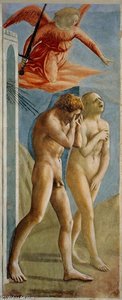
The Expulsion from the Garden of Eden

1426 · Fresco

The heavy silence of the Brancacci Chapel in the church of Santa Maria del Carmine in Florence, Italy, holds the weight of a profound tragedy. Here, the walls breathe with the story of The Expulsion from the Garden of Eden, a fresco painted by Masaccio around 1425. The air seems to thicken around the figures as they face their sudden, irreversible departure from paradise. This scene marks the beginning of…

Rendering of the Tribute Money (detail) by Masaccio
4

Rendering of the Tribute Money (detail)

Fresco

This captivating detail originates from Masaccio’s groundbreaking fresco, “The Tribute Money,” a pivotal work within the Brancacci Chapel in Florence. Executed around 1426, it represents a turning point in Western art, moving away from the stylized conventions of the Gothic period towards a new era of naturalism and humanistic expression.

Predella panel from the Pisa Altar (1426) by Masaccio
5

Predella panel from the Pisa Altar

1426 · Oil On Panel · Staatliche Museen zu Berlin, Berlin

To stand before this Predella panel from the Pisa Altar is to encounter a moment frozen in time, yet vibrating with raw, undeniable human drama. Dating to 1426, this work captures Masaccio at the zenith of his revolutionary power. It is not merely a depiction of the Crucifixion; it is a profound meditation on sacrifice, community, and the weight of divine narrative rendered with startling immediacy. The composition draws the…

The Madonna of Humility (1424) by Masaccio
6

The Madonna of Humility

1424 · Tempera On Panel

In the quiet, profound stillness of Masaccio’s The Madonna of Humility, we encounter one of the most moving snapshots of the Early Italian Renaissance. Created around 1424, this masterpiece transcends mere religious iconography to offer a window into a moment of raw, maternal intimacy. The scene is set not upon a celestial throne, but on the earth itself, where the Virgin Mary sits upon a blue patterned cushion. This choice…

Trinity (detail) (1425) by Masaccio
7

Trinity (detail)

1425 · Fresco · Santa Maria Novella, Florence

The image presents a detail from a fresco painting created in 1425 by Masaccio. Within this specific view, a figure is depicted that appears to be Mary Magdalene, identified by the traditional iconography of her long hair and a head covering. She possesses a contemplative expression, directing her gaze slightly downwards toward an object held in her right hand, which may be interpreted as a symbol of faith or devotion.

Two panels from the Pisa Altarpiece (1426) by Masaccio
8

Two panels from the Pisa Altarpiece

1426 · Tempera On Panel · Staatliche Museen zu Berlin, Berlin

In the quiet, hallowed halls of art history, few works capture the dawn of a new era as poignantly as Masaccio’s Two Panels from the Pisa Altarpiece. Completed in 1426, these panels are far more than mere fragments of a lost polyptych; they are windows into a transformative moment when the rigid conventions of the Gothic period began to dissolve, giving way to the profound humanism of the Early Italian…

Trinity (1425) by Masaccio
9

Trinity

1425 · Fresco · Santa Maria Novella, Florence

To step before Masaccio’s Holy Trinity is to witness the exact moment when the flattened, symbolic world of the Middle Ages dissolved into the profound, breathing reality of the Renaissance. Painted between 1425 and 1427 within the hallowed walls of Santa Maria Novella in Florence, this fresco does not merely depict a religious scene; it carves a hole in the very wall of the chapel, inviting the viewer to step…

Trinity (detail) (1425) by Masaccio
10

Trinity (detail)

1425 · Acrylic On Canvas · Santa Maria Novella, Florence

Masaccio’s “Trinity (detail),” housed within the magnificent Santa Maria Novella in Florence, isn't merely a fresco; it’s a pivotal moment in art history – a visual manifesto declaring the arrival of the High Renaissance. Painted between 1425 and 1427, this intimate section captures the essence of Masaccio’s revolutionary approach to depicting reality, a departure from the stylized elegance of the preceding Gothic era and a profound influence on generations of…

Masaccio, paintings 11 to 97

Madonna Casini (1426) by Masaccio
#16

Madonna Casini

1426

The Madonna Casini is a painting by the artist Masaccio. This intimate work carries several other names, including Madonna del Solletico, Madonna col bambino, Madonna con bambino, and…

Order a reproduction →
Adam and Eve banished from Paradise (1427) by Masaccio
#17

Adam and Eve banished from Paradise

1427

Adam and Eve banished from Paradise by Masaccio is a single scene from a larger fresco cycle located in the Brancacci Chapel of Santa Maria del Carmine in…

Frescoes in the Cappella Brancacci (left view) (1426) by Masaccio
#19

Frescoes in the Cappella Brancacci (left view)

1426 · Santa Maria del Carmine

Masaccio’s Frescoes in the Cappella Brancacci stand as a cornerstone of Renaissance art, representing an unprecedented leap forward in artistic innovation and profoundly influencing subsequent generations. Located within…

Bring it home →
Baptism of the Neophytes (1427) by Masaccio
#20

Baptism of the Neophytes

1427

In the quiet dimness of the Brancacci Chapel, within the Santa Maria del Carmine in Florence, Italy, a profound scene unfolds. This fresco, executed between 1426 and 1427,…

Crucifixion (1426) by Masaccio
#22

Crucifixion

1426 · Museo di Capodimonte

Masaccio’s Crucifixion, painted in 1426 during his tragically brief career, isn’t merely a depiction of a pivotal biblical event; it’s a foundational moment in Western art. Born in…

Order a reproduction →
Distribution of Alms and Death of Ananias (1425) by Masaccio
#48

Distribution of Alms and Death of Ananias

1425

In the quiet, profound depths of Masaccio’s Distribution of Alms and Death of Ananias, we encounter a moment where the divine intersects with the earthly through the simple,…

Plate of Nativity (Berlin Tondo) (1427) by Masaccio
#77

Plate of Nativity (Berlin Tondo)

1427 · Staatliche Museen zu Berlin

In the quiet intimacy of the Plate of Nativity (Berlin Tondo), we witness one of the most profound transformations in the history of Western art. Painted in 1427…

Bring it home →
Adoration of the Magi (1426) by Masaccio
#85

Adoration of the Magi

1426 · Staatliche Museen zu Berlin

To stand before Masaccio’s Adoration of the Magi is not merely to observe a painting; it is to step directly into the revolutionary atmosphere of the early Italian…

Order a reproduction →
Predella panel from the Pisa Altar (1426) by Masaccio
#87

Predella panel from the Pisa Altar

1426 · Staatliche Museen zu Berlin

The world of 15th-century Florentine painting was undergoing a seismic shift, and at the heart of this transformation stood Masaccio – a name that resonates with an almost…

Bring it home →
St. Andrew (1426) by Masaccio
#93

St. Andrew

1426 · J. Paul Getty Museum

A Revolutionary Vision of Faith: Masaccio’s St. Andrew Masaccio's *St. Andrew*, painted in 1426, is a landmark work of the Early Renaissance, embodying the seismic shift towards naturalism…

Bring it home →
Crucifixion of St Peter (1426) by Masaccio
#97

Crucifixion of St Peter

1426 · Staatliche Museen zu Berlin

Masaccio's 1426 painting, *Crucifixion of St. Peter*, is not merely a depiction of a pivotal moment in Christian history; it’s a foundational cornerstone of the Early Italian Renaissance.…

Commission a hand-painted copy →

Masaccio's paintings by period

The subjects Masaccio painted most

The four subjects that return most often among these masterpieces, with the finest example of each.

Where to see Masaccio's paintings

The 8 museums that hold the most of the paintings on this page.

Museum City Works by Masaccio Paintings from this list
Santa Maria del Carmine, FlorenceSanta Maria del Carmine Florence 7 View of the Cappella Brancacci (before restoration), Frescoes in the Cappella Brancacci (right view), Frescoes in the Cappella Brancacci (left view)
Staatliche Museen zu Berlin, BerlinStaatliche Museen zu Berlin Berlin 6 Predella panel from the Pisa Altar, Two panels from the Pisa Altarpiece, Plate of Nativity (Berlin Tondo)
Gemäldegalerie, BerlinGemäldegalerie Berlin 5 Martyrdom of San Giovanni Battista, A Bearded Carmelite Saint, San Agustín
Santa Maria Novella, FlorenceSanta Maria Novella Florence 4 Trinity (detail), Trinity, Trinity (detail)
Lindenau-Museum, AltengauLindenau-Museum Altengau 3 Christ in the Garden of Gethsemane (detail), Christ in the Garden of Gethsemane (detail), Christ in the Garden of Gethsemane
National Gallery of Art, WashingtonNational Gallery of Art Washington 2 Profile Portrait of a Young Man, Madonna of Humility
National Gallery, LondonNational Gallery London 2 Madonna with Child and Angels, St.Girolamo end Giovanni Battista
Museo di Capodimonte, NaplesMuseo di Capodimonte Naples 1 Crucifixion

Masaccio's most famous paintings, year by year

Masaccio painted for barely 9 years, from 1420 to 1428: follow that decade year by year, through the paintings that made the name.

  1. 1420
  2. 1422
  3. 1422
  4. 1422
    San Giovenale Triptych. Left panel (1422) by Masaccio
    No. 63 of 97

    San Giovenale Triptych. Left panel

    Age 21

    The San Giovenale Triptych, Left Panel by Masaccio is a seminal work of art that showcases the artist's innovative style and technique. Created in 1422, this painting is…

  5. 1422
  6. 1423
  7. 1423
  8. 1424
    The Madonna of Humility (1424) by Masaccio
    No. 6 of 97

    The Madonna of Humility

    Age 23

    In the quiet, profound stillness of Masaccio’s The Madonna of Humility, we encounter one of the most moving snapshots of the Early Italian Renaissance. Created around 1424, this…

  9. 1424
    Christ in the Garden of Gethsemane (detail) (1424) by Masaccio
    No. 21 of 97

    Christ in the Garden of Gethsemane (detail)

    Age 23 · Lindenau-Museum

    The garden holds a heavy stillness. In this detail from 1424, a single figure kneels upon the earth, hands clasped in a tight knot of devotion. The light…

  10. 1424
  11. 1424
    Christ in the Garden of Gethsemane (1424) by Masaccio
    Rank 62 / 97

    Christ in the Garden of Gethsemane

    Age 23 · Lindenau-Museum

    The painting Christ in the Garden of Gethsemane is a renowned work by the Italian artist Masaccio, created in 1424. This tempera painting, measuring 62 x 44 cm,…

  12. 1425
    The Tribute Money (1425) by Masaccio
    No. 2 of 97

    The Tribute Money

    Age 24

    The scene unfolds within the Brancacci Chapel of the basilica of Santa Maria del Carmine in Florence. Here, the fresco titled The Tribute Money by Masaccio brings a…

  13. 1425
    Trinity (detail) (1425) by Masaccio
    #7 of 97

    Trinity (detail)

    Age 24 · Santa Maria Novella

    The image presents a detail from a fresco painting created in 1425 by Masaccio. Within this specific view, a figure is depicted that appears to be Mary Magdalene,…

  14. 1425
    Trinity (1425) by Masaccio
    #9 of 97

    Trinity

    Age 24 · Santa Maria Novella

    To step before Masaccio’s Holy Trinity is to witness the exact moment when the flattened, symbolic world of the Middle Ages dissolved into the profound, breathing reality of…

  15. 1425
    Trinity (detail) (1425) by Masaccio
    No. 10 of 97

    Trinity (detail)

    Age 24 · Santa Maria Novella

    Masaccio’s “Trinity (detail),” housed within the magnificent Santa Maria Novella in Florence, isn't merely a fresco; it’s a pivotal moment in art history – a visual manifesto declaring…

  16. 1426
    The Expulsion from the Garden of Eden (1426) by Masaccio
    Rank 3 / 97

    The Expulsion from the Garden of Eden

    Age 25

    The heavy silence of the Brancacci Chapel in the church of Santa Maria del Carmine in Florence, Italy, holds the weight of a profound tragedy. Here, the walls…

  17. 1426
    Predella panel from the Pisa Altar (1426) by Masaccio
    Rank 5 / 97

    Predella panel from the Pisa Altar

    Age 25 · Staatliche Museen zu Berlin

    To stand before this Predella panel from the Pisa Altar is to encounter a moment frozen in time, yet vibrating with raw, undeniable human drama. Dating to 1426,…

  18. 1426
    Two panels from the Pisa Altarpiece (1426) by Masaccio
    #8 of 97

    Two panels from the Pisa Altarpiece

    Age 25 · Staatliche Museen zu Berlin

    In the quiet, hallowed halls of art history, few works capture the dawn of a new era as poignantly as Masaccio’s Two Panels from the Pisa Altarpiece. Completed…

  19. 1426
    View of the Cappella Brancacci (before restoration) (1426) by Masaccio
    Rank 11 / 97

    View of the Cappella Brancacci (before restoration)

    Age 25 · Santa Maria del Carmine

    Masaccio's View of the Cappella Brancacci (before restoration), painted in 1426, isn’t merely a depiction of a church interior; it’s a pivotal moment in art history – a…

  20. 1427
    Adam and Eve banished from Paradise (1427) by Masaccio
    Rank 17 / 97

    Adam and Eve banished from Paradise

    Age 26

    Adam and Eve banished from Paradise by Masaccio is a single scene from a larger fresco cycle located in the Brancacci Chapel of Santa Maria del Carmine in…

  21. 1427
    Baptism of the Neophytes (1427) by Masaccio
    No. 20 of 97

    Baptism of the Neophytes

    Age 26

    In the quiet dimness of the Brancacci Chapel, within the Santa Maria del Carmine in Florence, Italy, a profound scene unfolds. This fresco, executed between 1426 and 1427,…

  22. 1427
    Plate of Nativity (Berlin Tondo) (1427) by Masaccio
    Rank 77 / 97

    Plate of Nativity (Berlin Tondo)

    Age 26 · Staatliche Museen zu Berlin

    In the quiet intimacy of the Plate of Nativity (Berlin Tondo), we witness one of the most profound transformations in the history of Western art. Painted in 1427…

  23. 1428
    The Trinity (1428) by Masaccio
    #1 of 97

    The Trinity

    Age 27

    The Trinity by Masaccio is a fresco painting that marked the beginning of the Renaissance in Italy. Created in 1425, it is considered one of the most important…

  24. 1428
  25. 1428

Questions about Masaccio's paintings

What is Masaccio's most famous painting?Show the answer

The Trinity (1428). Next come The Tribute Money (1425) and The Expulsion from the Garden of Eden (1426).

How old was Masaccio when The Trinity was painted?Show the answer

27 years old: The Trinity dates from 1428 and Masaccio was born in 1401.

What are the top 10 paintings by Masaccio?Show the answer

The Trinity, The Tribute Money, The Expulsion from the Garden of Eden, Rendering of the Tribute Money (detail), Predella panel from the Pisa Altar, The Madonna of Humility, Trinity (detail), Two panels from the Pisa Altarpiece, Trinity and Trinity (detail). The ranking above gives the year and the museum of each.

How many paintings did Masaccio make?Show the answer

Our catalogue lists 97 works by Masaccio, dated from 1420 to 1428.

Where are Masaccio's most famous paintings?Show the answer

Most of them are in Santa Maria del Carmine (Florence), Staatliche Museen zu Berlin (Berlin) and Gemäldegalerie (Berlin). The table above lists the museums one by one.

When did Masaccio paint the most famous works?Show the answer

In 1426: 41 of the 97 works on this page date from then, among them The Expulsion from the Garden of Eden.

What are Masaccio's earliest and latest famous paintings?Show the answer

The earliest on this page is Madonna of Humility (1420), the latest The Trinity (1428).

What did Masaccio paint most often?Show the answer

Saints (29), Religious (23) and Religious art (11), among the 97 works on this page.

What medium did Masaccio use most?Show the answer

Fresco: 12 of the 97 works on this page.

Which art movement does Masaccio belong to?Show the answer

Early renaissance, as the paintings on this page show.

Which Masaccio paintings can I see at the Santa Maria del Carmine?Show the answer

View of the Cappella Brancacci (before restoration), Frescoes in the Cappella Brancacci (right view) and Frescoes in the Cappella Brancacci (left view) are among the 7 works on this page held by the Santa Maria del Carmine, Florence.

Can I buy a reproduction of a Masaccio painting?Show the answer

Yes. Every painting on this page can be ordered as a museum-quality, hand-painted oil reproduction or a fine art print, in the size you choose, from the painting's own page.

About Masaccio

Masaccio (1401-1428): The Dawn of Renaissance Realism

Tommaso di Ser Giovanni di Simone, better known as Masaccio (meaning "clumsy Tom"), was a pivotal figure in the Early Italian Renaissance. Born on December 21, 1401, in San Giovanni Valdarno, Italy, and dying tragically young in 1428, his brief career revolutionized painting with groundbreaking realism, perspective, and chiaroscuro (the use of strong contrasts between light and dark). Despite his short life, Masaccio’s impact on subsequent generations of artists was profound, establishing a new standard for naturalism and influencing the course of Western art.

Early Life and Training

  • Origins: Born to Giovanni di Simone Cassai, a notary, and Jacopa di Martinozzo. His family name, Cassai, derived from his paternal grandfather's trade as a cabinet maker.
  • Early Years: Orphaned at age five when his father died, he had a brother, Giovanni (Lo Scheggia), who also became a painter.
  • Apprenticeship: The details of Masaccio’s artistic training remain largely unknown, which is unusual for Renaissance artists. It's believed he likely apprenticed around the age of 12, but no definitive master has been identified. This lack of documented training adds to the mystery surrounding his rapid development and innovative techniques.
  • Guild Membership: He joined the painters’ guild (Arte de’ Medici e Speziali) in Florence on January 7, 1422, signifying his emergence as an independent master artist.

Artistic Development and Major Works

  • Early Influences: Initially influenced by Giotto di Bondone, a predecessor known for his naturalism, Masaccio quickly surpassed him in his understanding of perspective and anatomy. He also drew inspiration from the architectural innovations of Filippo Brunelleschi, particularly Brunelleschi’s rediscovery of linear perspective.
  • Key Innovations: Masaccio pioneered several groundbreaking techniques:
    • Linear Perspective: Employed vanishing points and mathematical precision to create a convincing illusion of depth on a two-dimensional surface.
    • Chiaroscuro: Masterfully used light and shadow to model forms, creating a sense of volume and realism previously unseen in painting.
    • Naturalism: Depicted figures with anatomical accuracy and emotional expressiveness, moving away from the stylized representations of earlier periods.
  • Significant Works:

Historical Significance and Legacy

Masaccio’s impact on the course of Western art is immeasurable, despite his tragically short career. His innovations in perspective, chiaroscuro, and naturalism fundamentally altered how artists depicted the world. He effectively bridged the gap between Medieval artistic conventions and the emerging ideals of the Renaissance.

  • Influence on Subsequent Artists: Masaccio’s work profoundly influenced generations of painters, including Donatello, Leonardo da Vinci, Michelangelo, and Raphael. They studied his frescoes intently, adopting and adapting his techniques to their own styles.
  • Foundation for the High Renaissance: His emphasis on realism and human emotion laid the groundwork for the artistic achievements of the High Renaissance.
  • Vasari's Account: The biographer Giorgio Vasari recognized Masaccio’s genius, praising him as "the best painter of his generation" and highlighting his ability to imitate nature with unparalleled skill.
  • A Tragic Loss: His death at the young age of 26 was mourned by contemporaries like Filippo Brunelleschi, who lamented the loss of such a remarkable talent.

Conclusion

Masaccio’s legacy endures as one of the most important and influential artists in history. He stands as a pivotal figure in the transition from Medieval to Renaissance art, forever changing the way we perceive and represent the world through painting. His brief but brilliant career serves as a testament to the power of innovation and the enduring impact of artistic genius.

All 97 works by Masaccio →