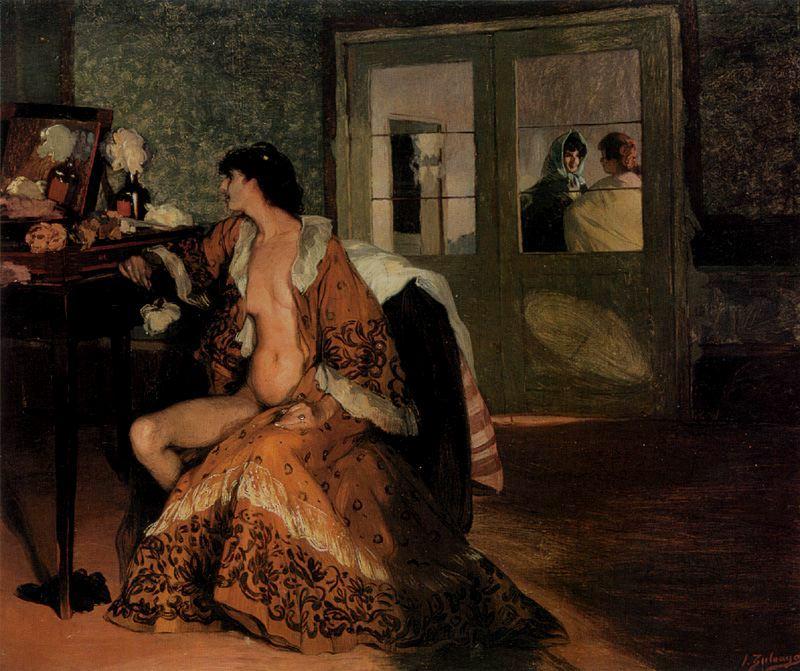
Ignacio Zuloaga, 1870 – 1945

Ignacio Zuloaga Paintings: The 100 Most Famous Works, Ranked

Ignacio Zuloaga's most famous painting is Portrait of Maurice Barrès. With Woman in Andalusian Dress (1911) and Anita Ramírez, in black (1915), it completes the three works everyone recognises. Our catalogue lists 108 works by Ignacio Zuloaga; the 100 below are the ones the world looks at most, each with its year, the museum that holds it and why it matters.

Ranked by our popularity score, which combines the searches, visits and orders for each work. Updated October 2026. Every masterpiece on this page can be ordered as a museum-quality, hand-painted oil reproduction or a fine art print, at the size you choose.

Portrait of Ignacio Zuloaga
Ignacio Zuloaga · 1870 – 1945
Born · died
1870 – 1945, Eibar
Movement
Spanish realism
Works in our catalogue
108
Most famous
Portrait of Maurice Barrès
Most works at
Hispanic Society Museum - Library

The 10 most famous Ignacio Zuloaga paintings

Portrait of Maurice Barrès by Ignacio Zuloaga
1

Portrait of Maurice Barrès

Oil On Canvas

The figure of Maurice Barrès occupies the left side of the canvas, a steady anchor amidst a swirling, dramatic landscape. He gazes toward a distant cityscape, his expression caught in a moment of quiet introspection. There is a certain weight to his presence, a sense of a man deeply connected to the history he contemplates. The light, diffused and soft as if filtered through an overcast sky, casts gentle shadows…

Woman in Andalusian Dress (1911) by Ignacio Zuloaga
2

Woman in Andalusian Dress

1911 · Oil On Canvas · National Gallery of Art, Washington

A woman emerges from a swirl of deep blues and teals. She is captured from the waist up, her presence anchored by the heavy textures of her attire. An orange headpiece rests upon her hair, pinned with pink and white floral accents that catch the light. Her skin glows with warmth against the cool, atmospheric clouds that churn in the background. There is a stillness in her gaze, a poised…

Julia Wainwright Robbins (1923) by Ignacio Zuloaga
7

Julia Wainwright Robbins

1923 · Oil On Canvas · Metropolitan Museum of Art, New York

In this 1923 oil on canvas, Ignacio Zuloaga captures Julia Wainwright Robbins as a solitary figure. She occupies the center of the frame, a single female presence held within a quiet, dark space. Her posture is formal, defined by an aristocratic poise that commands the stillness of the composition. She holds a closed fan, a small, rigid object that anchors her hands against the soft volume of her attire.

Ignacio Zuloaga, paintings 11 to 100

Portrait of Ivan Shchukin (1869-1908) (1899) by Ignacio Zuloaga
#11

Portrait of Ivan Shchukin (1869-1908)

1899 · Hermitage Museum

A full-length portrait depicts a man positioned centrally against a desolate, rocky landscape. He is oriented slightly toward the viewer, maintaining a frontal posture that occupies much of…

Bring it home →
My Uncle and My Cousins (1898) by Ignacio Zuloaga
#32

My Uncle and My Cousins

1898 · Musée d'Orsay

Ignacio Zuloaga y Zabala's 1898 painting, *My Uncle and My Cousins*, offers a poignant window into the formal portraiture traditions of late 19th-century Spain. More than simply a…

Bring it home →
Sepulveda (1909) by Ignacio Zuloaga
#39

Sepulveda

1909 · National Gallery of Art

The oil on canvas titled Sepúlveda was painted in 1909. It is a work by the Spanish artist Ignacio Zuloaga, who lived from 1870 to 1945. The painting…

Bring it home →
Torero (1902) by Ignacio Zuloaga
#91

Torero

1902 · Vil·la Casals-Museu Pau Casals

In the evocative portrait titled Torero, created in 1902 by the master of Spanish realism, Ignacio Zuloaga y Zabala, we are invited into a moment of profound stillness…

Commission a hand-painted copy →

Ignacio Zuloaga's paintings by period

The subjects Ignacio Zuloaga painted most

The four subjects that return most often among these masterpieces, with the finest example of each.

Where to see Ignacio Zuloaga's paintings

The 8 museums that hold the most of the paintings on this page.

Museum City Works by Ignacio Zuloaga Paintings from this list
Hispanic Society Museum - Library, New YorkHispanic Society Museum - Library New York 12 The Penitents, My Cousin Cándida, Self-Portrait
Metropolitan Museum of Art, New YorkMetropolitan Museum of Art New York 4 Julia Wainwright Robbins, Alva B. Gimbel, Mountains of Calatayud
National Museum of Fine Arts, Buenos AiresNational Museum of Fine Arts Buenos Aires 4 The Witches of San Millán, Gitanilla, Return of the Harvest
Museo Nacional Centro de Arte Reina Sofía, MadridMuseo Nacional Centro de Arte Reina Sofía Madrid 3 Tipo de Segovia (Man from Segovia), Retrato de Madame Malinowska (La Rusa) (Portrait of Madame Malinowska [The Russian]), Don Placido Zuloaga in his studio
National Gallery of Art, WashingtonNational Gallery of Art Washington 2 Woman in Andalusian Dress, Sepulveda
Museum of Fine Arts, BostonMuseum of Fine Arts Boston 2 My Uncle Daniel and his Family, Castilian Landscape
Hermitage Museum, Saint PetersburgHermitage Museum Saint Petersburg 3 Portrait of Ivan Shchukin (1869-1908)
Brooklyn Museum, BrooklynBrooklyn Museum Brooklyn 1 Anita Ramírez, in black

Ignacio Zuloaga's most famous painting of each decade

  1. 1890s
    Portrait of Ivan Shchukin (1869-1908) (1899) by Ignacio Zuloaga
    Rank 11 / 100

    Portrait of Ivan Shchukin (1869-1908)

    Age 20 – 29 · Hermitage Museum

    A full-length portrait depicts a man positioned centrally against a desolate, rocky landscape. He is oriented slightly toward the viewer, maintaining a frontal posture that occupies much of…

  2. 1900s
  3. 1910s
    Woman in Andalusian Dress (1911) by Ignacio Zuloaga
    No. 2 of 100

    Woman in Andalusian Dress

    Age 40 – 49 · National Gallery of Art

    A woman emerges from a swirl of deep blues and teals. She is captured from the waist up, her presence anchored by the heavy textures of her attire.…

  4. 1920s
    Julia Wainwright Robbins (1923) by Ignacio Zuloaga
    #7 of 100

    Julia Wainwright Robbins

    Age 50 – 59 · Metropolitan Museum of Art

    In this 1923 oil on canvas, Ignacio Zuloaga captures Julia Wainwright Robbins as a solitary figure. She occupies the center of the frame, a single female presence held…

  5. 1930s

Questions about Ignacio Zuloaga's paintings

What is Ignacio Zuloaga's most famous painting?Show the answer

Portrait of Maurice Barrès. Next come Woman in Andalusian Dress (1911) and Anita Ramírez, in black (1915).

What are the top 10 paintings by Ignacio Zuloaga?Show the answer

Portrait of Maurice Barrès, Woman in Andalusian Dress, Anita Ramírez, in black, My cousin Candida, Alice Lolita Muth Maacha, Celestina, Julia Wainwright Robbins, Segoviano, My friends and Mrs. Philip M. Lydig (Rita H. de Alba de Acosta). The ranking above gives the year and the museum of each.

How many paintings did Ignacio Zuloaga make?Show the answer

Our catalogue lists 108 works by Ignacio Zuloaga, dated from 1898 to 1931.

Where are Ignacio Zuloaga's most famous paintings?Show the answer

Most of them are in Hispanic Society Museum - Library (New York), Metropolitan Museum of Art (New York) and National Museum of Fine Arts (Buenos Aires). The table above lists the museums one by one.

When did Ignacio Zuloaga paint the most famous works?Show the answer

In 1920s: 11 of the 100 works on this page date from then, among them Julia Wainwright Robbins.

What are Ignacio Zuloaga's earliest and latest famous paintings?Show the answer

The earliest on this page is My Uncle and My Cousins (1898), the latest Carlos de Beistegui (Mexico, 1863 - Biarritz, 1953) (1931).

What did Ignacio Zuloaga paint most often?Show the answer

Portraits (8), Portraiture (7) and Landscape (6), among the 100 works on this page.

What medium did Ignacio Zuloaga use most?Show the answer

Oil On Canvas: 10 of the 100 works on this page.

Which art movement does Ignacio Zuloaga belong to?Show the answer

Spanish realism, as the paintings on this page show.

Which Ignacio Zuloaga paintings can I see at the Hispanic Society Museum - Library?Show the answer

The Penitents, My Cousin Cándida and Self-Portrait are among the 10 works on this page held by the Hispanic Society Museum - Library, New York.

Can I buy a reproduction of a Ignacio Zuloaga painting?Show the answer

Yes. Every painting on this page can be ordered as a museum-quality, hand-painted oil reproduction or a fine art print, in the size you choose, from the painting's own page.

About Ignacio Zuloaga

A Life Etched in Spanish Realism

Ignacio Zuloaga y Zabala, born in the Basque town of Eibar in 1870, stands as a pivotal figure in late 19th and early 20th-century Spanish painting. His artistic journey wasn’t predestined; rather, it blossomed from an unexpected spark ignited during a trip to Rome with his father. Coming from a family deeply rooted in craftsmanship – his grandfather was the royal armourer, and his father a skilled damascener – Zuloaga initially seemed destined for a more conventional path. However, the allure of artistic expression proved irresistible, leading him at eighteen to immerse himself in the vibrant post-impressionist scene of Paris. This period wasn’t about imitation, but absorption; he observed the innovations of artists like Ramon Casas, Gauguin, and Toulouse-Lautrec, yet steadfastly maintained a distinct focus on his Spanish heritage.

Forging an Identity Through Artistic Exploration

Zuloaga's time in Montmartre was formative, exposing him to new ideas and techniques. Yet, the pull of his homeland proved stronger. After several years abroad, he returned to Spain, initially settling in Seville before ultimately finding resonance in Segovia. This relocation marked a turning point, a conscious embrace of his national identity that would become the defining characteristic of his art. He deliberately sought inspiration from Spanish masters – Velázquez and Murillo foremost among them – adopting their earthy color palettes and genre themes while simultaneously forging an expressive style uniquely his own. It was a deliberate act of artistic excavation, unearthing the soul of Spain through paint and canvas. His early works demonstrate this search for authenticity, moving away from Parisian influences towards a distinctly Spanish aesthetic.

Themes of Nationhood and Human Experience

Zuloaga’s work is profoundly rooted in portraying the essence of Spain – not a romanticized vision, but an honest, often unflinching depiction of its people and landscapes. He turned his gaze to bullfighters, flamenco dancers, village dwarves, beggars, and the stark beauty of the Spanish countryside. His paintings aren't merely representations; they are visceral experiences, capturing the spirit of a nation with raw honesty. A signature element of his style is a muted color palette – maroons, blacks, and greys dominate, punctuated by vibrant splashes of color in traditional attire or religious garments. This deliberate use of tone creates a sense of drama and intensity, drawing the viewer into the emotional core of each scene. His portraits are particularly compelling, revealing not just physical likeness but also a profound understanding of human psychology, often conveying melancholy, introspection, or quiet dignity. Beyond the everyday lives of his subjects, Zuloaga explored themes of penance and religious fervor, most notably in works like “Cristo de la Sangre” (Christ of the Blood) and depictions of flagellants – reflections of Spain’s deeply ingrained Catholic traditions.

Recognition and Lasting Legacy

Zuloaga's talent didn't go unnoticed. His work was exhibited internationally, gaining recognition at prestigious venues like the Paris Salon, Venice Biennale (where he was accepted in 1901 and 1903), and Barcelona International Exposition. He garnered critical acclaim from prominent figures such as Miguel de Unamuno, who lauded his honest portrayal of Spain’s religious and tragic aspects. Patronage played a crucial role in his career, with Alice Warder Garrett becoming a significant supporter; her backing ultimately led to the establishment of the Evergreen Museum & Library in Baltimore, which houses a remarkable collection of his works. Ignacio Zuloaga's legacy lies in his ability to capture the essence of Spanish life with unflinching realism and profound emotional depth. His art provides an invaluable window into the cultural, social, and religious landscape of Spain during a period of significant change. He remains one of the most important Spanish realist painters of his generation, whose evocative portrayals of national identity and human experience continue to resonate powerfully with audiences today.

All 108 works by Ignacio Zuloaga →