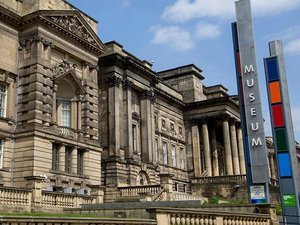
Henry Moore, 1898 – 1986

Henry Moore Paintings: The 100 Most Famous Works, Ranked

Henry Moore's most famous painting is Reclining Figure, in the Detroit Institute of Arts, Detroit. With Falling Warrior (1957) and Sculptural Objects (Cramer 47), it completes the three works everyone recognises. Our catalogue lists 492 works by Henry Moore; the 100 below are the ones the world looks at most, each with its year, the museum that holds it and why it matters.

Ranked by our popularity score, which combines the searches, visits and orders for each work. Updated October 2026.

Portrait of Henry Moore
Henry Moore · 1898 – 1986
Born · died
1898 – 1986, Castleford
Movement
Modernism
Works in our catalogue
492
Most famous
Reclining Figure
Most works at
Tate Britain

The 10 most famous Henry Moore paintings

Reclining Figure by Henry Moore
1

Reclining Figure

Wood · Detroit Institute of Arts, Detroit

Form and Materiality This elmwood carving presents an abstracted human form through sinuous lines and organic voids. The sculpture utilizes the wide grain of the wood to emphasize its undulating limbs and torso. Holes are integrated into the composition, allowing light and space to penetrate the solid mass. These openings create a relationship between the internal volume and the surrounding environment. Compositional Elements The figure features a looped head and…

Falling Warrior (1957) by Henry Moore
2

Falling Warrior

1957 · Bronze · National Museums Liverpool, Liverpool

In the quiet halls of Tate Britain, there exists a moment of profound stillness captured in bronze—a masterpiece that breathes with the weight of history and the lightness of spirit. Henry Moore’s “Falling Warrior,” created between 1956 and 1957, is far more than a mere sculpture; it is a meditation on the very nature of existence. As one approaches this monumental work, the eye is immediately drawn to the fluid,…

Sculptural Objects (Cramer 47) by Henry Moore
3

Sculptural Objects (Cramer 47)

Painting

In the vast landscape of twentieth-century modernism, few names resonate with as much tactile power and organic grace as Henry Moore. While the world often recognizes him through his monumental bronze figures that command public squares across the globe, his foray into the two-dimensional realm offers a uniquely intimate window into his creative psyche. Sculptural Objects (Cramer 47) stands as a breathtaking testament to this versatility, a painting that does…

Sheep 1 by Henry Moore
4

Sheep 1

Oil

In the quiet, evocative lines of Sheep 1, we encounter a profound moment of connection between the viewer and the natural world. This striking black and white drawing by the legendary British master Henry Moore transcends simple animal portraiture to become an exploration of form, texture, and presence. The subject—a sheep with a thick, tactile wool coat—is rendered not merely as livestock, but as a sculptural entity. With its prominent…

A Miner at Work (1942) by Henry Moore
5

A Miner at Work

1942 · Sculpture · Imperial War Museums, London

In the heavy, shadowed atmosphere of 1942, amidst the profound uncertainties of the Second World War, Henry Moore captured a moment of quiet, monumental strength in "A Miner at Work." This piece serves as much more than a mere depiction of industrial labor; it is a profound meditation on the human spirit under pressure. The artwork presents a solitary figure, a miner seated at the coal face, rendered through Moore’s…

Figure in a Shelter (1983) by Henry Moore
7

Figure in a Shelter

1983 · Sculpture Bronze · Kimbell Art Museum, Fort Worth

Henry Moore (1898-1986), a titan of twentieth-century sculpture, remains an artist whose work continues to resonate with audiences worldwide. His unwavering fascination with the human form—particularly its reclining postures—coupled with his exploration of organic shapes derived from nature—like pebbles and seashells—established him as a pioneer of abstract expressionism while simultaneously grounding his art in palpable physicality.

The Artist's Hand V (1979) by Henry Moore
8

The Artist's Hand V

1979 · Lithograph · Tate Britain, London

In the quiet intimacy of Henry Moore’s “The Artist's Hand V,” created in 1979, we are invited into a profound dialogue between the creator and his medium. This exquisite lithograph serves as more than a mere anatomical study; it is a soulful meditation on the very act of making. Through the outstretched gesture of Moore’s own hand, the artwork captures a moment of suspended animation, where the boundary between the…

Reclining Figure. Points by Henry Moore
9

Reclining Figure. Points

Bronze

In the vast landscape of twentieth-century British art, few names resonate with as much monumental authority as Henry Moore. His sculpture, Reclining Figure. Points, serves as a profound testament to his mastery of organic abstraction, a style that seeks to distill the complex vitality of the human form into its most essential, elemental shapes. Created during the late 1960s, this bronze masterpiece transcends mere representation; it is an exploration of…

Hands I (1973) by Henry Moore
10

Hands I

1973 · Lithograph · Tate Britain, London

Henry Moore's 'Hands I,' created in 1973, is more than just a lithograph depicting two hands clasped together; it’s a profound meditation on connection, vulnerability, and the enduring human need for touch. Born in Castleford, Yorkshire, in 1898, Henry Spencer Moore rose to international prominence as a sculptor, yet his exploration of form extended into printmaking with remarkable sensitivity. This particular work, rendered in stark black and white, captures an…

Henry Moore, paintings 11 to 100

Reclining Figure; Open Pose by Henry Moore
#11

Reclining Figure; Open Pose

Reclining Figure; Open Pose – A Testament to Organic Form and Quiet Contemplation Henry Moore’s “Reclining Figure; Open Pose,” created in 1982, stands as an enduring emblem of…

Two Piece Sculpture No. 7; Pipe by Henry Moore
#14

Two Piece Sculpture No. 7; Pipe

A Dance of Forms: Exploring Henry Moore’s ‘Two Piece Sculpture No. 7; Pipe’ This captivating bronze sculpture by Henry Moore exemplifies his mastery of abstract figurative form and…

Girl Seated at Desk V; and Seated Figure by Henry Moore
#16

Girl Seated at Desk V; and Seated Figure

A Moment Frozen in Gray: Exploring Henry Moore’s ‘Girl Seated at Desk V; and Seated Figure’ Henry Moore's 'Girl Seated at Desk V; and Seated Figure,' created in…

Catspaws off the Land (1885) by Henry Moore
#18

Catspaws off the Land

1885 · Tate Britain

To gaze upon Catspaws off the Land is to be gently swept away by the vast, breathing expanse of the sea meeting the steadfast embrace of the shore.…

The subjects Henry Moore painted most

The four subjects that return most often among these masterpieces, with the finest example of each.

Where to see Henry Moore's paintings

The 8 museums that hold the most of the paintings on this page.

Museum City Works by Henry Moore Paintings from this list
Tate Britain, LondonTate Britain London 3 The Artist's Hand V, Hands I, Catspaws off the Land
National Maritime Museum, LondonNational Maritime Museum London 2 Setting Nets on the Coast of North Wales, Hove-to for a Pilot
Detroit Institute of Arts, DetroitDetroit Institute of Arts Detroit 1 Reclining Figure
National Museums Liverpool, LiverpoolNational Museums Liverpool Liverpool 1 Falling Warrior
Imperial War Museums, LondonImperial War Museums London 1 A Miner at Work
Kimbell Art Museum, Fort WorthKimbell Art Museum Fort Worth 1 Figure in a Shelter
Zaragoza Museum, SaragossaZaragoza Museum Saragossa 1 Portrait of Isabel de Cistué y Nieto (Retrato de Dª Isabel de Cistué y Nieto)
Finnish National Gallery, HelsinkiFinnish National Gallery Helsinki 1 Family Group

Henry Moore's most famous painting of each decade

  1. 1940s
    A Miner at Work (1942) by Henry Moore
    #5 of 100

    A Miner at Work

    Age 42 – 51 · Imperial War Museums

    In the heavy, shadowed atmosphere of 1942, amidst the profound uncertainties of the Second World War, Henry Moore captured a moment of quiet, monumental strength in "A Miner…

  2. 1950s
    Falling Warrior (1957) by Henry Moore
    Rank 2 / 100

    Falling Warrior

    Age 52 – 61 · National Museums Liverpool

    In the quiet halls of Tate Britain, there exists a moment of profound stillness captured in bronze—a masterpiece that breathes with the weight of history and the lightness…

  3. 1970s
    The Artist's Hand V (1979) by Henry Moore
    #8 of 100

    The Artist's Hand V

    Age 72 – 81 · Tate Britain

    In the quiet intimacy of Henry Moore’s “The Artist's Hand V,” created in 1979, we are invited into a profound dialogue between the creator and his medium. This…

  4. 1980s
    Figure in a Shelter (1983) by Henry Moore
    #7 of 100

    Figure in a Shelter

    Age 82 – 88 · Kimbell Art Museum

    Henry Moore (1898-1986), a titan of twentieth-century sculpture, remains an artist whose work continues to resonate with audiences worldwide. His unwavering fascination with the human form—particularly its reclining…

Questions about Henry Moore's paintings

What is Henry Moore's most famous painting?Show the answer

Reclining Figure, Detroit Institute of Arts, Detroit. Next come Falling Warrior (1957) and Sculptural Objects (Cramer 47).

What are the top 10 paintings by Henry Moore?Show the answer

Reclining Figure, Falling Warrior, Sculptural Objects (Cramer 47), Sheep 1, A Miner at Work, Seated figure on square steps, Figure in a Shelter, The Artist's Hand V, Reclining Figure. Points and Hands I. The ranking above gives the year and the museum of each.

How many paintings did Henry Moore make?Show the answer

Our catalogue lists 492 works by Henry Moore, dated from 1942 to 1983.

Where are Henry Moore's most famous paintings?Show the answer

Most of them are in Tate Britain (London), National Maritime Museum (London) and Detroit Institute of Arts (Detroit). The table above lists the museums one by one.

When did Henry Moore paint the most famous works?Show the answer

In 1970s: 2 of the 100 works on this page date from then, among them The Artist's Hand V.

What are Henry Moore's earliest and latest famous paintings?Show the answer

The earliest on this page is A Miner at Work (1942), the latest Figure in a Shelter (1983).

What did Henry Moore paint most often?Show the answer

Scenes (22), Children (15) and Mothers (15), among the 100 works on this page.

What medium did Henry Moore use most?Show the answer

Bronze: 3 of the 100 works on this page.

Which art movement does Henry Moore belong to?Show the answer

Modernism, as the paintings on this page show.

Which Henry Moore paintings can I see at the Tate Britain?Show the answer

The Artist's Hand V, Hands I and Catspaws off the Land are among the 3 works on this page held by the Tate Britain, London.

About Henry Moore

A Life Sculpted in Form: The World of Henry Moore

Henry Spencer Moore, born in the Yorkshire mining town of Castleford in 1898, emerged as one of Britain’s most significant and internationally celebrated sculptors of the twentieth century. His journey from humble beginnings to global recognition is a testament to his unwavering dedication to artistic exploration and his profound connection to the human form and the natural world. Moore's father, a self-taught man with a passion for learning, instilled in him a belief in the power of education, steering him away from the life of a miner towards formal schooling. Even as a young boy, Moore demonstrated an innate talent for modeling clay and carving wood, foreshadowing the path his life would take. This early engagement with tactile materials laid the foundation for a career defined by three-dimensional form. His experiences growing up amidst the rolling hills of Yorkshire deeply influenced his aesthetic sensibility, imbuing his work with a sense of organic fluidity that echoes the landscape of his birthplace.

Early Influences and Artistic Development

Moore’s artistic education began at Castleford Secondary School, where his art teacher recognized and nurtured his talent. He later attended Leeds School of Art and then the Royal College of Art in London, immersing himself in the study of classical sculpture and modern movements like Cubism. However, Moore wasn't simply a follower of trends; he synthesized these influences into something uniquely his own. A pivotal moment came during a visit to Mexico in 1925, where he encountered pre-Columbian sculptures – particularly those of the Aztec civilization. The powerful simplicity and abstract forms of these works resonated deeply with Moore, liberating him from conventional representational constraints. He began to explore abstraction more fully, focusing on the human figure as a source of inspiration but moving away from strict anatomical accuracy. This period saw the development of his signature style: semi-abstract sculptures characterized by rounded, organic shapes and often featuring openings or voids that played with light and space.

The Reclining Figure and Mother and Child

Throughout his career, two recurring motifs dominated Moore’s oeuvre: the reclining figure and the mother and child. The *reclining figure*, in particular, became synonymous with his name. These sculptures are not merely depictions of the human body at rest; they are explorations of form, volume, and the relationship between the figure and its surrounding space. Their undulating curves evoke a sense of timelessness and serenity, while their often fragmented or pierced forms suggest vulnerability and resilience. The *mother and child* theme, equally prevalent in his work, speaks to universal themes of love, protection, and nurturing. Moore’s depictions of mothers and children are imbued with a profound emotional depth, capturing the intimate bond between parent and offspring. These sculptures were not idealized representations but rather honest portrayals of human connection, often reflecting the anxieties and uncertainties of the era in which they were created.

Wartime Reflections and Public Commissions

The outbreak of World War II profoundly impacted Moore’s work. He began documenting Londoners sheltering from the Blitz in the Underground stations, creating a series of powerful drawings that captured the fear, resilience, and communal spirit of the time. These *Shelter Drawings* are not only important historical documents but also demonstrate Moore's ability to translate his sculptural sensibility into two-dimensional form. After the war, Moore received numerous public commissions, allowing him to create large-scale sculptures for schools, hospitals, and civic spaces. He believed that art should be accessible to all and actively sought opportunities to integrate his work into everyday life. These monumental bronzes became landmarks, transforming urban landscapes and inspiring generations of artists and viewers. His ability to fulfill these grand projects while remaining true to his artistic vision solidified his reputation as a leading figure in modern sculpture.

Legacy and Enduring Influence

Henry Moore’s influence on twentieth-century art is undeniable. He paved the way for subsequent generations of sculptors, challenging conventional notions of form and space and demonstrating the power of abstraction. His work continues to resonate with audiences today, inspiring awe and contemplation. In 1977, Moore established the Henry Moore Foundation, ensuring that his legacy would endure through education and the promotion of the arts. The foundation supports artists, scholars, and institutions worldwide, furthering Moore’s commitment to fostering creativity and artistic innovation. His sculptures stand as enduring monuments to human ingenuity and a testament to the transformative power of art. Moore’s work remains a powerful reminder of the enduring human spirit and the beauty that can be found in even the most challenging circumstances.

All 492 works by Henry Moore →