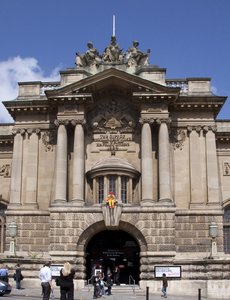
Henry Lamb, 1883 – 1960

Henry Lamb: The 100 Most Famous Paintings

William Loudon Mollison (1851–1929), Master (1915–1929) (1926) is the most famous painting by Henry Lamb, held by the Clare College in Cambridge. Henry Lamb (1950) and Major Mahomed Akbar Khan, Commanding Officer, 29 Mule Coy, Royal Indian Army Service Corps (1941) are the next two works the world knows best. From the 126 works of Henry Lamb in our catalogue, here are the 100 that collectors and museum visitors look at most, with the year, the museum and the story of each.

Ranked by our popularity score, which combines the searches, visits and orders for each work. Updated October 2026.

Portrait of Henry Lamb
Henry Lamb · 1883 – 1960
Born · died
1883 – 1960, Adelaide
Movement
Post-impressionism
Works in our catalogue
126
Most famous
William Loudon Mollison (1851–1929), Master (1915–1929) (1926)
Most works at
Government Art Collection

Top 10: Henry Lamb's best-known paintings

William Loudon Mollison (1851–1929), Master (1915–1929) (1926) by Henry Lamb
1

William Loudon Mollison (1851–1929), Master (1915–1929)

1926 · Oil On Canvas · Clare College, Cambridge

The air in the room seems to settle around the figure of William Loudon Mollison, a man whose presence commands a silent respect. He sits before us, a scholar and a leader, his gaze meeting the viewer with a steady, contemplative weight. There is a profound stillness in his expression, a sense of a mind occupied by the complexities of life and the responsibilities of his station. The portrait captures…

Ernest George Hardy (1852–1925) (1925) by Henry Lamb
4

Ernest George Hardy (1852–1925)

1925 · Oil On Canvas · Jesus College, Oxford

Henry Lamb's 1925 oil on canvas, “Ernest George Hardy,” is more than just a likeness; it’s a carefully constructed meditation on age, experience, and the quiet dignity of a life well-lived. The painting immediately draws the viewer in with its warm, earthy palette dominated by rich reds, deep browns, and subtle greens – colors that evoke both the warmth of a hearth and the somber hues of twilight. Lamb masterfully…

Sir Michael Ernest Sadler (1861–1943), KCSI, CB, LLD, DLitt, Vice Chancellor of the University of Leeds (1911–1923) (1924) by Henry Lamb
5

Sir Michael Ernest Sadler (1861–1943), KCSI, CB, LLD, DLitt, Vice Chancellor of the University of Leeds (1911–1923)

1924 · Painting · The Stanley - Audrey Burton Gallery, Leeds

This compelling painting captures Sir Michael Ernest Sadler, a figure synonymous with intellectual gravity and institutional authority during the early twentieth century. The subject is rendered with a palpable sense of presence; he stands poised near an open doorway, a compositional choice that immediately suggests transition—a moment caught between one space and another, much like a pivotal academic career itself. Dressed in the formal attire of his time, complete with…

Ernest Alfred Benians (1880–1952), Fellow, Master (1933) (1944) by Henry Lamb
6

Ernest Alfred Benians (1880–1952), Fellow, Master (1933)

1944 · Oil On Canvas · st John's College, Cambridge

This compelling portrait captures Ernest Alfred Benians in 1944, presenting him as an embodiment of learned authority. The subject is seated formally, dressed in the sober attire of a gentleman accustomed to intellectual pursuits—a suit and tie that speak of established convention. His posture, with hands crossed over his lap, suggests contemplation and quiet confidence. He occupies the foreground, grounded by the sturdy presence of the chair upon which he…

The rest of the Henry Lamb ranking, 11 to 100

The Overhaul (1941) by Henry Lamb
#26

The Overhaul

1941

In the evocative oil painting The Overhaul, created in 1941 by the versatile Henry Lamb, we are transported into the heart of a bustling hangar, where the raw…

A Bristol Committee (1921) by Henry Lamb
#30

A Bristol Committee

1921 · Bristol Museum - Art Gallery

Henry Lamb's "A Bristol Committee," painted in 1921, isn’t merely a depiction of a boardroom meeting; it’s a carefully constructed tableau of power, deliberation, and the quiet weight…

Trooper Juneau, Canadian Forces (1941) by Henry Lamb
#31

Trooper Juneau, Canadian Forces

1941 · Government Art Collection

In the quiet intensity of Trooper Juneau, Canadian Forces, we are invited into a moment of profound stillness amidst the turbulence of 1941. This evocative portrait by the…

Bombardier Olg, Canadian Forces (1942) by Henry Lamb
#33

Bombardier Olg, Canadian Forces

1942 · Government Art Collection

In the quiet gravity of 1942, amidst the global upheaval of the Second World War, Henry Lamb captured more than just a likeness; he captured a soul at…

Manon (1946) by Henry Lamb
#34

Manon

1946 · Arts Council Collection

In the quiet intimacy of Henry Lamb’s 1946 portrait, Manon, we encounter more than just a painted figure; we step into a poignant echo of the Belle Époque.…

Mrs Kennedy (1938) by Henry Lamb
#35

Mrs Kennedy

1938 · William Evans Bequest

A Glimpse into Grace: Henry Lamb's Portrait of Mrs. Kennedy Henry Lamb’s “Mrs. Kennedy,” painted in 1938, is more than just a portrait; it’s a window into an…

Breton Youth (1910) by Henry Lamb
#50

Breton Youth

1910 · Bolton Museum And Art Gallery

Breton Youth: A Portrait of Quiet Dignity Amidst Impressionistic Shadows Henry Lamb’s “Breton Youth,” completed in 1910, stands as a testament to the enduring power of portraiture and…

Corporal Albert Bull, 40th Battalion RTR (1941) by Henry Lamb
#63

Corporal Albert Bull, 40th Battalion RTR

1941 · Government Art Collection

In the quiet intensity of Corporal Albert Bull, 40th Battalion RTR, we are invited into a profound encounter with a man caught between the duties of war and…

The subjects Henry Lamb painted most

The four subjects that return most often among these masterpieces, with the finest example of each.

Where to see Henry Lamb's paintings

The 8 museums that hold the most of the paintings on this page.

Museum City Works by Henry Lamb Paintings from this list
Government Art Collection, LondonGovernment Art Collection London 10 A Spotter, Heavy AA, Canadian Forces, Trooper Owen, 40th Battalion RTR, Trooper Juneau, Canadian Forces
Balliol College, OxfordBalliol College Oxford 2 Kenneth Norman Bell (1884–1951), Scholar (1903), Fellow and Tutor in Modern History (1919–1941), Founding Secretary of the Balliol Society (1927–1950), George Lawrence Kennedy (1882–1954), Commoner (1901), Designed and Built Holywell Manor (1931–1932)
Bristol Museum - Art Gallery, BristolBristol Museum - Art Gallery Bristol 2 A Bristol Committee, Pay at the Canadian Armoured Division
Wadham College, OxfordWadham College Oxford 2 Lady Pansey Lamb, née Pakenham (1904–1999), Interior Designer
Fitzwilliam College, CambridgeFitzwilliam College Cambridge 2 Lytton Strachey
Clare College, CambridgeClare College Cambridge 1 William Loudon Mollison (1851–1929), Master (1915–1929)
Jesus College, OxfordJesus College Oxford 1 Ernest George Hardy (1852–1925)
The Stanley - Audrey Burton Gallery, LeedsThe Stanley - Audrey Burton Gallery Leeds 1 Sir Michael Ernest Sadler (1861–1943), KCSI, CB, LLD, DLitt, Vice Chancellor of the University of Leeds (1911–1923)

Henry Lamb through the decades: one masterpiece for each

  1. 1900s
  2. 1910s
  3. 1920s
  4. 1930s
  5. 1940s
  6. 1950s

Henry Lamb's paintings: frequently asked questions

What is the most famous Henry Lamb painting?Show the answer

William Loudon Mollison (1851–1929), Master (1915–1929) (1926), Clare College, Cambridge. Next come Henry Lamb (1950) and Major Mahomed Akbar Khan, Commanding Officer, 29 Mule Coy, Royal Indian Army Service Corps (1941).

At what age did Henry Lamb paint William Loudon Mollison (1851–1929), Master (1915–1929)?Show the answer

43 years old: William Loudon Mollison (1851–1929), Master (1915–1929) dates from 1926 and Henry Lamb was born in 1883.

Which are the 10 most famous Henry Lamb paintings?Show the answer

William Loudon Mollison (1851–1929), Master (1915–1929), Henry Lamb, Major Mahomed Akbar Khan, Commanding Officer, 29 Mule Coy, Royal Indian Army Service Corps, Ernest George Hardy (1852–1925), Sir Michael Ernest Sadler (1861–1943), KCSI, CB, LLD, DLitt, Vice Chancellor of the University of Leeds (1911–1923), Ernest Alfred Benians (1880–1952), Fellow, Master (1933), Francis Jones, 75, High Street, Poole, Dorset, Robert Ranulph Marett (1866–1943) and A Spotter, Heavy AA, Canadian Forces. The ranking above gives the year and the museum of each.

How many paintings by Henry Lamb are there?Show the answer

Our catalogue lists 126 works by Henry Lamb, dated from 1909 to 1950.

Where can I see the most famous Henry Lamb paintings?Show the answer

Most of them are in Government Art Collection (London), Balliol College (Oxford) and Bristol Museum - Art Gallery (Bristol). The table above lists the museums one by one.

In which period did Henry Lamb paint the best-known works?Show the answer

In 1940s: 57 of the 100 works on this page date from then, among them Major Mahomed Akbar Khan, Commanding Officer, 29 Mule Coy, Royal Indian Army Service Corps.

What is the earliest famous Henry Lamb painting, and the latest?Show the answer

The earliest on this page is Thundery Weather, Kennack Sands (1909), the latest Henry Lamb (1950).

What subjects did Henry Lamb paint?Show the answer

Portrait (15), Portraiture (7) and British art (6), among the 100 works on this page.

What did Henry Lamb paint on, and with what?Show the answer

Oil On Canvas: 11 of the 100 works on this page.

Which movement does Henry Lamb's art belong to?Show the answer

Post-impressionism and Contemporary realism, as the paintings on this page show.

What Henry Lamb paintings does the Government Art Collection hold?Show the answer

A Spotter, Heavy AA, Canadian Forces, Trooper Owen, 40th Battalion RTR and Trooper Juneau, Canadian Forces are among the 9 works on this page held by the Government Art Collection, London.

Henry Lamb: biography

A Life Bridging Continents and Eras

Henry Lamb, born in Adelaide, Australia, in 1883, was an artist whose life unfolded as a fascinating intersection of cultures and historical upheaval. The son of Sir Horace Lamb, a renowned mathematician, young Henry’s early years were steeped in intellectual stimulation. However, his path diverged from the purely academic when the family relocated to Manchester, England, in 1885—a move that proved pivotal, exposing him to a burgeoning artistic scene that would ultimately claim his allegiance. Initially pursuing medical studies at both Manchester University and Guy's Hospital, Lamb found himself increasingly drawn to the world of art, an irresistible pull he could no longer deny. By 1906, he decisively abandoned medicine, enrolling at Chelsea School of Art under the tutelage of Augustus John and William Orpen—a decision that would define his creative destiny. Subsequent studies at the Académie de la Palette in Paris further honed his skills, immersing him in the avant-garde currents of early 20th-century European art and introducing him to influential figures like Jean Metzinger and Henri Le Fauconnier.

Formative Influences and Artistic Awakening

The influence of Augustus John on Lamb’s artistic development was profound. John's emphasis on drawing from life, a direct lineage from the Slade School tradition, instilled in Lamb a commitment to observation and expressive line work. This foundation became central to his unique style—a style that favored capturing the essence of a subject rather than mere photographic representation. Lamb’s early years were also deeply intertwined with the bohemian circles of London, where he encountered and befriended prominent figures like Lytton Strachey, whose penetrating portrait would become one of Lamb's most celebrated achievements. His relationship with Nina Forrest, known affectionately as “Euphemia,” proved equally significant; she became his muse, model, and a constant source of inspiration—a figure who embodied the spirit of artistic freedom and unconventional beauty that permeated the era. Lamb’s involvement in the Camden Town Group in 1911 and later the London Group in 1913 solidified his position within the progressive art movement challenging conventional artistic norms. These groups provided a platform for experimentation and fostered a spirit of collaboration that shaped Lamb's evolving aesthetic, pushing him to explore new forms of expression and challenge established conventions.

War, Witness, and Remembrance

The outbreak of World War I dramatically altered the course of Lamb’s life. Returning to his medical training, he served as a battalion medical officer with the 5th Battalion, Royal Inniskilling Fusiliers, witnessing firsthand the horrors of conflict. Awarded the Military Cross for his bravery, Lamb was also appointed an official war artist, tasked with documenting the realities of warfare. This dual role—healer and observer—profoundly impacted his artistic vision. His wartime paintings, such as “Irish Troops in the Judaean Hills Surprised by a Turkish Bombardment,” are not merely depictions of battle but poignant reflections on the psychological toll of war, capturing moments of vulnerability and unexpected beauty amidst chaos. These works stand as powerful testaments to the human cost of conflict and remain significant historical documents—a stark reminder of the brutality and senselessness of war. The experience imbued his work with a newfound depth and emotional resonance, forever shaping his artistic perspective.

A Legacy in Portraiture and Beyond

While Lamb’s wartime experiences left an indelible mark on his work, he is perhaps best known for his evocative portraits. He possessed a remarkable ability to capture not just the physical likeness but also the inner character of his subjects—their thoughts, their emotions, their very souls. His portrait of Lytton Strachey, with its penetrating gaze and psychological depth, remains a masterpiece of 20th-century British portraiture. Throughout his career, Lamb continued to paint portraits, extending his practice to include high-ranking military commanders during World War II. His later years saw him appointed a Trustee of both the National Portrait Gallery and the Tate Gallery, demonstrating his respected position within the art world. Elected an Associate of the Royal Academy in 1940 and a full member in 1949, Lamb continued to paint until arthritis curtailed his ability to work. He died in 1960, leaving behind a rich artistic legacy that continues to resonate with audiences today. His contribution lies not only in his technical skill but also in his profound sensitivity to the human condition and his ability to translate complex emotions onto canvas. Lamb’s art serves as a compelling reminder of the power of observation, empathy, and the enduring relevance of portraiture.

Key Characteristics & Artistic Style

  • Expressive Line Work: Heavily influenced by Augustus John, Lamb’s work is characterized by a dynamic and expressive use of line, creating a sense of movement and energy.
  • Psychological Depth: His portraits are renowned for their ability to capture the inner lives of his subjects, revealing their personalities and emotions with remarkable sensitivity.
  • Post-Impressionist Influences: While rooted in traditional techniques, Lamb’s work also exhibits elements of Post-Impressionism, particularly in his use of color and form.
  • War Art as Testimony: His wartime paintings are not simply depictions of conflict but powerful statements about the human cost of war, imbued with a sense of empathy and realism.
  • Bohemian Spirit: Lamb’s association with the Camden Town Group and his personal life reflect a bohemian spirit—a rejection of conventional norms and an embrace of artistic freedom.

All 126 works by Henry Lamb →