Henri Lebasque, 1865 – 1937

Henri Lebasque: The 100 Most Famous Paintings

Street by the Port at Collioure (1921) is the most famous painting by Henri Lebasque. Young woman on a hammock (1923) and On the Beach (1921) are the next two works the world knows best. From the 539 works of Henri Lebasque in our catalogue, here are the 100 that collectors and museum visitors look at most, with the year, the museum and the story of each.

Ranked by our popularity score, which combines the searches, visits and orders for each work. Updated October 2026. Every masterpiece on this page can be ordered as a museum-quality, hand-painted oil reproduction or a fine art print, at the size you choose.

Portrait of Henri Lebasque
Henri Lebasque · 1865 – 1937
Born · died
1865 – 1937, Champigné
Movement
Post-impressionism
Works in our catalogue
539
Most famous
Street by the Port at Collioure (1921)
Most works at
Wallraf-Richartz-Museum

Top 10: Henri Lebasque's best-known paintings

Street by the Port at Collioure (1921) by Henri Lebasque
1

Street by the Port at Collioure

1921 · Oil

In this 1921 work, we find ourselves standing at the edge of a quiet harbor, looking out toward the water. The scene captures a narrow street leading down to the port, where the architecture of the town meets the movement of the sea. Several boats are scattered throughout the harbor, their forms resting upon the water, while small figures move along the waterfront. There is a sense of a lived-in…

Young woman on a hammock (1923) by Henri Lebasque
2

Young woman on a hammock

1923 · Oil On Canvas

Sunlight filters through a dense canopy of leaves, casting dappled patterns across a secluded garden. In the center of this lush sanctuary, a young woman reclines within the gentle embrace of a hammock. The fabric, marked by distinct stripes of red, yellow, and blue, sways almost imperceptibly between two sturdy trees. She rests in a state of profound contentment, her body softly contoured by the weight of her repose. Around…

On the Beach (1921) by Henri Lebasque
3

On the Beach

1921 · Oil On Canvas

On the Beach is an oil on canvas by the French artist Henri Lebasque. Created about 1921, the work reflects the artist's established interest in the interplay of light and leisure. Lebasque, born in Champigné, France, developed a style characterized by a natural brush-stroke and a focus on the serene atmosphere of the outdoors.

The rest of the Henri Lebasque ranking, 11 to 100

The Siesta (1923) by Henri Lebasque
#32

The Siesta

1923

To gaze upon Henri Lebasque's The Siesta is to be instantly transported to a moment suspended in golden, languid time. This oil-on-canvas masterpiece, painted in 1923, captures the…

Commission a hand-painted copy →
Garden with Urn (1913) by Henri Lebasque
#39

Garden with Urn

1913

To gaze upon Henri Lebasque’s Garden with Urn is to step through a veil and into a moment of perfect, sun-drenched tranquility. This painting, executed in 1913, is…

Bring it home →
Women Sewing (1922) by Henri Lebasque
#40

Women Sewing

1922

To gaze upon Henri Lebasque's "Women Sewing" is to be instantly transported to a sun-drenched afternoon by the gentle rhythm of the sea. This painting captures more than…

Commission a hand-painted copy →
Street in Lagny, in Chessy (1906) by Henri Lebasque
#41

Street in Lagny, in Chessy

1906

To gaze upon Henri Lebasque's Street in Lagny, in Chessy is to step through a veil of time and into a moment suspended in perfect, sun-dappled tranquility. This…

Bring it home →
Woman in a White Dress (1923) by Henri Lebasque
#46

Woman in a White Dress

1923

To gaze upon Henri Lebasque’s "Woman in a White Dress" is to step across the threshold into a moment suspended in time—a breath held just before the world…

Bring it home →

Henri Lebasque's paintings by period

The subjects Henri Lebasque painted most

The four subjects that return most often among these masterpieces, with the finest example of each.

Where to see Henri Lebasque's paintings

The 2 museums that hold the most of the paintings on this page.

Museum City Works by Henri Lebasque Paintings from this list
Wallraf-Richartz-Museum, CologneWallraf-Richartz-Museum Cologne 3 Village of Champigne
Museo de Arte de Ponce, PonceMuseo de Arte de Ponce Ponce 1 Young Girls in a Wood

Henri Lebasque through the decades: one masterpiece for each

  1. 1880s
  2. 1890s
  3. 1900s
  4. 1910s
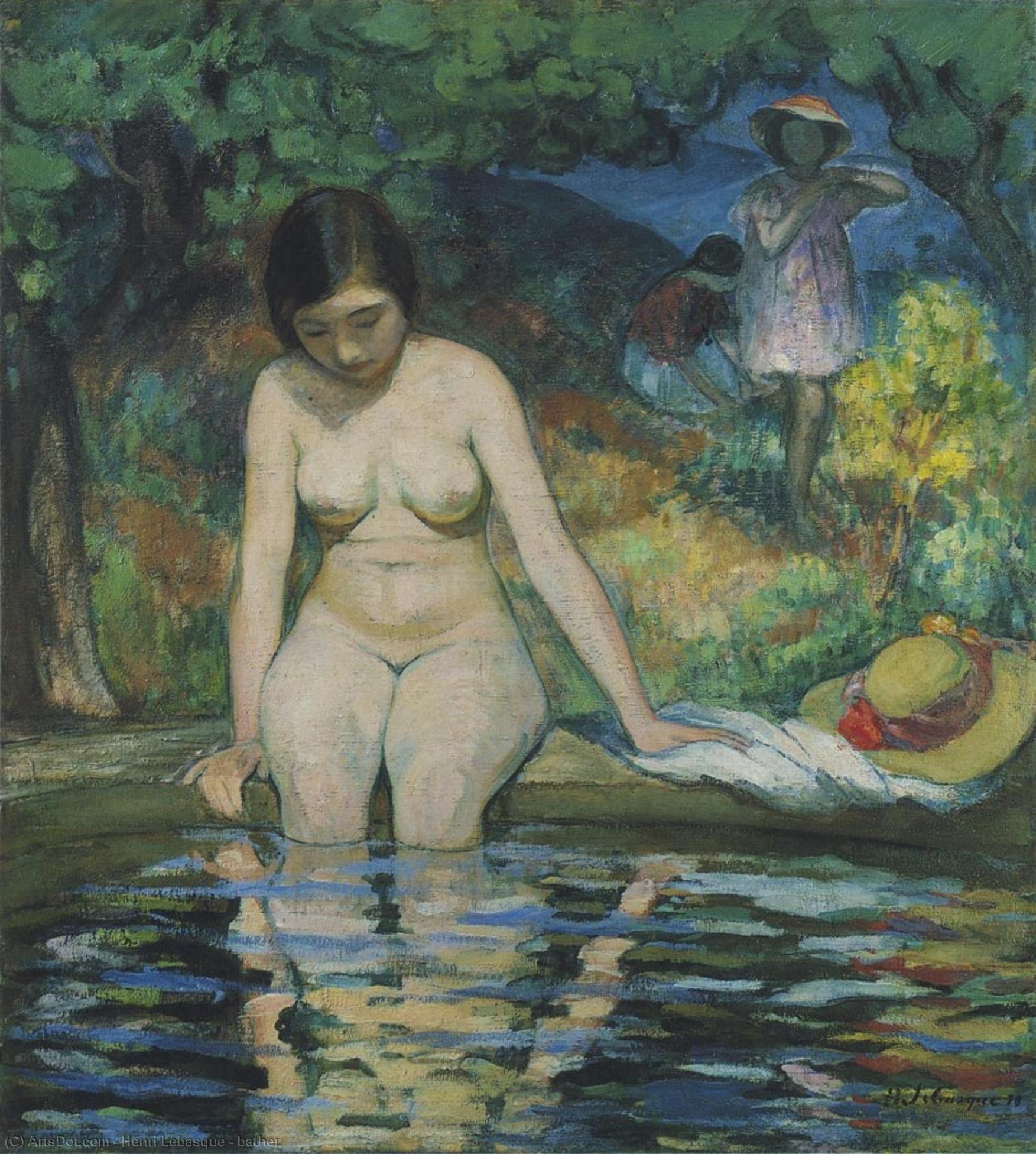
    bather (1910) by Henri Lebasque
    Rank 6 / 100

    bather

    Age 45 – 54
  5. 1920s
    Street by the Port at Collioure (1921) by Henri Lebasque
    #1 of 100

    Street by the Port at Collioure

    Age 55 – 64

    In this 1921 work, we find ourselves standing at the edge of a quiet harbor, looking out toward the water. The scene captures a narrow street leading down…

Henri Lebasque's paintings: frequently asked questions

What is the most famous Henri Lebasque painting?Show the answer

Street by the Port at Collioure (1921). Next come Young woman on a hammock (1923) and On the Beach (1921).

At what age did Henri Lebasque paint Street by the Port at Collioure?Show the answer

56 years old: Street by the Port at Collioure dates from 1921 and Henri Lebasque was born in 1865.

Which are the 10 most famous Henri Lebasque paintings?Show the answer

Street by the Port at Collioure, Young woman on a hammock, On the Beach, Girls in the Garden, In the Flowers, bather, Summer Afternoon at Frejus, Bathers at a fountain in Saint Tropez, Woman in a Boat with an Umbrella and Blue Reflection in the Fountain at Pradet. The ranking above gives the year and the museum of each.

How many paintings by Henri Lebasque are there?Show the answer

Our catalogue lists 539 works by Henri Lebasque, dated from 1886 to 1926.

Where can I see the most famous Henri Lebasque paintings?Show the answer

Most of them are in Wallraf-Richartz-Museum (Cologne) and Museo de Arte de Ponce (Ponce). The table above lists the museums one by one.

In which period did Henri Lebasque paint the best-known works?Show the answer

In 1900s: 41 of the 100 works on this page date from then, among them Girls in the Garden.

What is the earliest famous Henri Lebasque painting, and the latest?Show the answer

The earliest on this page is Reading in the Garden (1886), the latest Blue Mountains in Cannes (1926).

What subjects did Henri Lebasque paint?Show the answer

Rivers (13), Women (12) and Girls (9), among the 100 works on this page.

What did Henri Lebasque paint on, and with what?Show the answer

Oil On Canvas: 13 of the 100 works on this page.

Which movement does Henri Lebasque's art belong to?Show the answer

Post-impressionism and Impressionism, as the paintings on this page show.

Where can I buy a Henri Lebasque reproduction?Show the answer

Yes. Every painting on this page can be ordered as a museum-quality, hand-painted oil reproduction or a fine art print, in the size you choose, from the painting's own page.

Henri Lebasque: biography

A Painter of Joy and Light: The Life and Art of Henri Lebasque

Henri Lebasque, a name perhaps less immediately recognized than some of his Post-Impressionist contemporaries, nevertheless occupies a significant place in the artistic landscape of early 20th-century France. Born in Champigné, Maine-et-Loire, in 1865, Lebasque’s journey toward becoming a celebrated painter was one marked by diligent study, evolving influences, and an unwavering commitment to capturing beauty in everyday life. His early education at the École régionale des beaux-arts d'Angers provided a foundational grounding, but it was his move to Paris in 1886 that truly ignited his artistic development. There, under the tutelage of Léon Bonnat and through assisting Ferdinand Humbert with decorative murals at the Panthéon, he honed his technical skills while immersing himself in the vibrant Parisian art scene. This period proved crucial, bringing him into contact with pivotal figures like Camille Pissarro and Auguste Renoir, whose emphasis on light and color would profoundly shape his aesthetic sensibilities.

Embracing Intimacy: Influences and Artistic Development

Lebasque’s artistic trajectory wasn't solely defined by the established masters; it was equally influenced by a younger generation of artists pushing the boundaries of painting. His association with Les Nabis, particularly Édouard Vuillard and Pierre Bonnard, proved transformative. These Intimist painters prioritized domestic scenes and intimate moments, fostering in Lebasque a similar inclination toward capturing the quiet poetry of everyday existence. The Nabis’ emphasis on flattened forms, decorative patterns, and subtle color harmonies resonated deeply with his own artistic inclinations. Simultaneously, exposure to the theories of Georges Seurat and Paul Signac introduced him to the principles of Chromoluminarism – the scientific application of complementary colors to create luminous effects. This knowledge became a cornerstone of his technique, allowing him to imbue his canvases with an extraordinary vibrancy and sense of light. He wasn’t merely replicating what he saw; he was interpreting it through a lens of color and emotion, creating scenes that felt both familiar and dreamlike.

A Palette of Serenity: Themes and Techniques

The hallmark of Lebasque's work lies in its serene atmosphere and harmonious palette. He found inspiration in the simple pleasures of life – family portraits, leisurely moments in gardens, landscapes bathed in sunlight. His paintings are not grand historical narratives or dramatic allegories; instead, they offer glimpses into intimate domesticity and the beauty of the natural world. Madame Lebasque and Her Daughters, for example, exemplifies his ability to capture a tender moment with remarkable grace and sensitivity. The figures are rendered with soft brushstrokes and bathed in warm light, creating an atmosphere of peaceful contentment. His technique involved building up layers of thin, translucent paint, allowing the underlying colors to shimmer through, resulting in a luminous quality that is characteristic of his style. He skillfully employed complementary color pairings – blues and oranges, reds and greens – to create visual excitement while maintaining an overall sense of harmony. Works like Rest on the Banks of the Yaudet demonstrate his mastery of landscape painting, capturing the tranquility of nature with a delicate touch.

Legacy and Recognition: A Lasting Impression

Throughout his career, Lebasque enjoyed considerable success, participating in prestigious exhibitions such as the Salon d'Automne – which he helped found alongside Henri Matisse – and the Salon des Indépendants. He even received commissions for decorative projects, including work at the Champs-Élysées theatre and on transatlantic liners. His paintings are now held in numerous prominent museum collections, including the Musée d’Orsay in Paris, the Petit Palais in Geneva, and museums in Lille and Nantes, attesting to his enduring artistic significance. While perhaps not as widely celebrated as some of his more avant-garde contemporaries, Henri Lebasque's contribution to Post-Impressionism is undeniable. He offered a unique vision – one that prioritized beauty, harmony, and the quiet joys of everyday life. His paintings continue to resonate with viewers today, offering a welcome respite from the complexities of the modern world and reminding us of the enduring power of art to uplift and inspire.

Exploring Lebasque’s World Today

For those seeking to delve deeper into the world of Henri Lebasque, resources abound. Online databases like WahooArt offer a comprehensive collection of his works, alongside biographical information and insights into his artistic process. Museum websites, such as that of the Musée d'Orsay, provide access to digitized collections and scholarly articles. Furthermore, platforms dedicated to art history, like Wikipedia and Artnet, offer valuable context and analysis of his career. The enduring appeal of Lebasque’s work lies in its ability to transport viewers to a realm of serenity and beauty – a testament to the power of art to transcend time and connect us to something truly timeless.

All 539 works by Henri Lebasque →