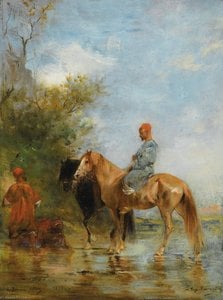
Eugène Fromentin, 1820 – 1876

Eugène Fromentin Paintings: The 69 Most Famous Works, Ranked

Eugène Fromentin's most famous painting is Women of the Ouled Nayls (1867), in the Art Institute of Chicago, Chicago. With Souvenir of Ezneh, Upper Egypt (1876) and Moorish Burial (1853), it completes the three works everyone recognises. Our catalogue lists 69 works by Eugène Fromentin; the 69 below are the ones the world looks at most, each with its year, the museum that holds it and why it matters.

Ranked by our popularity score, which combines the searches, visits and orders for each work. Updated October 2026. Every masterpiece on this page can be ordered as a museum-quality, hand-painted oil reproduction or a fine art print, at the size you choose.

Portrait of Eugène Fromentin
Eugène Fromentin · 1820 – 1876
Born · died
1820 – 1876, La Rochelle
Movement
Orientalism
Works in our catalogue
69
Most famous
Women of the Ouled Nayls (1867)
Most works at
Musée d'Orsay

The 10 most famous Eugène Fromentin paintings

Women of the Ouled Nayls (1867) by Eugène Fromentin
1

Women of the Ouled Nayls

1867 · Oil On Canvas · Art Institute of Chicago, Chicago

In this 1867 oil on canvas, we find ourselves within an enclosed Algerian courtyard, observing a group of Ouled Nayls women during a moment of repose. The composition uses the high, rugged walls of the setting to create a sense of deep enclosure, pulling the viewer into a private, shadowed space. Light enters the scene with a heavy, directional quality, characteristic of late afternoon or twilight. This light catches the…

Souvenir of Ezneh, Upper Egypt (1876) by Eugène Fromentin
2

Souvenir of Ezneh, Upper Egypt

1876 · Oil On Canvas · Musée d'Orsay, Paris

This work, titled Souvenir of Ezneh, Upper Egypt, was painted by Eugène Fromentin in 1876. It is a piece that captures a specific moment of observation, reflecting the artist's deep engagement with the landscapes and people of the region. The composition focuses on a quiet scene along the riverbank, rendered with a sense of stillness that defines much of Fromentin's output from this period.

Eugène Fromentin, paintings 11 to 69

Arabian Horses (1850) by Eugène Fromentin
#17

Arabian Horses

1850 · Art Institute of Chicago

In this 1850 oil painting, a monochromatic scene unfolds across a vast, rolling landscape under a sky filled with soft clouds. The composition centers on a light-colored horse…

Commission a hand-painted copy →
A Fantasia, Algeria (1869) by Eugène Fromentin
#18

A Fantasia, Algeria

1869 · Musée d'Orsay

A Fantasia, Algeria is an oil on canvas painting by Eugène Fromentin. Created in 1869, this work captures a specific moment of movement and tension within the North…

Bring it home →

The subjects Eugène Fromentin painted most

The four subjects that return most often among these masterpieces, with the finest example of each.

Where to see Eugène Fromentin's paintings

The 8 museums that hold the most of the paintings on this page.

Museum City Works by Eugène Fromentin Paintings from this list
Musée d'Orsay, ParisMusée d'Orsay Paris 5 Souvenir of Ezneh, Upper Egypt, The country's thirst, A Fantasia, Algeria
Art Institute of Chicago, ChicagoArt Institute of Chicago Chicago 3 Women of the Ouled Nayls, Arabian Horses, On the Nile, Near Philae
Museum of Fine Arts, BostonMuseum of Fine Arts Boston 3 Standard Bearer, North African Landscape, Khan in Algiers
National Gallery of Ireland, Dublin CityNational Gallery of Ireland Dublin City 3 L'Incendie, Crossing the Ford, Algeria, Falcon Hunt ('Algeria Remembered')
Metropolitan Museum of Art, New YorkMetropolitan Museum of Art New York 2 The Arab Falconer, Arabs Crossing a Ford
Minneapolis Institute of Art, MinneapolisMinneapolis Institute of Art Minneapolis 2 Orientals, An Arabian Camp
Walters Art Museum, BaltimoreWalters Art Museum Baltimore 2 At the Well, An Encampment in the Atlas Mountains
Museum of Fine Arts Ghent (MSK), GhentMuseum of Fine Arts Ghent (MSK) Ghent 2 Horsemen at the Foot of the Chiffa Cliffs, Lion hunting

Eugène Fromentin's most famous painting of each decade

  1. 1840s
  2. 1850s
  3. 1860s
    Women of the Ouled Nayls (1867) by Eugène Fromentin
    #1 of 69

    Women of the Ouled Nayls

    Age 40 – 49 · Art Institute of Chicago

    In this 1867 oil on canvas, we find ourselves within an enclosed Algerian courtyard, observing a group of Ouled Nayls women during a moment of repose. The composition…

  4. 1870s
    Souvenir of Ezneh, Upper Egypt (1876) by Eugène Fromentin
    #2 of 69

    Souvenir of Ezneh, Upper Egypt

    Age 50 – 56 · Musée d'Orsay

    This work, titled Souvenir of Ezneh, Upper Egypt, was painted by Eugène Fromentin in 1876. It is a piece that captures a specific moment of observation, reflecting the…

Questions about Eugène Fromentin's paintings

What is Eugène Fromentin's most famous painting?Show the answer

Women of the Ouled Nayls (1867), Art Institute of Chicago, Chicago. Next come Souvenir of Ezneh, Upper Egypt (1876) and Moorish Burial (1853).

How old was Eugène Fromentin when Women of the Ouled Nayls was painted?Show the answer

47 years old: Women of the Ouled Nayls dates from 1867 and Eugène Fromentin was born in 1820.

What are the top 10 paintings by Eugène Fromentin?Show the answer

Women of the Ouled Nayls, Souvenir of Ezneh, Upper Egypt, Moorish Burial, Falconry in Algeria, Standard Bearer, The Arab Chief, Stop of Arab Riders in the Plain, Centaurs, L'Incendie and Before the Race: Fantasia or The Halt in the Desert. The ranking above gives the year and the museum of each.

How many paintings did Eugène Fromentin make?Show the answer

Our catalogue lists 69 works by Eugène Fromentin, dated from 1847 to 1876.

Where are Eugène Fromentin's most famous paintings?Show the answer

Most of them are in Musée d'Orsay (Paris), Art Institute of Chicago (Chicago) and Museum of Fine Arts (Boston). The table above lists the museums one by one.

When did Eugène Fromentin paint the most famous works?Show the answer

In 1860s: 21 of the 69 works on this page date from then, among them Women of the Ouled Nayls.

What are Eugène Fromentin's earliest and latest famous paintings?Show the answer

The earliest on this page is Arabian Encampment (1847), the latest Souvenir of Ezneh, Upper Egypt (1876).

What did Eugène Fromentin paint most often?Show the answer

Landscape (8), Sky (5) and Horse (4), among the 69 works on this page.

What medium did Eugène Fromentin use most?Show the answer

Oil On Canvas: 5 of the 69 works on this page.

Which art movement does Eugène Fromentin belong to?Show the answer

Orientalism and Romanticism, as the paintings on this page show.

Which Eugène Fromentin paintings can I see at the Musée d'Orsay?Show the answer

Souvenir of Ezneh, Upper Egypt, The country's thirst and A Fantasia, Algeria are among the 5 works on this page held by the Musée d'Orsay, Paris.

Can I buy a reproduction of a Eugène Fromentin painting?Show the answer

Yes. Every painting on this page can be ordered as a museum-quality, hand-painted oil reproduction or a fine art print, in the size you choose, from the painting's own page.

About Eugène Fromentin

The Visionary of the Sahara: The Life and Legacy of Eugène Fromentin

Eugène Fromentin stands as a pivotal figure in French Orientalist painting, yet his legacy extends far beyond mere visual representation. Born in La Rochelle, France, in 1820, he embarked on an artistic journey marked by early exposure to landscape painting under the guidance of Louis Cabat. This foundational training propelled him toward a profound engagement with the vibrant culture of Algeria—a fascination that would define both his oeuvre and his intellectual pursuits. More than just capturing picturesque vistas, Fromentin sought to distill the essence of Algerian life, blending meticulous observation with expressive brushstrokes to create images imbued with a palpable, breathing atmosphere.

Fromentin’s artistic breakthrough arrived in 1847 with “Les gorges de la Chiffa,” a monumental canvas that immediately garnered acclaim at the Paris Salon and established him as one of the foremost interpreters of Algeria's dramatic topography. His connection to North Africa was not merely academic; through travels such as his 1852 mission accompanying an archaeological expedition, he achieved an intimate knowledge of the land. This firsthand experience allowed him to capture the rugged beauty of the Sahara Desert with remarkable accuracy, documenting its flora, fauna, and the nuanced habits of its people. His work often serves as a window into a world of light and shadow, where the heat of the desert and the resilience of human life are rendered with striking realism.

Mastery of Light and Orientalist Realism

The brilliance of Fromentin’s technique lies in his ability to blend elements of Orientalism and Romanticism. His paintings, such as “The Arab Falconer” and “Arabs Crossing a Ford,” exemplify a distinctive style characterized by luminous color palettes and dynamic compositions. Influenced deeply by the Romantic fervor of Eugène Delacroix, Fromentin utilized light to create depth and dimensionality, making the arid landscapes feel almost tactile. His use of vibrant colors was never merely decorative; it served to heighten the drama and tension inherent in scenes of survival and daily existence.

One of his most poignant works, “The Land of Thirst,” painted in 1869, showcases his mastery of narrative through landscape. In this piece, the artist depicts a dramatic scene of people struggling to survive within a harsh desert environment. Through intricate details and a powerful sense of atmosphere, he captures the essence of human resilience in the face of adversity. This ability to infuse realistic depictions with profound emotional weight is what separates Fromentin from many of his contemporaries who focused solely on the exoticism of the Orient.

The Scholar-Painter: Art Criticism and Literary Eminence

However, Fromentin's contribution to art history transcends purely visual aesthetics. He emerged as a pioneering art critic and writer, possessing a unique perspective that combined the eye of a practitioner with the soul of a philosopher. His seminal work, “Les maîtres d’autrefois” (The Masters of Past Time), published in 1876, remains an influential piece of art literature. In this ambitious undertaking, he provided a comprehensive analysis of early Netherlandish painting and the Northern Baroque masters, including legends such as Rubens and Rembrandt.

What made his criticism so revolutionary was his personal approach; he did not merely offer scholarly exposition but shared deeply personal reflections on artistic achievement. He viewed the Old Masters through the lens of an artist, considering their emotions and the social, political, and economic contexts in which they created their masterpieces. His insights were so profound that even the renowned critic Bernhard Berenson spoke of the necessity of reading Fromentin to truly understand the pictures he criticized. Through his dual identity as a painter and a man of letters, Eugène Fromentin left an indelible mark on the nineteenth-century intellectual landscape, bridging the gap between the seen world of the desert and the profound history of European art.

All 69 works by Eugène Fromentin →