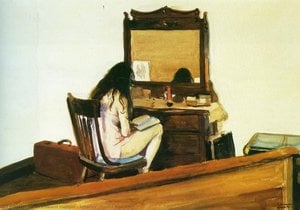
Edward Hopper, 1882 – 1967

The 100 Most Famous Paintings by Edward Hopper

The painting that made Edward Hopper famous is Nighthawks, The Art Institute of Chicago, Chica (1942); it hangs in the Art Institute of Chicago, Chicago. Automat (small) and House by the Railroad (1925) follow it in the hearts of collectors and museum visitors. Of the 366 works by Edward Hopper in our catalogue, these 100 are the most admired, each presented with its date, its museum and what sets it apart.

Ranked by our popularity score, which combines the searches, visits and orders for each work. Updated October 2026.

Portrait of Edward Hopper
Edward Hopper · 1882 – 1967
Born · died
1882 – 1967, Upper Nyack
Movement
Contemporary realism
Works in our catalogue
366
Most famous
Nighthawks, The Art Institute of Chicago, Chica (1942)
Most works at
MOMA - Museum of Modern Art

Edward Hopper: the ten masterpieces

Automat (small) by Edward Hopper
2

Automat (small)

Acrylic On Canvas · Des Moines Art Center, Des Moines

Edward Hopper’s “Automat” (small), a deceptively simple depiction of a woman seated alone at a cafe table, is a masterclass in conveying the profound sense of solitude that characterized much of 20th-century American life. Painted during a period of rapid urbanization and social change, this work resonates with a quiet melancholy that speaks to the alienation inherent in modern existence. Hopper’s ability to capture fleeting moments of human experience –…

House by the Railroad (1925) by Edward Hopper
3

House by the Railroad

1925 · Oil On Canvas · MOMA - Museum of Modern Art, New York City

Introduction to Edward Hopper and His Work Edward Hopper, a renowned American artist, is celebrated for his captivating oil paintings that often depicted modern life in the early 20th century. One of his most notable works is "House by the Railroad," which is currently housed at the Museum of Modern Art (New York, United States). This painting, created in 1925, showcases Hopper's unique style and ability to evoke a sense…

New York Movie (1939) by Edward Hopper
4

New York Movie

1939 · Acrylic On Canvas · MOMA - Museum of Modern Art, New York City

The Painting "CITE>New York Movie" by Edward Hopper is a poignant oil on canvas painting created in 1939. It is currently housed at the prestigious Museum of Modern Art (MoMA) in New York City, United States. This masterpiece exemplifies Hopper's unique ability to capture the essence of urban life, often focusing on themes of isolation and contemplation. Composition and Symbolism The painting depicts a woman standing alone in front of…

untitled (5560) by Edward Hopper
5

untitled (5560)

Oil On Canvas · MOMA - Museum of Modern Art, New York City

Edward Hopper's untitled (5560) is far more than a mere depiction of a roadside service station; it is a distilled essence of the American experience, a moment frozen in time that speaks volumes about human connection and the profound weight of isolation. Painted during the transformative years between 1942 and 1945, this monochrome masterpiece captures a scene familiar to the mid-century traveler—the late-night glow of artificial light illuminating a sparsely…

Early sunday morning Whitney Museum of American (1930) by Edward Hopper
6

Early sunday morning Whitney Museum of American

1930 · Oil On Canvas · Whitney Museum of American Art, New York

Early Sunday Morning: A Portrait of Quietude Edward Hopper’s “Early Sunday Morning,” painted in 1930, isn't merely a depiction of a New York City street; it’s an arresting distillation of the anxieties and aspirations inherent in the American psyche during the Depression era. Executed in oil paint on canvas, this iconic piece exemplifies Hopper’s signature style – American Scene Painting—characterized by stark realism combined with a palpable sense of solitude…

Automat (1927) by Edward Hopper
7

Automat

1927 · Oil On Canvas

A Masterpiece of Solitude and Light Edward Hopper's "Automat" (1927) is a quintessential example of American Realism, capturing the quiet solitude and introspective mood that define much of his work. This evocative painting invites viewers into a dimly lit interior where a lone woman sits at a round table in what appears to be an automat—a type of self-service restaurant popular in early 20th-century America. The scene is bathed in…

Sunday (1926) by Edward Hopper
8

Sunday

1926 · Oil On Canvas · The Phillips Collection, Washington, D.C.

The Essence of Urban Solitude Edward Hopper's "Sunday" captures the quietude and introspection of an urban scene on what appears to be a Sunday morning. The painting features a solitary man sitting on a wooden bench in front of closed storefronts, evoking a sense of solitude and contemplation that is characteristic of Hopper's work. This piece is a masterful exploration of the human condition, set against the backdrop of early…

Gas (1940) by Edward Hopper
9

Gas

1940 · Oil On Canvas

A Timeless Depiction of American Solitude Edward Hopper's "Gas" (1940) is a masterful exploration of solitude and nostalgia, capturing an old-fashioned gas station bathed in soft, natural light. This evocative painting invites viewers into a moment frozen in time, where the quietude of rural America is palpable. The scene exudes a sense of introspection, making it a compelling addition to any art collection or interior space. Composition and Style: A…

Chop Suey (1929) by Edward Hopper
10

Chop Suey

1929 · Oil On Canvas

"Chop Suey," created by Edward Hopper in 1929, is a captivating oil painting that invites viewers into the intimate yet isolated world of a 1920s diner. This masterpiece exemplifies Hopper's signature style, blending American Realism with subtle Expressionist influences to evoke a sense of nostalgia and quiet introspection.

More Edward Hopper masterpieces, 11 to 100

Office at Night (1940) by Edward Hopper
#11

Office at Night

1940

A Glimpse into Mid-20th Century America Edward Hopper's "Office at Night" (1940) is a masterful portrayal of an office scene from the mid-20th century. This painting captures a…

Summertime (1943) by Edward Hopper
#12

Summertime

1943

Painted in 1943, during a period of significant societal change and wartime uncertainty, “Summertime” is a quintessential example of Edward Hopper's masterful ability to capture the quiet drama…

Sunlight in a Cafeteria (1958) by Edward Hopper
#13

Sunlight in a Cafeteria

1958 · Yale University Art Gallery

Edward Hopper’s Sunlight in a Cafeteria (1958) is a masterful depiction of urban solitude, rendered with the precision and emotional depth that define his iconic style. This oil…

People in the Sun (1960) by Edward Hopper
#14

People in the Sun

1960

A Serene Moment Captured in Time Edward Hopper's "People in the Sun" invites viewers into a tranquil scene of five individuals enjoying a moment of quiet repose under…

Cape Cod Morning (1950) by Edward Hopper
#15

Cape Cod Morning

1950

A Moment of Quiet Reflection: Edward Hopper's Masterpiece The Scene: A Woman in Contemplation Edward Hopper's "Cape Cod Morning" captures a serene yet intriguing moment of solitude. The…

Rooms for Tourists (1945) by Edward Hopper
#16

Rooms for Tourists

1945 · Yale University Art Gallery

A Masterpiece of American Realism "Rooms for Tourists" (1945) is a captivating artwork by Edward Hopper, renowned for his evocative depictions of modern American life. This painting exemplifies…

nighthawks (1942) by Edward Hopper
#17

nighthawks

1942 · Art Institute of Chicago

A Window Into Loneliness: Exploring Edward Hopper’s Nighthawks Edward Hopper's "Nighthawks," completed in 1942 during the tumultuous backdrop of World War II, transcends mere representation; it embodies a…

Compartment C Car by Edward Hopper
#18

Compartment C Car

The Artist and His Work Edward Hopper, a renowned American realist painter, is celebrated for his ability to capture the essence of American life through his art. Born…

Two Comedians (1965) by Edward Hopper
#19

Two Comedians

1965

Edward Hopper’s 1965 painting, “Two Comedians,” isn’t merely a depiction of two figures on a stage; it’s a carefully constructed meditation on loneliness, the fleeting nature of performance,…

New York Movie, Moma, NY (1939) by Edward Hopper
#21

New York Movie, Moma, NY

1939

A Cinematic Stillness: Edward Hopper’s *New York Movie* (1939) New York Movie*, housed within the esteemed collection of The Museum of Modern Art (MoMA), is a quintessential example…

Summer Evening (1947) by Edward Hopper
#22

Summer Evening

1947

A Portrait of Quietude: Exploring Edward Hopper’s “Summer Evening” Edward Hopper's "Summer Evening" isn’t merely a depiction of a scene; it’s an exquisitely crafted meditation on human experience—a…

Hotel room (1931) by Edward Hopper
#23

Hotel room

1931

The Poignant Stillness of a Private Moment In Edward Hopper’s 1931 masterpiece, Hotel Room, the viewer is invited into a sanctuary of profound introspection. The scene is deceptively…

Excursion into Philosophy by Edward Hopper
#24

Excursion into Philosophy

A Quiet Drama: Unveiling Edward Hopper’s “Excursion into Philosophy” Edward Hopper's "Excursion into Philosophy" is a profoundly evocative work that encapsulates the core tenets of American Realism, offering…

The Cat Boat (1922) by Edward Hopper
#25

The Cat Boat

1922 · Smithsonian American Art Museum

Edward Hopper's “The Cat Boat,” created in 1922, stands as a quintessential emblem of American Modernism—a deceptively simple scene imbued with profound psychological depth. More than just depicting…

Rooms By The Sea (1951) by Edward Hopper
#26

Rooms By The Sea

1951

Rooms By The Sea: A Portrait of Quiet Contemplation Edward Hopper’s “Rooms by the Sea” transcends mere depiction; it's a distillation of mood, an embodiment of American Modernism’s…

Reclining Nude (1927) by Edward Hopper
#27

Reclining Nude

1927

Introduction Reclining Nude, a watercolour painting by Edward Hopper, is a quintessential example of the artist's unique style and contribution to the New Realism movement. Created in 1927,…

Rooms by the Sea (1951) by Edward Hopper
#28

Rooms by the Sea

1951

The Painting: A Representation of Serenity "CITE>Edward Hopper's 'Rooms by the Sea' (1951) is a masterpiece that embodies the essence of stillness and contemplation. The painting, available for…

House At Dusk (1935) by Edward Hopper
#29

House At Dusk

1935

The Painting: An Overview "CITE>Edward Hopper:CITE>'s House At Dusk, created in 1935, is a quintessential example of the artist's ability to capture the essence of American life through…

Drug Store (1927) by Edward Hopper
#30

Drug Store

1927 · Museum of Fine Arts

A Quiet Moment in the City: Exploring Edward Hopper’s “Drug Store” (1927) “Drug Store,” painted in 1927 by American master Edward Hopper, is a poignant depiction of urban…

Sun on Prospect Street (Gloucester, Massachusetts) (1934) by Edward Hopper
#31

Sun on Prospect Street (Gloucester, Massachusetts)

1934

Edward Hopper's "Sun on Prospect Street" isn't merely a depiction of a Gloucester street scene; it’s a distilled essence of early 20th-century American experience. Painted in 1934, during…

Woman in the Sun (1961) by Edward Hopper
#32

Woman in the Sun

1961

A Moment Frozen in Light: Edward Hopper’s “Woman in the Sun” Edward Hopper's "Woman in the Sun," painted in 1961, isn’t merely a depiction of a nude figure;…

Second Story Sunlight (1960) by Edward Hopper
#33

Second Story Sunlight

1960

A Moment Suspended: Unveiling Edward Hopper’s “Second Story Sunlight” Edward Hopper's 1960 oil on canvas, *Second Story Sunlight*, is a quintessential example of American Realism at its most…

Night Windows (1928) by Edward Hopper
#34

Night Windows

1928 · MOMA - Museum of Modern Art

A Window Into Solitude: Exploring Edward Hopper’s Night Windows Edward Hopper, a name synonymous with the quiet contemplation of modern existence, wasn't merely capturing landscapes; he was distilling…

New York Office (1962) by Edward Hopper
#35

New York Office

1962

Edward Hopper’s “New York Office,” painted in 1962, transcends mere depiction; it embodies the very essence of modern solitude—a feeling profoundly familiar to viewers grappling with the complexities…

Office in a Small City (1953) by Edward Hopper
#36

Office in a Small City

1953

In the vast gallery of American Realism, few works possess the haunting, cinematic stillness found in Edward Hopper’s 1953 masterpiece, Office in a Small City. To gaze upon…

City Roofs (1932) by Edward Hopper
#37

City Roofs

1932

A Quiet Moment of Urban Existence Edward Hopper’s “City Roofs” (1932) is more than just a depiction of a cityscape; it's a poignant meditation on modern life, isolation,…

Self-Portrait (1930) by Edward Hopper
#38

Self-Portrait

1930

This oil on canvas painting depicts a man wearing a brown hat and a blue shirt. He is shown with a serious expression, looking directly at the viewer.…

Monhegan Houses, Maine by Edward Hopper
#39

Monhegan Houses, Maine

Introduction to American Realism Edward Hopper, a prominent American realist painter, is renowned for his captivating oil paintings that depict urban and rural scenes. His unique style has…

Four Lane Road by Edward Hopper
#40

Four Lane Road

Edward Hopper's "Four Lane Road," painted in 1956, isn’t merely a depiction of a roadside scene; it’s a distilled essence of the American experience – a poignant meditation…

Woman at Cafe Table (1907) by Edward Hopper
#41

Woman at Cafe Table

1907 · Whitney Museum of American Art

Woman at Cafe Table: A Portrait of Urban Isolation Edward Hopper’s “Woman at Cafe Table,” painted in 1906-1907, stands as a quintessential emblem of New Realism and embodies…

First Row Orchestra (1951) by Edward Hopper
#42

First Row Orchestra

1951 · Hirshhorn Museum and Sculpture Garden

A Portrait of Quiet Observation: Exploring Edward Hopper’s “First Row Orchestra” Edward Hopper's "First Row Orchestra," painted in 1951, transcends mere depiction; it embodies the very essence of…

House by the Railroad by Edward Hopper
#43

House by the Railroad

In his 1925 masterpiece, House by the Railroad, Edward Hopper presents a scene that captures a profound sense of isolation through a meticulously controlled interplay of light and…

untitled (3714) by Edward Hopper
#44

untitled (3714)

Edward Hopper's "Untitled (3714)," painted in 1942, isn’t merely a depiction of a diner interior; it’s a distilled essence of modern American loneliness. This deceptively simple scene—an elderly…

el palacio (1946) by Edward Hopper
#45

el palacio

1946

Edward Hopper’s 1946 painting, “El Palacio,” isn’t merely a depiction of a city street; it’s a carefully constructed tableau of urban solitude and the quiet anxieties of modern…

the city (1927) by Edward Hopper
#46

the city

1927

The City, painted by Edward Hopper in 1927, is a striking black and white depiction of early 20th-century American urban life. This artwork isn't merely a representation of…

rooms by the sea by Edward Hopper
#47

rooms by the sea

Edward Hopper’s Rooms by the Sea is a painting from 1951 that depicts an interior space with a doorway opening toward the ocean. The scene features a room…

The Camel's Hump (1931) by Edward Hopper
#49

The Camel's Hump

1931

Edward Hopper's "The Camel’s Hump," painted in 1931, isn’t merely a depiction of a mountain range; it’s a distilled essence of American loneliness and the quiet drama unfolding…

the el station by Edward Hopper
#50

the el station

In the quiet, heavy atmosphere of Edward Hopper’s “The El Station,” we are invited into a moment suspended in time, where the bustling energy of the American metropolis…

Dawn in Pennsylvania (1942) by Edward Hopper
#51

Dawn in Pennsylvania

1942

A Solitary Glimpse: Dawn in Pennsylvania by Edward Hopper Edward Hopper’s *Dawn in Pennsylvania*, painted in 1942, isn't merely a depiction of a railroad station; it’s a distilled…

Corn Hill (1930) by Edward Hopper
#52

Corn Hill

1930

Edward Hopper's "Corn Hill," painted in 1930, isn’t merely a depiction of a rural landscape; it’s a poignant meditation on isolation and the quiet dignity of human existence…

tramp steamer (1908) by Edward Hopper
#53

tramp steamer

1908

A Storm-Tossed Soul: Edward Hopper’s “Tramp Steamer” Edward Hopper's "Tramp Steamer," painted in 1908, isn’t merely a depiction of a ship at sea; it’s a profound meditation on…

Self Portrait, , Whitney Museum of American (1930) by Edward Hopper
#54

Self Portrait, , Whitney Museum of American

1930

Edward Hopper's "Self Portrait," painted in 1930, isn’t merely a depiction of an artist; it’s a distilled essence of the anxieties and quietude that defined much of early…

Rocks at the Fort Gloucester (1924) by Edward Hopper
#55

Rocks at the Fort Gloucester

1924

Edward Hopper's 1924 painting, “Rocks at the Fort Gloucester,” is more than just a landscape; it’s a quiet meditation on human presence within the vastness of nature and…

Morning sun, Columbus Museum of Art, Columbus, (1952) by Edward Hopper
#56

Morning sun, Columbus Museum of Art, Columbus,

1952

A Window into Quietude: Exploring Edward Hopper’s “Morning Sun” Edward Hopper's "Morning Sun," painted in 1952, isn’t merely a depiction of a room; it’s an encapsulation of the…

Study of a Seated Woman (1899) by Edward Hopper
#57

Study of a Seated Woman

1899

Edward Hopper's "Study of a Seated Woman," rendered in 1899, isn’t merely a depiction of a figure; it’s a distilled essence of late 19th-century American introspection. This intimate…

Portrait Of Orleans by Edward Hopper
#58

Portrait Of Orleans

WahooArt offers exquisite hand-painted reproductions of Edward Hopper's "Portrait of Orleans," allowing you to bring this iconic work of American art into your home or office. Each reproduction…

sun empty room by Edward Hopper
#59

sun empty room

Edward Hopper's "Sun in an Empty Room," painted in 1963, isn’t merely a depiction of a vacant room; it’s a distilled essence of modern American isolation and the…

The Long Leg (1930) by Edward Hopper
#60

The Long Leg

1930

A Quiet Drama on the Waves: Edward Hopper’s *The Long Leg* (1930) Edward Hopper's *The Long Leg*, painted in 1930, is more than just a seascape; it’s a…

Bridle Path (1939) by Edward Hopper
#61

Bridle Path

1939

Bridle Path: A Portrait of Quietude in Modern America Edward Hopper’s “Bridle Path,” painted in 1939, stands as a quintessential emblem of American Realism—a genre that sought to…

night windows by Edward Hopper
#62

night windows

In the quietude of a dimly lit room, where the boundaries between the interior soul and the external world begin to blur, lies the profound essence of Edward…

Hotel by a Railroad (1952) by Edward Hopper
#63

Hotel by a Railroad

1952

Edward Hopper's "Hotel by a Railroad," painted in 1952, isn’t merely a depiction of an interior scene; it’s a carefully constructed meditation on loneliness, isolation, and the subtle…

Queensborough-Bridge (1913) by Edward Hopper
#64

Queensborough-Bridge

1913

In the vast landscape of American modernism, few images capture the quiet tension of urban existence as poignantly as Edward Hopper’s Queensborough Bridge. Painted in 1913, this monumental…

paris street by Edward Hopper
#65

paris street

In the quiet corners of Edward Hopper’s “Paris Street,” we encounter more than just a cityscape; we find a profound meditation on the human condition. Painted in 1926,…

cape cod morning by Edward Hopper
#66

cape cod morning

In the quietude of an early summer morning, Edward Hopper captures a moment that feels both profoundly intimate and hauntingly distant. Cape Cod Morning is not merely a…

sunday by Edward Hopper
#67

sunday

The Painting and Its Context Sunday, a painting by Edward Hopper, is a quintessential representation of modern American life in the early 20th century. Created in 1926, this…

Evening Wind by Edward Hopper
#68

Evening Wind

Edward Hopper’s “Evening Wind,” executed in 1930, stands as a quintessential emblem of American Modernism—a deceptively simple image brimming with psychological depth and masterful artistic execution. More than…

untitled (7523) by Edward Hopper
#69

untitled (7523)

A Glimpse into Modern Life: Edward Hopper’s Untitled Social Gathering This captivating work by *Edward Hopper*, tentatively titled “untitled (7523),” offers a compelling window into the social dynamics…

People in the Sun (1960) by Edward Hopper
#70

People in the Sun

1960

Edward Hopper's People in the Sun, completed in 1960, serves as a profound meditation on the human experience, capturing a sense of quietude and the pervasive feeling of…

The lee shore, private (1941) by Edward Hopper
#71

The lee shore, private

1941

Edward Hopper's "The Lee Shore," painted in 1941, isn’t merely a depiction of a coastal scene; it’s a distilled essence of American loneliness and the subtle anxieties simmering…

Rocks and Sea (1919) by Edward Hopper
#72

Rocks and Sea

1919 · Whitney Museum of American Art

A Moment Frozen in Azure The sea air feels heavy and salt-laden as the eye meets the deep, blue expanse of this landscape. In this 1919 scene, the…

Self Portrait by Edward Hopper
#73

Self Portrait

Edward Hopper's "Self Portrait," painted between 1925 and 1930, isn’t merely a depiction of an artist; it’s a profound meditation on isolation, introspection, and the quiet dignity of…

Sheridan Theatre by Edward Hopper
#74

Sheridan Theatre

Edward Hopper’s Sheridan Theatre, painted in 1937, isn't merely a depiction of an interior scene; it’s a carefully constructed tableau of loneliness and unspoken narratives. The painting immediately…

Freight Car at Truro by Edward Hopper
#75

Freight Car at Truro

In the vast, sweeping landscape of American art, few images capture the heavy, cinematic silence of a moment quite like Edward Hopper’s Freight Car at Trurol. Painted in…

Lighthouse at Two Lights (1929) by Edward Hopper
#76

Lighthouse at Two Lights

1929

Edward Hopper’s Lighthouse at Two Lights, completed in 1929, presents a striking visual meditation on the interplay between light and shadow. The composition features a tall lighthouse situated…

summer interior (1909) by Edward Hopper
#77

summer interior

1909

Edward Hopper’s Summer Interior, painted in 1909, presents a scene of profound stillness within a domestic setting. The composition centers on a young woman positioned on the floor…

cape cod evening by Edward Hopper
#78

cape cod evening

In the quiet corners of American Modernism, few images resonate with as much profound, whispered intensity as Edward Hopper’s Cape Cod Evening. At first glance, the painting presents…

rooms for tourists by Edward Hopper
#80

rooms for tourists

A Quiet American Narrative: Exploring Edward Hopper’s “Rooms for Tourists” Rooms for Tourists, painted in 1945 by the master of American Realism, Edward Hopper, is a captivating study…

South Carolina Morning by Edward Hopper
#81

South Carolina Morning

Edward Hopper's "South Carolina Morning," painted in 1955, is a poignant depiction of an African American woman named Dinah standing before her home in Charleston, South Carolina. The…

Intermission (small) by Edward Hopper
#82

Intermission (small)

Edward Hopper’s Solitary Stage: Unpacking “Intermission” Edward Hopper's "Intermission" (1963) isn’t merely a painting; it’s a distilled moment of American solitude, a poignant tableau captured with the artist’s…

untitled (7096) by Edward Hopper
#83

untitled (7096)

Edward Hopper’s “Untitled (7096),” a painting rendered in the twilight hours, isn’t merely a depiction of a pharmacy storefront; it’s a distilled essence of 20th-century American loneliness. Completed…

Eleven AM by Edward Hopper
#84

Eleven AM

Edward Hopper, a master of American realism, possessed an uncanny ability to distill the essence of modern life – its quiet desperation, its pervasive loneliness, and its fleeting…

New York Pavements, (1924) by Edward Hopper
#85

New York Pavements,

1924

Edward Hopper's "New York Pavements," painted in 1924, stands as a quintessential emblem of American Modernism—a deceptively simple depiction that speaks volumes about the anxieties and quiet contemplations…

Lighthouse and Building, Portland by Edward Hopper
#86

Lighthouse and Building, Portland

Edward Hopper’s Luminous Solitude: Exploring “Lighthouse and Building” Edward Hopper's "Lighthouse and Building," painted in 1927, isn’t merely a depiction of a coastal scene; it’s a masterful distillation…

Circle Theatre by Edward Hopper
#87

Circle Theatre

In the quiet, heavy atmosphere of Edward Hopper’s "Circle Theatre," we are invited to witness more than just a street corner in a bustling metropolis; we are invited…

Room in Brooklyn (1932) by Edward Hopper
#88

Room in Brooklyn

1932 · Museum of Fine Arts

Edward Hopper's "Room in Brooklyn," painted in 1932, isn’t merely a depiction of an interior space; it’s a distilled essence of American loneliness and the quiet contemplation that…

Seven A.M. (1948) by Edward Hopper
#90

Seven A.M.

1948

In the quiet, early hours of a mid-century morning, Edward Hopper’s "Seven A.M." invites us into a space where time seems to hold its breath. Painted in 1948,…

The City (1927) by Edward Hopper
#91

The City

1927

A Quiet Vision of Urban Life: Edward Hopper’s “The City” (1927) Subject and Composition: “The City” presents a strikingly composed street corner scene, a quintessential example of Edward…

First Row Orchestra (1951) by Edward Hopper
#92

First Row Orchestra

1951

A Moment Frozen in Time: Edward Hopper’s “First Row Orchestra” Edward Hopper's "First Row Orchestra," painted in 1951, isn’t merely a depiction of an evening at the theater;…

House with big pine by Edward Hopper
#93

House with big pine

The painting depicts a white house featuring a black roof and a large chimney positioned on its side. Two windows are visible within the structure. The setting includes…

Valley Of The Seine (1908) by Edward Hopper
#94

Valley Of The Seine

1908

Edward Hopper's "Valley Of The Seine," painted in 1908, isn’t merely a landscape; it’s a distilled essence of early 20th-century America – a poignant tableau of solitude and…

Ryder's House (1933) by Edward Hopper
#95

Ryder's House

1933

Edward Hopper’s “Ryder’s House,” completed in 1933, stands as a quintessential emblem of American Realism during the Depression era. More than just a depiction of a simple farmhouse…

Intermission by Edward Hopper
#96

Intermission

Edward Hopper’s Intermission, painted in 1963, isn't merely a depiction of a theater lobby; it’s a meticulously crafted tableau of human isolation and the poignant beauty of unspoken…

Gas, Moma, NY (1940) by Edward Hopper
#97

Gas, Moma, NY

1940

Edward Hopper’s “Gas,” painted in 1940 and currently residing at MoMA (Museum of Modern Art), isn't merely a depiction of a roadside gas station; it’s a masterful distillation…

Cape Cod Morning (1950) by Edward Hopper
#98

Cape Cod Morning

1950

In the vast landscape of American modernism, few images resonate with as much profound stillness as Edward Hopper’s 1950 masterpiece, Cape Cod Morning. This striking canvas serves as…

Room for tourists, Yale University Art Gallery, (1945) by Edward Hopper
#99

Room for tourists, Yale University Art Gallery,

1945

A Quiet American Night: Exploring Edward Hopper’s “Room for Tourists” “Room for Tourists,” painted in 1945 by master realist Edward Hopper, is more than just a depiction of…

Eleven A.M. (1926) by Edward Hopper
#100

Eleven A.M.

1926

Edward Hopper’s “Eleven A.M.” (1926) is more than just a depiction of a woman in a room; it’s a meticulously crafted meditation on the quiet loneliness inherent within…

Edward Hopper's paintings by period

The subjects Edward Hopper painted most

The four subjects that return most often among these masterpieces, with the finest example of each.

Where to see Edward Hopper's paintings

The 8 museums that hold the most of the paintings on this page.

Museum City Works by Edward Hopper Paintings from this list
MOMA - Museum of Modern Art, New York CityMOMA - Museum of Modern Art New York City 4 House by the Railroad, New York Movie, untitled (5560)
Whitney Museum of American Art, New YorkWhitney Museum of American Art New York 10 Early sunday morning Whitney Museum of American, Woman at Cafe Table, Rocks and Sea
Art Institute of Chicago, ChicagoArt Institute of Chicago Chicago 3 Nighthawks, The Art Institute of Chicago, Chica, nighthawks, Interior (Model Reading)
Yale University Art Gallery, HartfordYale University Art Gallery Hartford 3 Sunlight in a Cafeteria, Rooms for Tourists
Museum of Fine Arts, BostonMuseum of Fine Arts Boston 3 Drug Store, Room in Brooklyn
Hirshhorn Museum and Sculpture Garden, Washington, D.C.Hirshhorn Museum and Sculpture Garden Washington, D.C. 3 First Row Orchestra
Smithsonian American Art Museum, Washington, D.C.Smithsonian American Art Museum Washington, D.C. 2 The Cat Boat
Des Moines Art Center, Des MoinesDes Moines Art Center Des Moines 1 Automat (small)

Edward Hopper, decade by decade: the defining painting of each

  1. 1890s
    Study of a Seated Woman (1899) by Edward Hopper
    No. 57 of 100

    Study of a Seated Woman

    Age 8 – 17

    Edward Hopper's "Study of a Seated Woman," rendered in 1899, isn’t merely a depiction of a figure; it’s a distilled essence of late 19th-century American introspection. This intimate…

  2. 1900s
    Woman at Cafe Table (1907) by Edward Hopper
    #41 of 100

    Woman at Cafe Table

    Age 18 – 27 · Whitney Museum of American Art

    Woman at Cafe Table: A Portrait of Urban Isolation Edward Hopper’s “Woman at Cafe Table,” painted in 1906-1907, stands as a quintessential emblem of New Realism and embodies…

  3. 1910s
    Queensborough-Bridge (1913) by Edward Hopper
    No. 64 of 100

    Queensborough-Bridge

    Age 28 – 37

    In the vast landscape of American modernism, few images capture the quiet tension of urban existence as poignantly as Edward Hopper’s Queensborough Bridge. Painted in 1913, this monumental…

  4. 1920s
    House by the Railroad (1925) by Edward Hopper
    #3 of 100

    House by the Railroad

    Age 38 – 47 · MOMA - Museum of Modern Art

    Introduction to Edward Hopper and His Work Edward Hopper, a renowned American artist, is celebrated for his captivating oil paintings that often depicted modern life in the early…

  5. 1930s
    New York Movie (1939) by Edward Hopper
    Rank 4 / 100

    New York Movie

    Age 48 – 57 · MOMA - Museum of Modern Art

    The Painting "CITE>New York Movie" by Edward Hopper is a poignant oil on canvas painting created in 1939. It is currently housed at the prestigious Museum of Modern…

  6. 1940s
    Nighthawks, The Art Institute of Chicago, Chica (1942) by Edward Hopper
    No. 1 of 100

    Nighthawks, The Art Institute of Chicago, Chica

    Age 58 – 67 · Art Institute of Chicago

    Created in 1942, this iconic painting captures a late-night scene within an all-night diner, becoming one of the most recognizable images in American art. More than just a…

  7. 1950s
    Sunlight in a Cafeteria (1958) by Edward Hopper
    #13 of 100

    Sunlight in a Cafeteria

    Age 68 – 77 · Yale University Art Gallery

    Edward Hopper’s Sunlight in a Cafeteria (1958) is a masterful depiction of urban solitude, rendered with the precision and emotional depth that define his iconic style. This oil…

  8. 1960s
    People in the Sun (1960) by Edward Hopper
    No. 14 of 100

    People in the Sun

    Age 78 – 85

    A Serene Moment Captured in Time Edward Hopper's "People in the Sun" invites viewers into a tranquil scene of five individuals enjoying a moment of quiet repose under…

Edward Hopper's masterpieces: questions and answers

Which painting is Edward Hopper best known for?Show the answer

Nighthawks, The Art Institute of Chicago, Chica (1942), Art Institute of Chicago, Chicago. Next come Automat (small) and House by the Railroad (1925).

How old was Edward Hopper when painting Nighthawks, The Art Institute of Chicago, Chica?Show the answer

60 years old: Nighthawks, The Art Institute of Chicago, Chica dates from 1942 and Edward Hopper was born in 1882.

What are Edward Hopper's ten greatest paintings?Show the answer

Nighthawks, The Art Institute of Chicago, Chica, Automat (small), House by the Railroad, New York Movie, untitled (5560), Early sunday morning Whitney Museum of American, Automat, Sunday, Gas and Chop Suey. The ranking above gives the year and the museum of each.

How many works did Edward Hopper paint?Show the answer

Our catalogue lists 366 works by Edward Hopper, dated from 1899 to 1965.

In which museums can I see Edward Hopper's masterpieces?Show the answer

Most of them are in MOMA - Museum of Modern Art (New York City), Whitney Museum of American Art (New York) and Art Institute of Chicago (Chicago). The table above lists the museums one by one.

When did Edward Hopper paint the masterpieces?Show the answer

In 1920s: 15 of the 100 works on this page date from then, among them House by the Railroad.

What are the first and last famous paintings of Edward Hopper?Show the answer

The earliest on this page is Study of a Seated Woman (1899), the latest Two Comedians (1965).

What were Edward Hopper's favourite subjects?Show the answer

Solitude (46), Isolation (41) and Urban landscape (23), among the 100 works on this page.

Which technique did Edward Hopper favour?Show the answer

Oil On Canvas: 51 of the 100 works on this page.

What art movement is Edward Hopper part of?Show the answer

Contemporary realism and American scene painting, as the paintings on this page show.

Which masterpieces by Edward Hopper hang at the MOMA - Museum of Modern Art?Show the answer

House by the Railroad, New York Movie and untitled (5560) are among the 4 works on this page held by the MOMA - Museum of Modern Art, New York City.

The life of Edward Hopper

The Quietude of the American Scene

Edward Hopper was born in Upper Nyack, United States of America. His early years were spent observing the world with a steady eye, a habit that began with childhood sketches meticulously dated and signed. While his parents suggested a practical path in commercial illustration, his focus remained on fine art. He studied at the New York School of Art under William Merritt Chase and Robert Henri. These years taught him the technical skill required to depict the world unvarnished and honest. He did not seek the fleeting brushstrokes of the Impressionists he encountered in Paris. Instead, he developed a way of seeing that favored the stillness of a moment over the movement of a crowd.

His work often centers on the mundane. He looked at houses, diners, offices, and hotel rooms. He stripped away unnecessary details to find the underlying emotional truth of a scene. In House by the Railroad (1925), a simple composition reveals a sense of mystery and isolation. He used light and shadow not merely to describe a room, but to set a mood. The precise rendering of a shadow on a wall or the way light hits a window became his way of communicating the psychological state of his subjects.

Light and the Urban Interior

The way light enters a space is a central character in his paintings. In Nighthawks (1942), the stark fluorescent light of a late-night diner cuts through the darkness of a deserted urban street. The figures inside are physically close but appear lost in their own thoughts, disconnected from one another. This sense of anonymity in a crowded city became a recurring theme. He captured the tension of being alone in a public place, a feeling that resonates in works like Automat and Office in a Small City. He was interested in the way artificial light interacts with the natural darkness of the night.

His wife, Josephine Nivison Hopper, was a constant presence. She was a fellow artist and often served as his model. Her presence is felt in the characterization of many of his female figures. Together, they lived a modest life, often spending summers in New England, which influenced the landscapes he painted. His depictions of the American landscape, both rural and urban, often emphasize a certain starkness or emptiness. Whether it is a roadside gas station in Gas (1940) or a quiet room in a hotel, the subject is always the intersection of a physical place and a private, internal experience.

A Legacy of Observation

Hopper’s influence extends into the visual language of film and literature. His ability to create a sense of psychological tension through composition has been noted by many who study the way stories are told through images. His paintings remain in major museums worldwide, held in collections such as the Whitney Museum of American Art and the Museum of Fine Arts, Boston. He did not aim for grand historical narratives. He found his subject matter in the quiet corners of everyday life, turning a simple window or a passing stranger into a study of the human condition. His work remains a study of the silence that exists between people.

All 366 works by Edward Hopper →