Dmitry Levitzky, 1735 – 1822

Dmitry Levitzky Paintings: The 60 Most Famous Works, Ranked

Dmitry Levitzky's most famous painting is Portrait of Catherine II of Russia in red dress. (1782), in the National Museum in Warsaw, Warsaw. With Portrait of Catherine II the Legislatress in the Temple Devoted to the Godess of Justice (1780) and Portrait of Countess Ursula Mniszek (1782), it completes the three works everyone recognises. Our catalogue lists 60 works by Dmitry Levitzky; the 60 below are the ones the world looks at most, each with its year, the museum that holds it and why it matters.

Ranked by our popularity score, which combines the searches, visits and orders for each work. Updated October 2026. Every masterpiece on this page can be ordered as a museum-quality, hand-painted oil reproduction or a fine art print, at the size you choose.

Portrait of Dmitry Levitzky
Dmitry Levitzky · 1735 – 1822
Born · died
1735 – 1822, Kyiv
Movement
Rococo
Works in our catalogue
60
Most famous
Portrait of Catherine II of Russia in red dress. (1782)
Most works at
Tretyakov Gallery

The 10 most famous Dmitry Levitzky paintings

Portrait of Catherine II the Legislatress in the Temple  Devoted to the Godess of Justice (1780) by Dmitry Levitzky
2

Portrait of Catherine II the Legislatress in the Temple Devoted to the Godess of Justice

1780 · Oil · Tretyakov Gallery, Moscow

The work is the Portrait of Catherine II the Legislatress in the Temple Devoted to the Godess of Justice by the artist Dmitry Grigoryevich Levitsky. Created about 1780, this oil portrait presents the subject, Catherine II, within a specific architectural and symbolic framework. The composition places the Empress inside a temple dedicated to the goddess of Justice, a setting that defines the allegorical nature of the image.

Portrait of Countess Ursula Mniszek (1782) by Dmitry Levitzky
3

Portrait of Countess Ursula Mniszek

1782 · Oil On Canvas · Tretyakov Gallery, Moscow

An elegant oval-format bust-length portrait, this work captures Countess Ursula Mniszek in a moment of poised serenity. The composition focuses on the subject's face and upper torso, set against a dark, indeterminate background that creates a strong chiaroscuro effect. Light enters from the upper left, illuminating her features and the shimmering textures of her attire. Her powdered hair is styled in voluminous curls, framing a face rendered with smooth skin…

Portrait of A.I. Novikova (? ) (1794) by Dmitry Levitzky
4

Portrait of A.I. Novikova (? )

1794 · Oil On Canvas · Hermitage Museum, Saint Petersburg

The Subject and Composition Portrait of A.I. Novikova (? ) presents a middle-aged man in a three-quarter view, positioned slightly off-center against a dark, atmospheric background. The figure is depicted from the waist up, wearing a deep forest green coat accented by a vermilion red collar and a white cravat. His hair is light-colored and appears powdered, a common stylistic choice for the period. The subject's expression remains calm and…

Dmitry Levitzky, paintings 11 to 60

Portrait of Maria Dyakova (1778) by Dmitry Levitzky
#11

Portrait of Maria Dyakova

1778 · Tretyakov Gallery

The Portrait of Maria Dyakova is an oil on canvas work executed by Dmitry Levitzky in 1778. Classified within the portrait genre, the piece reflects the Rococo style…

Order a reproduction →

Dmitry Levitzky's paintings by period

The subjects Dmitry Levitzky painted most

The four subjects that return most often among these masterpieces, with the finest example of each.

Where to see Dmitry Levitzky's paintings

The 7 museums that hold the most of the paintings on this page.

Museum City Works by Dmitry Levitzky Paintings from this list
Tretyakov Gallery, MoscowTretyakov Gallery Moscow 6 Portrait of Catherine II the Legislatress in the Temple Devoted to the Godess of Justice, Portrait of Countess Ursula Mniszek, Portrait of Maria Dyakova
Hermitage Museum, Saint PetersburgHermitage Museum Saint Petersburg 5 Portrait of A.I. Novikova (? ), Portrait of Nikolai Novikov, Portrait of Mikhail Krechetnikov
The State Russian Museum, St. PetersburgThe State Russian Museum St. Petersburg 5 Portrait of E. N. Khruschova and Princess E. N. Khovanskaya, Portrait of the Princesses Davidova and Rzevskaja, Portrait of Alexander Kokorino
National Museum in Warsaw, WarsawNational Museum in Warsaw Warsaw 2 Portrait of Catherine II of Russia in red dress., Catherine the Great
National Gallery of Armenia, YerevanNational Gallery of Armenia Yerevan 1 Portrait of B.V. Umsky
Hillwood Estate, Музей та Сади, Washington, D.C.Hillwood Estate, Музей та Сади Washington, D.C. 1 Portrait of Yekaterina Dashkova
Fine Arts Museum Kharkiv, KharkivFine Arts Museum Kharkiv Kharkiv 1 Irina Vasilyeva (count)

Dmitry Levitzky's most famous painting of each decade

  1. 1770s
  2. 1780s
    Portrait of Catherine II of Russia in red dress. (1782) by Dmitry Levitzky
    Rank 1 / 60

    Portrait of Catherine II of Russia in red dress.

    Age 45 – 54 · National Museum in Warsaw

    The Portrait of Catherine II of Russia in red dress. is an oil painting executed by the artist Dmitry Levitzky. Created in 1782, this work depicts the subject,…

  3. 1790s
    Portrait of A.I. Novikova (? ) (1794) by Dmitry Levitzky
    #4 of 60

    Portrait of A.I. Novikova (? )

    Age 55 – 64 · Hermitage Museum

    The Subject and Composition Portrait of A.I. Novikova (? ) presents a middle-aged man in a three-quarter view, positioned slightly off-center against a dark, atmospheric background. The figure…

Questions about Dmitry Levitzky's paintings

What is Dmitry Levitzky's most famous painting?Show the answer

Portrait of Catherine II of Russia in red dress. (1782), National Museum in Warsaw, Warsaw. Next come Portrait of Catherine II the Legislatress in the Temple Devoted to the Godess of Justice (1780) and Portrait of Countess Ursula Mniszek (1782).

How old was Dmitry Levitzky when Portrait of Catherine II of Russia in red dress. was painted?Show the answer

47 years old: Portrait of Catherine II of Russia in red dress. dates from 1782 and Dmitry Levitzky was born in 1735.

What are the top 10 paintings by Dmitry Levitzky?Show the answer

Portrait of Catherine II of Russia in red dress., Portrait of Catherine II the Legislatress in the Temple Devoted to the Godess of Justice, Portrait of Countess Ursula Mniszek, Portrait of A.I. Novikova (? ), Portrait of Maria Ivanovna Narychkine (1731-1807), formerly known as Portrait of Princess Maria Pavlovna Narychkine, Portrait of B.V. Umsky, La Maréchale d'Arseniev, Catherine the Great, Portrait of Yekaterina Dashkova and Portrait of Nikolai Novikov. The ranking above gives the year and the museum of each.

How many paintings did Dmitry Levitzky make?Show the answer

Our catalogue lists 60 works by Dmitry Levitzky, dated from 1770 to 1794.

Where are Dmitry Levitzky's most famous paintings?Show the answer

Most of them are in Tretyakov Gallery (Moscow), Hermitage Museum (Saint Petersburg) and The State Russian Museum (St. Petersburg). The table above lists the museums one by one.

When did Dmitry Levitzky paint the most famous works?Show the answer

In 1780s: 8 of the 60 works on this page date from then, among them Portrait of Catherine II of Russia in red dress..

What are Dmitry Levitzky's earliest and latest famous paintings?Show the answer

The earliest on this page is Portrait of B.V. Umsky (1770), the latest Portrait of A.I. Novikova (? ) (1794).

What did Dmitry Levitzky paint most often?Show the answer

Portraits (33), 18th century (6) and Woman (5), among the 60 works on this page.

What medium did Dmitry Levitzky use most?Show the answer

Oil On Canvas: 5 of the 60 works on this page.

Which art movement does Dmitry Levitzky belong to?Show the answer

Rococo, as the paintings on this page show.

Which Dmitry Levitzky paintings can I see at the Tretyakov Gallery?Show the answer

Portrait of Catherine II the Legislatress in the Temple Devoted to the Godess of Justice, Portrait of Countess Ursula Mniszek and Portrait of Maria Dyakova are among the 6 works on this page held by the Tretyakov Gallery, Moscow.

Can I buy a reproduction of a Dmitry Levitzky painting?Show the answer

Yes. Every painting on this page can be ordered as a museum-quality, hand-painted oil reproduction or a fine art print, in the size you choose, from the painting's own page.

About Dmitry Levitzky

Early Life and Artistic Foundations

Dmitry Grigoryevich Levitsky, born in Kyiv in 1735, emerged from a family deeply rooted in the artistic traditions of Ukraine. His father, Grigory Kirillovich Levitsky-Nos, was not merely a priest but also an accomplished engraver and painter, serving as young Dmitry’s initial guide into the world of visual expression. This early tutelage laid a crucial foundation, instilling in him a reverence for detail and a nascent understanding of form. The family's move to St. Petersburg around 1758 marked a pivotal moment, opening doors to formal artistic training under the esteemed Aleksey Antropov. Antropov’s influence proved significant; he imparted an objectivity that would become a hallmark of Levitsky’s mature style.

Ascension and Academic Recognition

Levitsky's path wasn’t solely defined by apprenticeship. He absorbed knowledge from other masters, including Louis Lagrenée at the St. Petersburg Academy of Arts, further refining his technique. His breakthrough arrived in 1770 with an exhibition of six portraits at the Imperial Academy of Arts. These works didn’t simply showcase technical skill; they captured a distinct aristocratic sensibility that resonated deeply within the courtly circles of Catherine the Great's Russia. The portrait of Alexander Kokorinov, Director and First Rector of the Academy, proved particularly impactful, earning Levitsky academician status and a professorship in portrait painting at the very institution where he had once been a student. This appointment solidified his position as one of Russia’s leading artists.

The Smolny Institute Series: Portraits of Youth and Idealism

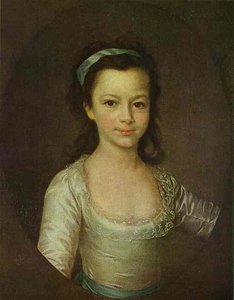
Perhaps Levitsky's most celebrated achievement lies within the series of portraits commissioned by Catherine II for the Smolny Institute for Young Ladies between 1772 and 1776. These weren’t merely likenesses; they were carefully constructed representations of youthful virtue, grace, and potential. Each portrait depicts a student engaged in various activities – dancing, music, dramatic performance – embodying the ideals of education and refinement that Catherine sought to promote through the Institute. The compositional structure, influenced by European formal portraiture, emphasized the dignity and importance of each sitter, while Levitsky’s masterful use of light and color brought a vibrant life to these scenes of aristocratic upbringing. These paintings are not just historical documents; they are windows into the aspirations and values of 18th-century Russian society.

A Refined Style and Lasting Legacy

Levitsky's artistry was characterized by a remarkable ability to capture both the physical likeness and the inner character of his subjects. He moved beyond mere representation, imbuing his portraits with a sense of psychological depth and social nuance. His technique blended meticulous detail with a delicate touch, creating images that were simultaneously realistic and idealized. While he enjoyed considerable success during his lifetime, financial hardship plagued his later years. Deteriorating eyesight forced him to curtail his painting activities in the 1790s, though he remained connected to the Academy as a council member. Despite these challenges, Levitsky left behind an enduring legacy as one of Russia’s foremost portrait painters, alongside contemporaries like Fyodor Rokotov and Vladimir Borovikovsky.

Historical Significance and Enduring Appeal

Levitsky's work provides invaluable insight into the lives and values of the Russian aristocracy during a period of significant social and political change. His portraits are not simply beautiful objects; they are historical artifacts that reflect the evolving tastes, aspirations, and self-perception of an elite class. His ability to balance realism with idealization, coupled with his technical mastery, established him as a defining figure in Russian portraiture. Today, Levitsky’s paintings continue to captivate audiences with their elegance, psychological depth, and enduring beauty. They offer a glimpse into a bygone era, reminding us of the power of art to capture not just appearances but also the spirit of a time.

All 60 works by Dmitry Levitzky →