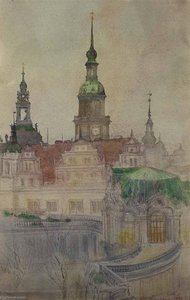
Cass Gilbert, 1859 – 1934

Cass Gilbert Paintings: The 68 Most Famous Works, Ranked

Cass Gilbert's most famous painting is Old House at Segovia, Spain (1920), in the Smithsonian American Art Museum, Washington, D.C.. With Latin Quarter, Paris (1880) and Porta San Paulo, Rome (1880), it completes the three works everyone recognises. Our catalogue lists 68 works by Cass Gilbert; the 68 below are the ones the world looks at most, each with its year, the museum that holds it and why it matters.

Ranked by our popularity score, which combines the searches, visits and orders for each work. Updated October 2026. Every masterpiece on this page can be ordered as a museum-quality, hand-painted oil reproduction or a fine art print, at the size you choose.

Portrait of Cass Gilbert
Cass Gilbert · 1859 – 1934
Born · died
1859 – 1934, Zanesville
Movement
Realism
Works in our catalogue
68
Most famous
Old House at Segovia, Spain (1920)
Most works at
Smithsonian American Art Museum

The 10 most famous Cass Gilbert paintings

Cass Gilbert, paintings 11 to 68

Battle Abbey (1931) by Cass Gilbert
#31

Battle Abbey

1931 · Smithsonian American Art Museum

The painting "Battle Abbey" is a beautiful watercolor work created by the American architect and artist Cass Gilbert in 1931. The piece measures 31 x 46 cm and…

Bring it home →
Towers from the City Wall, Nuremberg (1897) by Cass Gilbert
#62

Towers from the City Wall, Nuremberg

1897 · Smithsonian American Art Museum

The painting Towers from the City Wall, Nuremberg is a beautiful representation of an old European city with its historical architecture and lively birdlife. Created in 1897 by…

Bring it home →
Antwerp Cathedral (1899) by Cass Gilbert
#63

Antwerp Cathedral

1899 · Smithsonian American Art Museum

The Antwerp Cathedral painting by Cass Gilbert is a stunning watercolor artwork that showcases the artist's exceptional skill and attention to detail. Created in 1899, this piece is…

Commission a hand-painted copy →
A Road in Dorset (1931) by Cass Gilbert
#64

A Road in Dorset

1931

The painting A Road in Dorset is a beautiful watercolor work created by the American architect and artist Cass Gilbert in 1931. The piece measures 31 x 46…

Bring it home →
Latin Quarter, Paris (1880) by Cass Gilbert
#65

Latin Quarter, Paris

1880 · Smithsonian American Art Museum

The Latin Quarter, Paris painting by Cass Gilbert is a captivating piece that showcases the artist's skill in capturing the essence of a historic neighborhood. Created in 1880,…

Order a reproduction →

The subjects Cass Gilbert painted most

The four subjects that return most often among these masterpieces, with the finest example of each.

Where to see Cass Gilbert's paintings

The museum that holds the most of the paintings on this page.

Museum City Works by Cass Gilbert Paintings from this list
Smithsonian American Art Museum, Washington, D.C.Smithsonian American Art Museum Washington, D.C. 65 Old House at Segovia, Spain, Latin Quarter, Paris, Porta San Paulo, Rome

Cass Gilbert's most famous painting of each decade

  1. 1880s
  2. 1890s
  3. 1900s
  4. 1910s
  5. 1920s
  6. 1930s
    Battle Abbey (1931) by Cass Gilbert
    Rank 31 / 68

    Battle Abbey

    Age 71 – 75 · Smithsonian American Art Museum

    The painting "Battle Abbey" is a beautiful watercolor work created by the American architect and artist Cass Gilbert in 1931. The piece measures 31 x 46 cm and…

Questions about Cass Gilbert's paintings

What is Cass Gilbert's most famous painting?Show the answer

Old House at Segovia, Spain (1920), Smithsonian American Art Museum, Washington, D.C.. Next come Latin Quarter, Paris (1880) and Porta San Paulo, Rome (1880).

How old was Cass Gilbert when Old House at Segovia, Spain was painted?Show the answer

61 years old: Old House at Segovia, Spain dates from 1920 and Cass Gilbert was born in 1859.

What are the top 10 paintings by Cass Gilbert?Show the answer

Old House at Segovia, Spain, Latin Quarter, Paris, Porta San Paulo, Rome, St. Peters Church, Cambridge, England, Tower of Palazzo Vecchio, Florence, Italy, Southwest Tower, Amiens Cathedral, Old Church, Tours, France, Baths of Caracalla, Rome, Portal of Church of Nervy St. Sepulchre (facsimile copy of a drawing by E. Viollet Le Duc in Hotel De Cluny) and San Giorgio Maggiore, Venice. The ranking above gives the year and the museum of each.

How many paintings did Cass Gilbert make?Show the answer

Our catalogue lists 68 works by Cass Gilbert, dated from 1880 to 1933.

Where are Cass Gilbert's most famous paintings?Show the answer

Most of them are in Smithsonian American Art Museum (Washington, D.C.). The table above lists the museums one by one.

When did Cass Gilbert paint the most famous works?Show the answer

In 1890s: 18 of the 68 works on this page date from then, among them San Giorgio Maggiore, Venice.

What are Cass Gilbert's earliest and latest famous paintings?Show the answer

The earliest on this page is Latin Quarter, Paris (1880), the latest Cathedral of Notre Dame, Paris (1933).

What did Cass Gilbert paint most often?Show the answer

Architectural detail (2), Religious art (2) and Gothic architecture (2), among the 68 works on this page.

Which art movement does Cass Gilbert belong to?Show the answer

Realism, as the paintings on this page show.

Which Cass Gilbert paintings can I see at the Smithsonian American Art Museum?Show the answer

Old House at Segovia, Spain, Latin Quarter, Paris and Porta San Paulo, Rome are among the 65 works on this page held by the Smithsonian American Art Museum, Washington, D.C..

Can I buy a reproduction of a Cass Gilbert painting?Show the answer

Yes. Every painting on this page can be ordered as a museum-quality, hand-painted oil reproduction or a fine art print, in the size you choose, from the painting's own page.

About Cass Gilbert

The Architect of American Grandeur

Cass Gilbert stands as a towering figure in the annals of American architectural history, a man whose vision fundamentally reshaped the aesthetic landscape of the early twentieth century. Born in Troy, New York, his formative years were steeped in a deep appreciation for classical tradition and meticulous craftsmanship. Through his formal training at Rensselaer Polytechnic Institute, Gilbert developed a philosophy that would become his hallmark: the seamless synthesis of Beaux-Arts principles with the cutting-edge engineering techniques of a burgeoning nation. Drawing inspiration from the grandeur of Parisian masters like Auguste Choisel and Eugène Viollet-le-Duc, he sought to embody the ideals of democracy, law, and humanism within the very bones of his structures.

A Legacy Carved in Stone and Steel

His work was characterized by a rare ability to prioritize structural integrity alongside profound artistic expression. This duality allowed him to become a monumental pioneer in skyscraper design, most notably with the completion of the Woolworth Building in 1913. A soaring edifice of limestone and terracotta, this masterpiece redefined the aesthetics of the modern skyline and served as a symbol of New York City's immense economic power. Yet, Gilbert’s genius was not reserved solely for the heights of Manhattan; his commitment to civic dignity is equally evident in his monumental public works, such as the Minnesota Capitol and the Detroit Public Library, where he utilized scale and ornamentation to celebrate the permanence of American institutions.

The Delicate Hand Behind the Monumental

While history remembers him for his massive stone facades and soaring towers, there existed within Gilbert a sensitive, observant artist capable of immense delicacy. His watercolor and pencil works reveal a different facet of his soul—one attuned to the romanticism of historical scenes and the subtle play of light. In pieces such as 'Latin Quarter, Paris' and 'Tower at Enkhuisen, Holland,' one finds a muted palette and a mastery of texture that captures the essence of a bygone era. These works demonstrate that his architectural precision was born from a deep, artistic understanding of atmosphere and detail, proving that even the most monumental creator possesses a heart for the intimate and the ephemeral.

All 68 works by Cass Gilbert →