August Macke, 1887 – 1914

August Macke: The 100 Most Famous Paintings

Woman in a Green Jacket (1913) is the most famous painting by August Macke, held by the Museum Ludwig in Cologne. Bathing girls with town in the backgraund (1913) and The Hat Shop (1913) are the next two works the world knows best. From the 283 works of August Macke in our catalogue, here are the 100 that collectors and museum visitors look at most, with the year, the museum and the story of each.

Ranked by our popularity score, which combines the searches, visits and orders for each work. Updated October 2026. Every masterpiece on this page can be ordered as a museum-quality, hand-painted oil reproduction or a fine art print, at the size you choose.

Portrait of August Macke
August Macke · 1887 – 1914
Born · died
1887 – 1914, Meschede
Movement
Expressionism
Works in our catalogue
283
Most famous
Woman in a Green Jacket (1913)
Most works at
Westfälishes Landesmuseum

Top 10: August Macke's best-known paintings

Woman in a Green Jacket (1913) by August Macke
1

Woman in a Green Jacket

1913 · Oil On Canvas · Museum Ludwig, Cologne

Painted in 1913, this captivating artwork by German Expressionist August Macke offers a vibrant snapshot of leisure and social interaction. More than just a depiction of figures strolling through a park-like setting, it's a masterful exploration of color, form, and the burgeoning modern spirit of the early 20th century.

The Hat Shop (1913) by August Macke
3

The Hat Shop

1913 · Oil On Canvas

Subject and Composition This captivating artwork captures a lively yet intimate moment within an urban boutique, where a woman is engaged in the simple act of shopping for hats. The scene is thoughtfully composed, with the woman positioned on the left, her contemplative posture guiding viewers’ eyes toward the display of hats in the shop window. Architectural elements frame the scene, suggesting a bustling city street, while textured walls and…

Portrait of the Artist's Wife with Hat (1909) by August Macke
4

Portrait of the Artist's Wife with Hat

1909 · Oil On Canvas · Westfälishes Landesmuseum, Munster

August Macke’s “Portrait of the Artist’s Wife with Hat,” painted in 1909, isn't merely a depiction of a woman; it’s a carefully constructed window into the heart of early German Expressionism and the burgeoning artistic spirit of the time. This captivating work, housed within the Westphalian State Museum of Art and Cultural History, immediately draws the viewer in with its warm palette, intimate setting, and the direct gaze of the…

People by the Lake (1913) by August Macke
5

People by the Lake

1913 · Acrylic On Canvas · Staatliche Kunsthalle, Carlsruhe

People by the Lake – An Expressionist Echo of Summer’s Embrace The painting “People by the Lake,” created in 1913 by August Macke, isn't merely a depiction of a tranquil lakeside scene; it’s a visceral embodiment of Expressionism’s core tenets—a fervent distillation of emotion and experience rendered with audacious color and fractured form. Situated at the Staatliche Kunsthalle Karlsruhe, this oil on canvas masterpiece captures a moment suspended in time,…

Woman Playing the Lute (1910) by August Macke
6

Woman Playing the Lute

1910 · Acrylic On Canvas · Musee d'art Moderne de la Ville de Paris, Paris

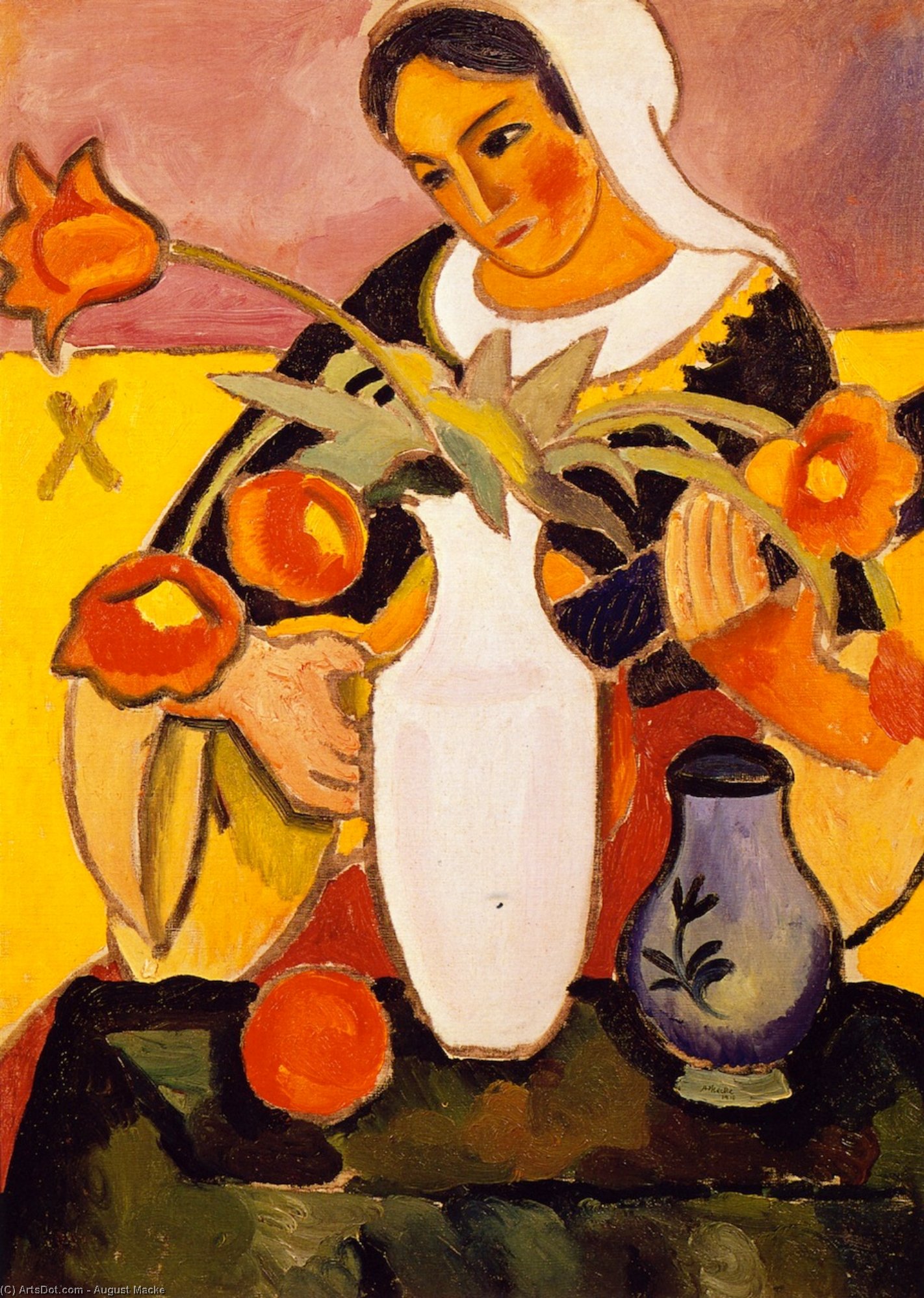
August Macke’s Woman Playing the Lute: A Portrait of Fragility Amidst Expressionist Boldness The painting “Woman Playing the Lute,” executed by August Macke in 1910, stands as a poignant emblem of German Expressionism's aesthetic sensibilities – a captivating blend of delicate beauty and unsettling psychological depth. More than just a depiction of an instrument and its performer, it’s a meticulously crafted meditation on vulnerability and artistic contemplation within the turbulent…

Reclining female nude by August Macke
7

Reclining female nude

Oil

In this intimate composition, a woman rests upon a bed, her body partially draped in a sheet that softens the contours of her form. She is positioned on her side, her gaze turned away from us toward something unseen beyond the frame. There is a profound sense of stillness here, a moment of private repose captured in a way that feels both fleeting and permanent. The background is a deep,…

Ballet Russes I (1912) by August Macke
8

Ballet Russes I

1912 · Oil On Canvas · Kunsthalle Bremen, Bremen

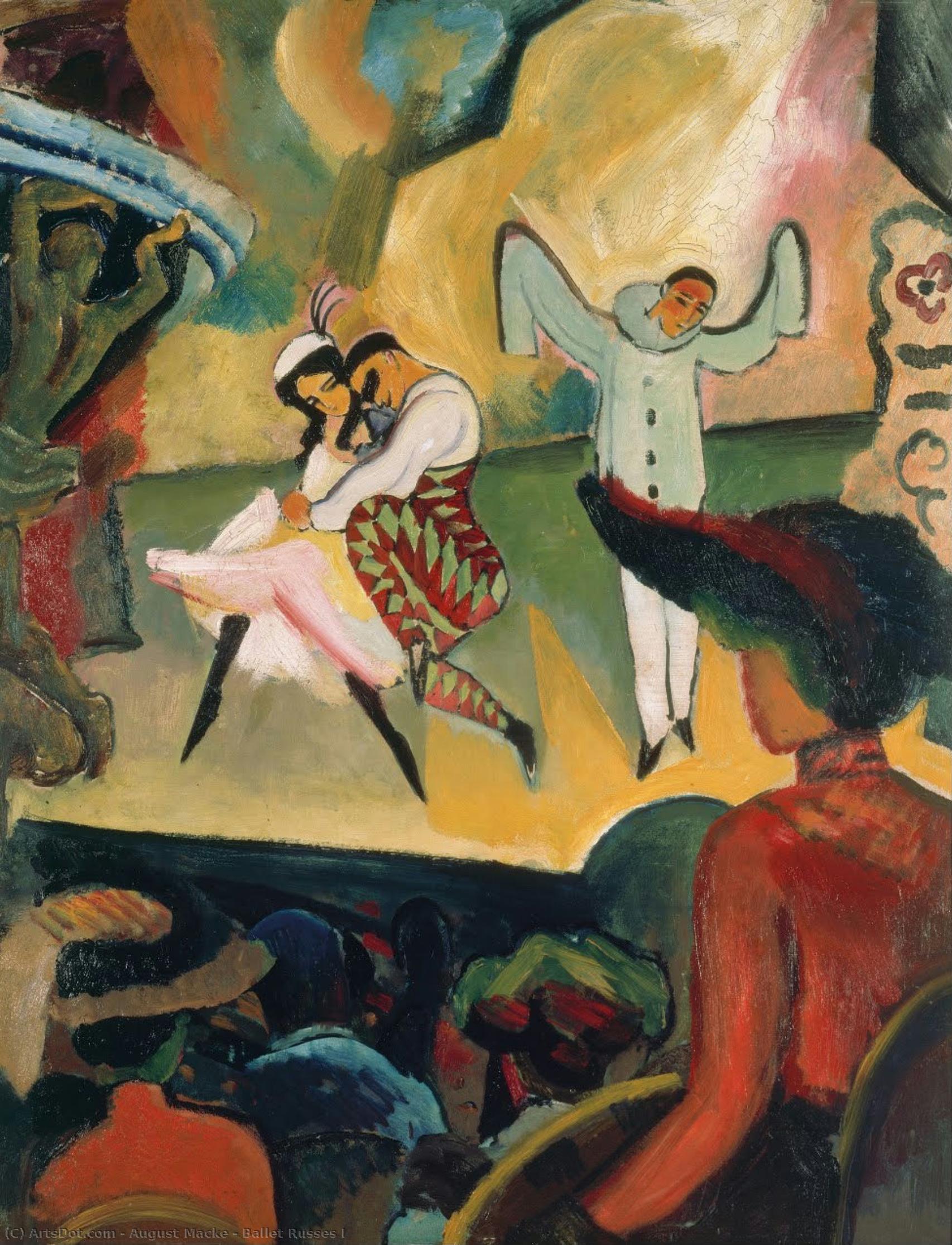
Ballet Russes I is an oil painting on canvas that depicts a dramatic scene from a ballet performance. The composition centers on two principal dancers in a close embrace, illuminated by a warm light source. The figure of Harlequin is shown in the act of abducting the coquettish Columbine. Nearby, the figure of Pierrot is depicted with arms raised in a plaintive gesture of abandonment, a movement echoed by a…

Couple in the woods (1912) by August Macke
9

Couple in the woods

1912 · Acrylic On Canvas

August Macke's "Couple in the Woods," painted in 1912, is more than just a depiction of two figures amidst a woodland setting; it’s a vibrant distillation of the burgeoning Orphism movement and a poignant reflection on the anxieties and aspirations of early 20th-century Germany. Created during a pivotal moment in Macke's artistic development, this work showcases his increasingly bold experimentation with color and form, anticipating the radical shifts that would…

The rest of the August Macke ranking, 11 to 100

Naked Girl with Headscarf (1910) by August Macke
#35

Naked Girl with Headscarf

1910 · Städel Museum

The oil painting titled Naked Girl with Headscarf was created by the German artist August Macke in 1910. This work belongs to the Expressionist movement, utilizing a medium…

Order a reproduction →
Couple on the Forest Track (1913) by August Macke
#36

Couple on the Forest Track

1913 · Lehmbruck Museum

“Couple on the Forest Track,” painted in 1913 by August Macke, is more than just a depiction of two women amidst a woodland scene; it's a poignant encapsulation…

Bring it home →
Leave-taking (1914) by August Macke
#37

Leave-taking

1914

A Bustling Street in Motion Leave-taking unfolds as a lively urban scene where the rhythm of daily life pulses through a crowded thoroughfare. People move in a synchronized…

Order a reproduction →
Landscape near Hammamet (1914) by August Macke
#38

Landscape near Hammamet

1914 · Westfälishes Landesmuseum

This watercolor depicts a serene coastal landscape overlooking the Mediterranean Sea, situated close to Hammamet, Tunisia. The composition features a small boat gliding across calm waters, framed by…

Commission a hand-painted copy →
House in a Landscape by August Macke
#40

House in a Landscape

To gaze upon August Macke’s "House in a Landscape" is to step through a portal into a sun-drenched, almost dreamlike corner of early 20th-century life. The scene unfolds…

Bring it home →
St. Germain near Tunis (1914) by August Macke
#41

St. Germain near Tunis

1914

is a watercolor painting created in 1914. The artwork depicts a cityscape featuring a variety of buildings and structures, including houses with different colors and styles. A woman…

Bring it home →
Hat Shop (1914) by August Macke
#44

Hat Shop

1914 · Museum Folkwang

August Macke's "Hat Shop" (1914) isn’t merely a depiction of a street scene; it’s a carefully constructed distillation of modern experience, rendered with the vibrant energy and emotional…

Commission a hand-painted copy →
Self-Portrait with Hat (1909) by August Macke
#49

Self-Portrait with Hat

1909

August Macke’s Self-Portrait with Hat, painted in 1909, captures more than just a likeness; it arrests a moment of vibrant, almost theatrical engagement. The central figure dominates the…

Order a reproduction →
Tegernsee Landscape (1910) by August Macke
#53

Tegernsee Landscape

1910 · Germanisches Nationalmuseum

August Macke captured the essence of the Bavarian scenery in his 1910 work, Tegernsee Landscape. This oil on canvas presents a specific moment of light and color through…

Bring it home →
Afternoon in the Garden (1913) by August Macke
#54

Afternoon in the Garden

1913

August Macke’s Afternoon in the Garden transports us into a scene steeped in the gentle warmth of early 20th-century leisure. This watercolor captures more than just a gathering;…

Order a reproduction →
Native Sea Fight (1912) by August Macke
#55

Native Sea Fight

1912

August Macke’s Native Sea Fight is not merely a depiction of naval combat; it is a visceral plunge into the heart of human drama played out against the…

Bring it home →
Landscape by the Sea (1914) by August Macke
#56

Landscape by the Sea

1914 · Bavarian State Painting Collections

The scene unfolds in Landscape by the Sea, an expressive work by August Macke. Created in 1914, this painting captures a coastal moment through a lens of intense…

Commission a hand-painted copy →
Woman in park (1914) by August Macke
#57

Woman in park

1914 · MOMA - Museum of Modern Art

In the fleeting moments before the shadows of the Great War descended upon Europe, August Macke captured a vision of serenity that remains as vibrant today as it…

Commission a hand-painted copy →
Girls under Trees (1914) by August Macke
#62

Girls under Trees

1914 · Staatsgalerie Moderner Kunst

August Macke's “Girls Under Trees” (1914) isn't merely a depiction of children playing in the woods; it’s a vibrant distillation of early 20th-century optimism and a powerful expression…

Order a reproduction →
Parkway (1914) by August Macke
#67

Parkway

1914

To stand before August Macke’s Parkway is to be enveloped by a joyous, almost breathless current of modern existence. This oil on canvas, dating from the pivotal year…

Order a reproduction →
People by the Blue Lake (1913) by August Macke
#69

People by the Blue Lake

1913

The scene unfolds in 1913, a moment frozen in time as August Macke captures a quiet afternoon by the water. In this genre art piece, titled People by…

Bring it home →
Sunny way (1913) by August Macke
#70

Sunny way

1913 · Westfälishes Landesmuseum

In the fleeting moments captured within "Sunny Way," we are transported to a world where the boundaries between nature and humanity dissolve into a vibrant dance of color.…

Bring it home →

August Macke's paintings by period

The subjects August Macke painted most

The four subjects that return most often among these masterpieces, with the finest example of each.

Where to see August Macke's paintings

The 8 museums that hold the most of the paintings on this page.

Museum City Works by August Macke Paintings from this list
Westfälishes Landesmuseum, MunsterWestfälishes Landesmuseum Munster 19 Portrait of the Artist's Wife with Hat, Knight Georg and Dragon, Circus Scene I: Equestrian with Clowns
Lenbachhaus, MunichLenbachhaus Munich 17 Portrait Elisabeth Macke, Study for a self-portrait, The Spirit in the House Furniture: Still Life with Cat
Kunstmuseum, BonnKunstmuseum Bonn 11 Courtyard of a Villa at St. Germain, Red House in a Park, St. Mary's with Houses and Chimney (Bonn)
Städel Museum, FrankfurtStädel Museum Frankfurt 4 Two Girls, Naked Girl with Headscarf
Thyssen-Bornemisza Museum, MadridThyssen-Bornemisza Museum Madrid 3 Circus, Woman on a Divan
Staatsgalerie Moderner Kunst, MunichStaatsgalerie Moderner Kunst Munich 2 Bathing girls with town in the backgraund, Girls under Trees
Bavarian State Painting Collections, MunichBavarian State Painting Collections Munich 5 Landscape by the Sea
Albertina, ViennaAlbertina Vienna 4 Sailing boat on the Tegernsee

August Macke through the years: the masterpieces of each year

12 years of August Macke's painting, 1903 to 1914, told year by year through its best-known works.

  1. 1903
  2. 1906
    Self Portrait (1906) by August Macke
    No. 20 of 100

    Self Portrait

    Age 19 · Westfälishes Landesmuseum
  3. 1906
    Self-portrait (1906) by August Macke
    No. 59 of 100

    Self-portrait

    Age 19

    In the quiet, focused gaze of Self-portrait (1906), we encounter a rare moment of stillness from an artist whose life would soon be swept up in the turbulent…

  4. 1907
  5. 1907
  6. 1907
  7. 1908
  8. 1908
  9. 1909
    Portrait of the Artist's Wife with Hat (1909) by August Macke
    #4 of 100

    Portrait of the Artist's Wife with Hat

    Age 22 · Westfälishes Landesmuseum

    August Macke’s “Portrait of the Artist’s Wife with Hat,” painted in 1909, isn't merely a depiction of a woman; it’s a carefully constructed window into the heart of…

  10. 1909
  11. 1909
    Self-Portrait with Hat (1909) by August Macke
    #49 of 100

    Self-Portrait with Hat

    Age 22

    August Macke’s Self-Portrait with Hat, painted in 1909, captures more than just a likeness; it arrests a moment of vibrant, almost theatrical engagement. The central figure dominates the…

  12. 1910
    Woman Playing the Lute (1910) by August Macke
    No. 6 of 100

    Woman Playing the Lute

    Age 23 · Musee d'art Moderne de la Ville de Paris

    August Macke’s Woman Playing the Lute: A Portrait of Fragility Amidst Expressionist Boldness The painting “Woman Playing the Lute,” executed by August Macke in 1910, stands as a…

  13. 1910
    Portrait Elisabeth Macke (1910) by August Macke
    No. 13 of 100

    Portrait Elisabeth Macke

    Age 23 · Lenbachhaus

    The gaze of Elisabeth Macke meets the viewer in this intimate 1910 portrait, a work titled Portrait Elisabeth Macke. Painted by the artist August Macke, the piece captures…

  14. 1910
  15. 1911
  16. 1911
  17. 1912
    Ballet Russes I (1912) by August Macke
    #8 of 100

    Ballet Russes I

    Age 25 · Kunsthalle Bremen

    Ballet Russes I is an oil painting on canvas that depicts a dramatic scene from a ballet performance. The composition centers on two principal dancers in a close…

  18. 1912
    Couple in the woods (1912) by August Macke
    #9 of 100

    Couple in the woods

    Age 25

    August Macke's "Couple in the Woods," painted in 1912, is more than just a depiction of two figures amidst a woodland setting; it’s a vibrant distillation of the…

  19. 1912
  20. 1913
    Woman in a Green Jacket (1913) by August Macke
    No. 1 of 100

    Woman in a Green Jacket

    Age 26 · Museum Ludwig

    Painted in 1913, this captivating artwork by German Expressionist August Macke offers a vibrant snapshot of leisure and social interaction. More than just a depiction of figures strolling…

  21. 1913
    Bathing girls with town in the backgraund (1913) by August Macke
    Rank 2 / 100

    Bathing girls with town in the backgraund

    Age 26 · Staatsgalerie Moderner Kunst

    August Macke's "Bathing Girls with Town in the Background" is a captivating masterpiece that embodies the spirit of early 20th-century Expressionism. Created in 1913, this painting is a…

  22. 1913
    The Hat Shop (1913) by August Macke
    #3 of 100

    The Hat Shop

    Age 26

    Subject and Composition This captivating artwork captures a lively yet intimate moment within an urban boutique, where a woman is engaged in the simple act of shopping for…

  23. 1914
  24. 1914
  25. 1914

August Macke's paintings: frequently asked questions

What is the most famous August Macke painting?Show the answer

Woman in a Green Jacket (1913), Museum Ludwig, Cologne. Next come Bathing girls with town in the backgraund (1913) and The Hat Shop (1913).

At what age did August Macke paint Woman in a Green Jacket?Show the answer

26 years old: Woman in a Green Jacket dates from 1913 and August Macke was born in 1887.

Which are the 10 most famous August Macke paintings?Show the answer

Woman in a Green Jacket, Bathing girls with town in the backgraund, The Hat Shop, Portrait of the Artist's Wife with Hat, People by the Lake, Woman Playing the Lute, Reclining female nude, Ballet Russes I, Couple in the woods and Circus. The ranking above gives the year and the museum of each.

How many paintings by August Macke are there?Show the answer

Our catalogue lists 283 works by August Macke, dated from 1903 to 1914.

Where can I see the most famous August Macke paintings?Show the answer

Most of them are in Westfälishes Landesmuseum (Munster), Lenbachhaus (Munich) and Kunstmuseum (Bonn). The table above lists the museums one by one.

In which period did August Macke paint the best-known works?Show the answer

In 1914: 25 of the 100 works on this page date from then, among them Woman with Parrot.

What is the earliest famous August Macke painting, and the latest?Show the answer

The earliest on this page is Portrait of Dr. Ludwig Deubner, writing (1903), the latest Woman with Parrot (1914).

What subjects did August Macke paint?Show the answer

Landscape (14), Trees (9) and German art (8), among the 100 works on this page.

What did August Macke paint on, and with what?Show the answer

Oil On Canvas: 28 of the 100 works on this page.

Which movement does August Macke's art belong to?Show the answer

Expressionism, as the paintings on this page show.

What August Macke paintings does the Westfälishes Landesmuseum hold?Show the answer

Portrait of the Artist's Wife with Hat, Knight Georg and Dragon and Circus Scene I: Equestrian with Clowns are among the 12 works on this page held by the Westfälishes Landesmuseum, Munster.

Where can I buy a August Macke reproduction?Show the answer

Yes. Every painting on this page can be ordered as a museum-quality, hand-painted oil reproduction or a fine art print, in the size you choose, from the painting's own page.

August Macke: biography

Early Life, Family and Training

The story of August Macke begins in the town of Meschede, Germany, where he was born on January 3, 1887. He was the only son born to August Friedrich Hermann Macke, a building contractor and amateur artist, and Maria Florentine. His childhood was shaped by the shifting fortunes of his father’s company, which brought the family to Cologne and later to Bonn. Even as a young boy, the pull of visual expression was evident; he spent his early years sketching and designing sets for school plays, finding a way to translate his surroundings onto paper long before he ever stepped into a formal academy.

His formal education in the arts began in earnest when he arrived at the Düsseldorf Academy, where he studied from 1904 to 1906. Under the guidance of Adolf Maennchen, he learned the discipline of traditional technique, yet his spirit seemed to crave something more expansive. This restlessness led him to seek further knowledge through night classes with Fritz Helmut Ehmke. His hunger for understanding the craft drove him toward Berlin, where he studied under the German painter Lovis Corinth. These years of rigorous training provided the technical foundation upon which he would later build his unique visual language, moving away from the strictures of his early instruction toward a more personal way of seeing.

The Influence of French Modernism

The streets of Paris exerted a powerful pull on the young artist, drawing him away from the traditional structures of his training. During his first visit to the city in 1907, he found himself profoundly moved by the Impressionist painters. He began to emulate their approach, seeking to capture the play of light through subtly dappled colors. This was no passing interest; he returned to Paris frequently between 1907 and 1912, allowing the atmosphere of the French capital to reshape his perception of the canvas.

A transformative moment arrived in 1912 when he encountered Robert Delaunay. This meeting proved to be a revelation, fundamentally altering the direction of his work. He became deeply influenced by Delaunay's chromatic Cubism, a style that focused on the rhythm of color and light. This approach, often associated with Orphism, encouraged him to move toward a more dynamic and non-representational way of seeing. He began to experiment with broken planes of color, seeking to translate the sensation of modern life into a language of pure light and form.

Membership in Der Blaue Reiter

The trajectory of Macke’s life shifted significantly in 1909 when he arrived in Munich. It was there that he encountered Franz Marc, a meeting that would spark a deep and lasting friendship. This connection drew him into a circle of thinkers and creators who sought to move beyond the mere imitation of nature. By 1911, Macke had become a leading member of the influential Expressionist group known as Der Blaue Reiter. He did not merely participate in the movement; he helped to shape its very spirit, contributing to its exhibitions and the spread of its radical ideas.

His place within this avant-garde circle was strengthened by his close ties to other luminaries of the era. He shared a profound bond with Marc and Paul Klee, finding in their company a shared pursuit of the spiritual and the emotive. Even as he moved through the shifting landscapes of modernism, his interactions with figures like Robert Delaunay helped to refine his unique perspective. While others in the group often explored darker or more anxious themes, Macke sought a sense of harmony and beauty. He looked at the world and saw a place of light and joy, even as the political shadows of Europe began to lengthen.

Artistic Technique and Style

Macke sought to capture the inner spirit of a scene rather than the mere surface of things. His brushwork moved away from the objective reproduction of reality, choosing instead to express deep-seated feelings and moods. To achieve this, he frequently distorted both color and form, bending the physical world to suit his emotional needs. His compositions often relied on bold colors and geometric shapes, creating a sense of structure amidst the expressive flux of his subjects. He found a way to weave the dynamism of Italian Futurism into his compositions, imbuing his scenes with a sense of movement and modern energy.

This pursuit of light and color reached a peak during his travels to North Africa. His Tunisian watercolors from 1914 reveal an exceptional command of color, capturing the intense, shifting light of the region. In these works, the pigment seems to pulse with a life of its own, moving beyond simple representation toward a more luminous, spiritual essence. He did not merely paint the landscape; he painted the sensation of being within it.

Key Works and Masterpieces

As his vision matured, Macke began to capture the quiet rhythms of modern life through a lens of intense color. In 1913, he produced Woman in a Green Jacket, a work that radiates a certain vitality through its bold palette and confident brushwork. His interest in the interplay of light and urbanity led him to create Large Bright Shop Window, where he explored the way light filters through glass. He often turned his attention to the simple pleasures of existence, such as in Bathing girls with town in the backgraund, where he sought to portray a sense of idyllic tranquility through simplified forms.

The final period of his life, shaped by his travels to North Africa, brought a new luminosity to his canvases. His time in Tunisia resulted in a series of works that many consider his finest achievements, most notably Türkisches Café. This period also produced Market in Tunis, a work that later fetched $4.1 million (£2.86 million) in a 2000 auction. Even as the shadows of war loomed, he continued to find beauty in intimate settings, such as in The Couple at a Garden Table, which was sold for £2 million at a 1997 Christie's auction.

Later Years and Tragic Death

The year 1914 brought a sudden shift in the light that Macke sought to capture. In the spring, he traveled to Tunis, Tunisia, accompanied by Paul Klee and Louis Moilliet. This excursion allowed him to witness a different kind of sun, influencing the luminist approach that would define his final period. He returned to a Europe that was rapidly descending into chaos. As the first month of the Great War passed, the artist found himself drawn into the conflict. Driven by a sense of duty, he volunteered for military service.

The end came with startling speed. In the second month of the First World War, Macke was killed in action at the front in France. He fell near Perthes-lès-Hurlus on 26 September 1914. He was only 27 years old. His death occurred just as his artistic language was reaching a new level of clarity and light. The suddenness of his passing left a void in the avant-garde circles of Germany, cutting short a career that had been defined by a restless, searching spirit.

Legacy and Influence

Though his time in the sun was brief, the impact Macke left upon the major artistic movements of the twentieth century remains profound. He secured his place in history as a significant figure within Expressionism, offering a perspective that often sought harmony where others found only discord. His ability to synthesize the radical ideas of his contemporaries into a personal language ensured that his vision would not be lost to the shadows of the Great War.

The weight of his contribution was formally recognized long after his passing, leading to the establishment of the August Macke Prize in 1959. This honor continues to honor the spirit of his creative inquiry. Even today, his presence is felt in the way contemporary artists continue to explore the deep connections between color and human emotion. He taught that light and hue could speak of the soul's inner state, a lesson that resonates through the decades.

Where to See the Works Today

To walk through the rooms where his spirit remains, one might travel to Bonn, Germany. There, the August-Macke-Haus stands as a dedicated sanctuary, preserving the memory of the man within the very walls where he once lived and worked. It was in this house that he found his studio, a space that allowed his creative energy to flourish before the shadows of war intervened. Nearby, the Kunstmuseum in Bonn also holds his paintings, ensuring that his vision remains accessible to those who seek the light he so carefully captured.

His presence is felt across many borders, carried in the collections of great institutions. In Cologne, the Museum Ludwig houses his works, while the Museum Folkwang in Essen keeps his canvases for the public to observe. One can also find his traces in the Staatsgalerie Moderner Kunst in Munich, where his colors continue to speak from the frames. Even in Zurich, the Kunsthaus Zürich maintains a part of his legacy, holding paintings that reflect his unique way of seeing the world.

All 283 works by August Macke →