Anton Graff, 1736 – 1813

The 79 Most Famous Paintings by Anton Graff

The painting that made Anton Graff famous is Friedrich der Große (1786); it hangs in the Sanssouci Palace, Potsdam. Portrait of Johann Nepomuk von Schaffgotsch in military uniform. (1770) and Porträt der Isabella von Broizem (1783) follow it in the hearts of collectors and museum visitors. Of the 79 works by Anton Graff in our catalogue, these 79 are the most admired, each presented with its date, its museum and what sets it apart.

Ranked by our popularity score, which combines the searches, visits and orders for each work. Updated October 2026. Every masterpiece on this page can be ordered as a museum-quality, hand-painted oil reproduction or a fine art print, at the size you choose.

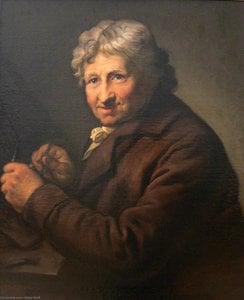
Portrait of Anton Graff
Anton Graff · 1736 – 1813
Born · died
1736 – 1813, Winterthur
Movement
Neoclassicism
Works in our catalogue
79
Most famous
Friedrich der Große (1786)
Most works at
Gemäldegalerie

Anton Graff: the ten masterpieces

Friedrich der Große (1786) by Anton Graff
1

Friedrich der Große

1786 · Oil On Canvas · Sanssouci Palace, Potsdam

Anton Graff’s 1786 portrait of Frederick the Great is more than just a likeness; it’s a carefully constructed embodiment of power, intellect, and a touch of melancholy. This arresting image, housed within a relatively modest frame of 62 x 51 cm, captures the essence of a man who shaped Prussia into a formidable European force – a ruler renowned for his military brilliance, strategic mind, and surprisingly progressive policies. Graff’s…

Portrait of Johann Nepomuk von Schaffgotsch in military uniform. (1770) by Anton Graff
2

Portrait of Johann Nepomuk von Schaffgotsch in military uniform.

1770 · Oil On Canvas · National Museum in Warsaw, Warsaw

The oil on canvas work titled Portrait of Johann Nepomuk von Schaffgotsch in military uniform. captures a specific moment of presence. Created by the artist Anton Graff, the painting focuses on the likeness of Johann Nepomuk Gotthard Freiherr von Schaffgotsch. It is a study of a man defined by his station and the heavy weight of his attire.

Porträt der Isabella von Broizem (1783) by Anton Graff
3

Porträt der Isabella von Broizem

1783 · Oil On Canvas · Alte Nationalgalerie, Berlin

The face of Isabella von Broizem emerges from a void of deep, dark shadow. Light falls from the upper left, brushing against the porcelain smoothness of her skin and the delicate, translucent folds of a lace veil. She is positioned slightly off-center, her gaze directed toward the right of the frame. The composition is a bust-length portrait, quiet and still. Every line is soft, tracing the gentle contours of her…

Henriette Herz (1792) by Anton Graff
4

Henriette Herz

1792 · Oil On Canvas · Alte Nationalgalerie, Berlin

The gaze of Henriette Herz meets the viewer through this 1792 portrait by Anton Graff. She sits poised, a woman of twenty-seven years, captured in a moment of quiet presence. Her lineage traces back to a family that immigrated from Portugal, bringing a unique history to the social circles of Berlin. There is a sense of a life lived through intellect and conversation, a spirit that once anchored a famous…

Portrait of Johanna Henriette Louise Countess of Bestucheff-Rumin, née von Carlowitz (1717-1787) (?) (1774) by Anton Graff
5

Portrait of Johanna Henriette Louise Countess of Bestucheff-Rumin, née von Carlowitz (1717-1787) (?)

1774 · Oil On Canvas · Städel Museum, Frankfurt

This 1774 oil on canvas presents a bust-length portrait of a noblewoman, positioned in a three-quarter profile facing toward the left. The subject is depicted with a luminous complexion, her features defined by soft shadows created by directional lighting originating from the upper left. She wears a voluminous, high-piled wig in a light grey or powdered tone, which is adorned with a translucent, gauzy fabric draped over her shoulder. Her…

Self-portrait with green eyeshade (1813) by Anton Graff
8

Self-portrait with green eyeshade

1813 · Oil On Canvas · Alte Nationalgalerie, Berlin

The oil-on-canvas work titled Self-portrait with green eyeshade was executed by the Swiss-German portrait artist Anton Graff. Created in 1813, the painting captures the artist in his final year. It presents an elderly man, the artist himself, looking out from the frame. The subject's gaze meets the observer with a quiet, steady presence.

More Anton Graff masterpieces, 11 to 79

Self-portrait (1780) by Anton Graff
#11

Self-portrait

1780 · Bavarian State Painting Collections

This oil on canvas painting, titled Self-portrait, offers a direct encounter with the artist Anton Graff. It is a work of quiet intention, where the creator turns his…

Bring it home →
Self-portrait of Anton Graff (1736-1813) (1805) by Anton Graff
#13

Self-portrait of Anton Graff (1736-1813)

1805 · Staatliche Kunstsammlungen Dresden

Self-portrait of Anton Graff (1736-1813) by the artist Anton Graff is a self-representation created about 1805. The work functions as a documentation of the artist's own identity and…

Bring it home →
Selbstporträt (1804) by Anton Graff
#15

Selbstporträt

1804 · Alte Nationalgalerie

This oil on canvas painting, titled Selbstporträt, offers a direct encounter with the artist himself. Created in 1804, the work functions as a self-portrait, a genre that Anton…

Order a reproduction →
Henriette von Carlowitz, 1772 (1772) by Anton Graff
#20

Henriette von Carlowitz, 1772

1772 · Alte Nationalgalerie

The portrait of Henriette von Carlowitz, executed in 1772, presents a three-quarter length view of a young woman positioned against a dark, atmospheric background. The subject faces the…

Order a reproduction →
Juliane Wilhelmine Bause (1785) by Anton Graff
#21

Juliane Wilhelmine Bause

1785 · Alte Nationalgalerie

The gaze of Juliane Wilhelmine Bause meets the viewer from across the years, captured in this 1785 portrait by Anton Graff. She appears poised and serene, her presence…

Order a reproduction →
Heinrich XIII, Graf Reuss (1775) by Anton Graff
#59

Heinrich XIII, Graf Reuss

1775 · Neue Pinakothek

Anton Graff's portrait of Heinrich XIII, Graf Reuss stands as a quintessential emblem of the late Baroque and early Neoclassical era—a period characterized by intellectual curiosity, artistic refinement,…

Commission a hand-painted copy →
Self-Portrait at the Age of 58 (1794) by Anton Graff
#63

Self-Portrait at the Age of 58

1794 · Gemäldegalerie

Anton Graff's "Self-Portrait at the Age of 58," painted in 1794, is more than a simple likeness; it’s a profound meditation on aging, artistic identity, and the quiet…

Bring it home →

Anton Graff's paintings by period

The subjects Anton Graff painted most

The four subjects that return most often among these masterpieces, with the finest example of each.

Where to see Anton Graff's paintings

The 8 museums that hold the most of the paintings on this page.

Museum City Works by Anton Graff Paintings from this list
Gemäldegalerie, BerlinGemäldegalerie Berlin 13 The saxon Electoral Councilor of War Johann Gottlieb von Leyser (around 1698-1780), Doctor and Philosopher Johann Georg, Ritter von Zimmermann, The Painter Christian Wilhelm Ernst Dietrich (1712-1774)
Alte Nationalgalerie, BerlinAlte Nationalgalerie Berlin 12 Porträt der Isabella von Broizem, Henriette Herz, Self-portrait with green eyeshade
National Museum in Warsaw, WarsawNational Museum in Warsaw Warsaw 8 Portrait of Johann Nepomuk von Schaffgotsch in military uniform., Portrait of Georg Sachs, Portrait of Johann Nepomuk von Schaffgotsch in a bathrobe.
Bavarian State Painting Collections, MunichBavarian State Painting Collections Munich 4 Self-portrait, Heinrich Prince of Prussia, Friederike Elisabeth Oeser
National Museum of Art, Architecture and Design, OsloNational Museum of Art, Architecture and Design Oslo 3 Portrait of a Woman, Portrait of Freiherr von Lindemann-Just, Portrait of the Landscape Painter Carl Anton Graff
Staatliche Kunsthalle Karlsruhe, CarlsruheStaatliche Kunsthalle Karlsruhe Carlsruhe 2 Portrait of Friedrich Gottlob Benno von Heynitz, Portrait of the three daughters of Julius Johann von Vieth und Gossenau
Staatliche Kunstsammlungen Dresden, DresdenStaatliche Kunstsammlungen Dresden Dresden 2 Youthful self-portrait, Self-portrait of Anton Graff (1736-1813)
Hermitage Museum, Saint PetersburgHermitage Museum Saint Petersburg 2 Portrait of a Man, Portrait of George Leopold de Gogul

Anton Graff, decade by decade: the defining painting of each

  1. 1760s
    Youthful self-portrait (1765) by Anton Graff
    No. 7 of 79

    Youthful self-portrait

    Age 24 – 33 · Staatliche Kunstsammlungen Dresden

    Youthful self-portrait is a work by the Swiss artist Anton Graff. Executed in 1765, the painting arrived in Dresden on 16 January 1766. This specific piece arrived at…

  2. 1770s
  3. 1780s
    Friedrich der Große (1786) by Anton Graff
    No. 1 of 79

    Friedrich der Große

    Age 44 – 53 · Sanssouci Palace

    Anton Graff’s 1786 portrait of Frederick the Great is more than just a likeness; it’s a carefully constructed embodiment of power, intellect, and a touch of melancholy. This…

  4. 1790s
    Henriette Herz (1792) by Anton Graff
    Rank 4 / 79

    Henriette Herz

    Age 54 – 63 · Alte Nationalgalerie

    The gaze of Henriette Herz meets the viewer through this 1792 portrait by Anton Graff. She sits poised, a woman of twenty-seven years, captured in a moment of…

  5. 1800s
    Self-portrait of Anton Graff (1736-1813) (1805) by Anton Graff
    Rank 13 / 79

    Self-portrait of Anton Graff (1736-1813)

    Age 64 – 73 · Staatliche Kunstsammlungen Dresden

    Self-portrait of Anton Graff (1736-1813) by the artist Anton Graff is a self-representation created about 1805. The work functions as a documentation of the artist's own identity and…

  6. 1810s
    Self-portrait with green eyeshade (1813) by Anton Graff
    Rank 8 / 79

    Self-portrait with green eyeshade

    Age 74 – 77 · Alte Nationalgalerie

    The oil-on-canvas work titled Self-portrait with green eyeshade was executed by the Swiss-German portrait artist Anton Graff. Created in 1813, the painting captures the artist in his final…

Anton Graff's masterpieces: questions and answers

Which painting is Anton Graff best known for?Show the answer

Friedrich der Große (1786), Sanssouci Palace, Potsdam. Next come Portrait of Johann Nepomuk von Schaffgotsch in military uniform. (1770) and Porträt der Isabella von Broizem (1783).

How old was Anton Graff when painting Friedrich der Große?Show the answer

50 years old: Friedrich der Große dates from 1786 and Anton Graff was born in 1736.

What are Anton Graff's ten greatest paintings?Show the answer

Friedrich der Große, Portrait of Johann Nepomuk von Schaffgotsch in military uniform., Porträt der Isabella von Broizem, Henriette Herz, Portrait of Johanna Henriette Louise Countess of Bestucheff-Rumin, née von Carlowitz (1717-1787) (?), Portrait of Friedrich Gottlob Benno von Heynitz, Youthful self-portrait, Self-portrait with green eyeshade, The Poetess Elisa von der Recke and Portrait of Johann Georg Sulzer. The ranking above gives the year and the museum of each.

How many works did Anton Graff paint?Show the answer

Our catalogue lists 79 works by Anton Graff, dated from 1761 to 1813.

In which museums can I see Anton Graff's masterpieces?Show the answer

Most of them are in Gemäldegalerie (Berlin), Alte Nationalgalerie (Berlin) and National Museum in Warsaw (Warsaw). The table above lists the museums one by one.

When did Anton Graff paint the masterpieces?Show the answer

In 1780s: 18 of the 79 works on this page date from then, among them Friedrich der Große.

What are the first and last famous paintings of Anton Graff?Show the answer

The earliest on this page is Portrait of a lady (1761), the latest Self-portrait with green eyeshade (1813).

What were Anton Graff's favourite subjects?Show the answer

Man (13), Portrait (13) and Woman (7), among the 79 works on this page.

Which technique did Anton Graff favour?Show the answer

Oil On Canvas: 22 of the 79 works on this page.

What art movement is Anton Graff part of?Show the answer

Neoclassicism, as the paintings on this page show.

Which masterpieces by Anton Graff hang at the Gemäldegalerie?Show the answer

The saxon Electoral Councilor of War Johann Gottlieb von Leyser (around 1698-1780), Doctor and Philosopher Johann Georg, Ritter von Zimmermann and The Painter Christian Wilhelm Ernst Dietrich (1712-1774) are among the 13 works on this page held by the Gemäldegalerie, Berlin.

Can I own a reproduction of a Anton Graff masterpiece?Show the answer

Yes. Every painting on this page can be ordered as a museum-quality, hand-painted oil reproduction or a fine art print, in the size you choose, from the painting's own page.

The life of Anton Graff

A Life Etched in Likeness: The World of Anton Graff

Anton Graff, born in Winterthur, Switzerland in 1736, emerged as one of the most celebrated portraitists of his era—a period defined by the Enlightenment’s intellectual fervor and the burgeoning Neoclassical aesthetic. His story is not merely a chronicle of artistic skill but a fascinating journey through the social and cultural landscapes of 18th and early 19th century Europe, intimately connected with some of its most brilliant minds. Graff's beginnings were humble; he received his initial training in Winterthur under Johann Ulrich Schellenberg before venturing to Augsburg where his talent quickly outpaced the local guild’s comfort level. Forced to move on due to the anxieties of less gifted contemporaries, he found mentorship with Johann Jakob Haid and later, Leonhard Schneider in Ansbach, honing his skills while absorbing diverse artistic influences. These early experiences instilled in him not only technical proficiency but also a resilience that would characterize his career. Frequent trips to Munich allowed him to study masterworks, laying the foundation for his distinctive style—a blend of meticulous detail, psychological insight, and an emerging Neoclassical sensibility.

From Dresden Court Painter to Chronicler of an Era

The pivotal moment in Graff’s career arrived with his appointment as court painter to the Saxon electorate in Dresden in 1766. This position provided him not only financial security but also access to a vibrant intellectual circle and a steady stream of prominent sitters. He quickly became *the* portraitist of choice for the leading figures of the German Enlightenment, immortalizing individuals like Friedrich Schiller, Christoph Willibald Gluck, Gotthold Ephraim Lessing, Moses Mendelssohn, and Johann Gottfried Herder on canvas. These were not simply likenesses; Graff possessed a remarkable ability to capture the inner lives of his subjects—their intellect, their passions, and their vulnerabilities. He wasn’t merely painting faces; he was documenting an intellectual revolution. His portraits became visual embodiments of the era's philosophical and artistic currents. The invitation from Christian Ludwig von Hagedorn, director of the Dresden Art Academy, initially met with Graff’s own self-doubt, speaks volumes about his humility despite undeniable talent. It was a self-portrait that ultimately secured his position, demonstrating a confidence and skill that resonated deeply within the court.

A Master of Light, Shadow, and Social Nuance

Graff's artistic technique was characterized by a masterful command of light and shadow, influenced significantly by the work of Ján Kupecký, whose paintings he studied intently. He employed this skill to draw attention to the faces of his sitters, imbuing them with depth and psychological complexity. However, Graff wasn’t oblivious to the social conventions of his time; while focusing on the face for male subjects, he often subtly highlighted the décolletage of female sitters—a nod to prevailing aesthetic expectations. His attention to detail extended beyond the human form, encompassing the textures of fabrics and draperies with a precision reminiscent of French court painters like Hyacinthe Rigaud. Initially favoring monochrome backgrounds, Graff later embraced outdoor settings, reflecting the growing trend in English portraiture. The price of his portraits reflected not only his time but also the intricacy of the sitter’s attire—a testament to the importance placed on social status and material wealth during that period. He was a keen observer of human nature, famously noting Schiller's difficulty in remaining still for a sitting – a charming anecdote revealing both his patience and his perceptive eye.

Legacy and Historical Significance

Anton Graff’s influence extended beyond the realm of portraiture. As a teacher at the Dresden Art Academy, he nurtured the talents of future generations of artists, including Emma Körner, Philipp Otto Runge, and Karl Ludwig Kaaz. His work represents a crucial bridge between the Rococo and Neoclassical styles, embodying both the elegance and ornamentation of the former with the clarity and restraint of the latter. He painted nearly 1,000 portraits during his lifetime, creating an invaluable visual record of the German Enlightenment and its leading figures. Perhaps his most celebrated work is the portrait of Frederick the Great, a masterpiece created without ever having the king pose for him directly. Graff cleverly observed the monarch during military parades, capturing his commanding presence and steely gaze with remarkable accuracy. This painting, housed at Schloss Charlottenburg, remains an iconic image of Prussian power and leadership. Anton Graff’s legacy endures not only through his stunning portraits but also as a testament to the power of art to capture the spirit of an age. He was more than just a painter; he was a chronicler, a social commentator, and a master of human representation whose work continues to resonate with audiences today.

A Lasting Impression

Despite receiving lucrative offers from other academies, including one in Berlin, Graff remained committed to Dresden, solidifying his position as the leading portrait painter in Germany throughout the late 18th and early 19th centuries. His clientele extended beyond the German nobility to include Russian, Polish, and Baltic aristocrats, further cementing his international reputation. He was a favorite among poets, musicians, diplomats, and scholars—individuals who appreciated his ability to capture their essence on canvas. Graff’s portraits offer a unique window into a pivotal period in European history, providing invaluable insights into the lives, thoughts, and aspirations of those who shaped the Enlightenment and laid the foundations for the Romantic era. His work stands as a lasting tribute to the power of portraiture to transcend mere representation and become a profound expression of human experience.

All 79 works by Anton Graff →