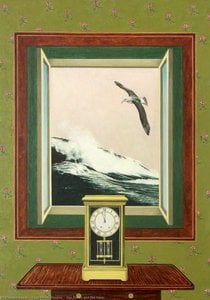
Tony Steele Morgan: A Master of Dramatic Portraiture
Tony Steele Morgan (1930-2009) was a singular figure in 20th-century British art, renowned for his intensely dramatic and psychologically probing figurative paintings. His work, often characterized by stark lighting, rich textures, and a palpable sense of narrative, transcends mere portraiture to become explorations of character, history, and the human condition. Morgan’s career spanned six decades, marked by a consistent dedication to his distinctive style and a profound engagement with historical subjects, particularly those rooted in British identity.
Born in Detroit, Michigan, in 1930, Morgan's early life was shaped by his father’s profession as a professional wrestler – an influence that would later inform his artistic approach. He moved to England in the late 1950s and quickly established himself within the vibrant London art scene. Initially drawn to the Group Theatre movement, he honed his skills in stage design and set construction before transitioning to painting. His early works demonstrated a clear debt to the theatrical traditions of the Group, utilizing bold compositions and dramatic lighting reminiscent of Bertolt Brecht’s stagecraft. This initial period was characterized by a focus on social commentary and political themes, reflecting the anxieties and upheavals of post-war Britain.
- Early Influences: Morgan's artistic development was significantly shaped by his exposure to American theatre and film, particularly the works of directors like John Ford and Howard Hawks. He also drew inspiration from the British Romantic painters, notably J.M.W. Turner, whose use of light and atmosphere profoundly influenced his own approach to color and composition.
- Theatrical Techniques: Morgan’s background in theatre is evident throughout his oeuvre. He frequently employed techniques borrowed from stage design – dramatic lighting, theatrical poses, and carefully constructed narratives – to create a sense of immediacy and emotional intensity within his paintings.
A Palette of Power and Emotion
Morgan's distinctive style is immediately recognizable by its masterful manipulation of light and shadow. He rarely employed subtle gradations; instead, he favored stark contrasts that heightened the drama of each scene. His palette was rich and earthy, dominated by deep reds, browns, and ochres, punctuated by flashes of gold and silver. This combination created a sense of both warmth and intensity, reflecting the complex emotions he sought to convey.
He frequently depicted historical figures – from Sir John Perrot, a 16th-century English nobleman, to Lord Elwyn Jones, a prominent Welsh politician – imbuing them with a contemporary relevance. These portraits were not simply representations of likeness; they were carefully constructed narratives designed to evoke specific moods and emotions. Morgan’s use of symbolism—often subtle yet potent—added layers of meaning to his work, inviting viewers to engage in a deeper interpretation.
- Compositional Strategies: Morgan often employed dynamic compositional arrangements, utilizing diagonal lines and asymmetrical balances to create a sense of movement and tension.
- Texture and Surface Detail: He meticulously rendered surface detail, using thick impasto techniques to build up layers of paint that created a tactile quality within his paintings. This attention to texture further enhanced the sense of drama and immediacy.
Major Works and Historical Significance
Several works stand out as particularly significant examples of Morgan’s artistic vision. “Tiger Mirror Box” (1976), a large-scale painting depicting a mysterious figure in a dimly lit room, is considered one of his most iconic pieces. The work's unsettling atmosphere and ambiguous narrative have captivated viewers for decades. Similarly, "Horse" (1977) captures the raw power and vulnerability of a lone rider against a dramatic sky, while “Ovis Alarmed” (1973) presents a striking image of a sheep in distress, prompting reflection on themes of innocence and vulnerability.
Morgan’s work gained increasing recognition throughout the 1970s and 80s, with exhibitions at major galleries across Britain. His paintings are now held in public collections including Scolton Manor Museum, Newport Museum and Art Gallery, and The National Library of Wales. He is remembered as a significant figure in British figurative painting, whose dramatic style and psychological depth continue to resonate with contemporary audiences.
Legacy and Continuing Influence
Tony Steele Morgan’s legacy extends beyond his individual works; he represents a pivotal moment in the evolution of British portraiture. His willingness to embrace theatrical techniques and explore complex emotional landscapes paved the way for subsequent generations of artists who sought to challenge traditional conventions and engage with the darker aspects of human experience. His influence can be seen in the work of contemporary figurative painters who continue to experiment with dramatic lighting, symbolic imagery, and narrative storytelling.