Tian Shixin: Bridging Tradition and Innovation in Sculpture
Tian Shixin (born 1941, Beijing) stands as a prominent figure in contemporary Chinese sculpture, recognized for his profound engagement with philosophical concepts – particularly Lao Tzu’s “The Way of Hard and Soft” – and his masterful execution of sculptural forms that resonate with both cultural heritage and artistic experimentation. His journey began at the Beijing Fine Arts Academy where he honed foundational skills before embarking on a distinguished academic career as professor at the Sculpture Graduate School of Central Academy of Art & Design, shaping generations of artists.- Early Influences: Shixin’s formative years were marked by exposure to Marxist aesthetics and socialist realism, reflecting the artistic landscape of his time. However, he quickly transcended these constraints, demonstrating an innate inclination towards exploring abstract forms and conveying emotional depth.
- Lao Tzu's Philosophy: The core of Shixin’s artistic vision is rooted in Lao Tzu’s Tao Te Ching – specifically the concept of “Hard and Soft.” He interprets this principle not merely as opposing forces but as interdependent elements crucial for achieving harmony and balance. This philosophical underpinning informs his sculptural explorations, where he seeks to capture dynamism through seemingly contradictory textures and shapes.
Sculptural Style and Technique
Shixin’s distinctive style is characterized by a deliberate fusion of traditional Chinese craftsmanship with modern artistic sensibilities. He predominantly utilizes bronze casting – a technique deeply embedded in Chinese history – but employs innovative methods to achieve remarkable textural complexity and sculptural precision. His works often incorporate intricate patterns inspired by ancient calligraphy and decorative arts, subtly referencing cultural traditions while maintaining an uncompromising commitment to formal abstraction.- Material Exploration: Bronze remains Shixin’s favored medium, allowing him to manipulate molten metal with exceptional skill. He meticulously controls temperature variations and utilizes specialized molds to create surfaces that exhibit subtle gradations of color and texture – mirroring the fluidity described in Lao Tzu's teachings.
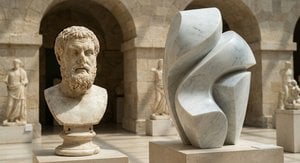
- Formal Abstraction: Despite drawing inspiration from Chinese iconography, Shixin’s sculptures rarely depict recognizable subjects. Instead, he prioritizes geometric forms and curvilinear lines, striving to express universal emotions and spiritual concepts through pure visual language.
Notable Works and Exhibitions
Shixin's artistic reputation solidified with several internationally acclaimed pieces including “Seated Portrait of Lu Xun No.1,” a poignant depiction capturing the spirit of China’s literary icon, and "Covered Bridge: Life is a Lively Play," which embodies Shixin's exploration of balance and movement. His sculptures have graced galleries across Europe and North America, garnering critical acclaim for their conceptual depth and artistic merit.- Recognition & Awards: Shixin’s contributions to the art world have been acknowledged through numerous awards and honors, cementing his position as one of China's leading sculptors.
Legacy and Significance
Tian Shixin’s oeuvre represents a pivotal moment in Chinese sculpture history. He successfully reconciled tradition with innovation, demonstrating that artistic expression can simultaneously honor cultural heritage while embracing contemporary aesthetic concerns. His sculptures continue to inspire artists globally, serving as a testament to the enduring power of philosophical contemplation and masterful craftsmanship—a legacy firmly rooted in Lao Tzu's wisdom and expressed through breathtaking sculptural forms.Questions & Answers
How do I find works by Tian Shixin in a specific palette?
To find works by Tian Shixin in a specific palette, use the artist's By Palettes page.
Can I sort Tian Shixin's artworks by color?
The Spectral Index page organizes Tian Shixin's artworks by color.
Is there an overview of all the subjects Tian Shixin painted?
The Subject Atlas page maps Tian Shixin's artworks by subject.