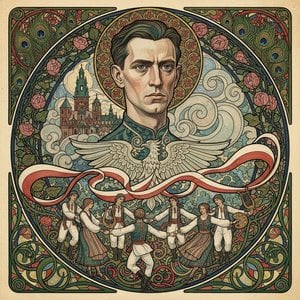
The Soul of the Carpathian Meadows: The Life of Tadeusz Lubicz Rybkowski
In the tapestry of nineteenth-century Polish art, few threads are as vibrant or as deeply rooted in the soil of tradition as those woven by Tadeusz Lubicz Rybkowski. Born in 1848 in Kielce, Rybkowski emerged from a period of profound national identity formation, carrying with him a vision that would eventually bridge the gap between academic rigor and the raw, lyrical beauty of rural life. His journey was one of constant movement and intellectual expansion, beginning with his formative studies in Kraków under the guidance of Władysław Łuszczkiewicz. This foundation in the Polish academic tradition provided him with the technical precision that would later allow him to capture the most delicate nuances of light and texture, yet it was his subsequent travels through the artistic hubs of Europe that truly expanded his visual vocabulary.
The pursuit of excellence led Rybkiowski to Vienna, where he immersed himself in the prestigious Academy of Fine Arts between 1875 and 1877. It was here, amidst the cosmopolitan energy of the Austro-Hungarian Empire, that he encountered the burgeoning influences of Impressionism. Studying under masters such as Leopold Löffler and Hans Makart, he learned to manipulate palette and composition to evoke atmosphere rather than mere documentation. This period of refinement allowed him to integrate a more fluid, light-sensitive approach into his work, though he never abandoned the meticulous observational skills instilled in him during his youth. His ability to marry the structural discipline of the academy with a softer, more emotive use of color became the hallmark of his maturing style.
A Vision of Hucul Traditions and Rural Splendor
While his training was international, Rybkowski’s heart remained firmly planted in the landscapes of Galicia and the cultural heritage of the Hucul people. He possessed a rare, empathetic eye for the rhythms of peasant life, transforming everyday agricultural labors into scenes of profound dignity and quiet grandeur. His canvases do not merely depict subjects; they breathe with the vitality of the Carpathian mountains. One might find himself lost in the golden warmth of an autumnal sunset or the lush, verdant depths of a summer meadow, all rendered with a sensitivity that honors the subject matter.
His oeuvre is celebrated for its ability to capture the essence of folk existence through several key thematic elements:
- The Dignity of Labor: Through depictions of farmers harvesting crops and shepherds tending their flocks, he elevated the mundane tasks of rural life to the level of high art.
- Cultural Portraiture: His fascination with the Hucul people allowed him to document unique costumes, customs, and the rugged beauty of their mountain dwellings with ethnographic accuracy.
- Atmospheric Landscapes: He mastered the use of light to convey the passage of time, from the hazy, nostalgic glow of a fairground to the stark, clear light of a mountain morning.
Works such as “Returning from a Fair” and “A Man in a Russet Coat” serve as quintessential examples of his mastery. In these pieces, the viewer is invited to experience the texture of heavy wool, the dust of a traveled path, and the subtle emotional weight carried by his subjects. There is an understated majesty in his ability to use subtle visual cues—a tilt of a head or the way light catches a sleeve—to communicate deep-seated human emotions.
Legacy of a Versatile Master
Beyond the confines of the easel, Rybkowski’s artistic spirit was remarkably versatile. He understood that art could permeate all aspects of culture, leading him to contribute significantly to the world of book illustration and even large-scale decorative arts. His illustrations brought a sense of narrative depth to literature, while his ambitious wall murals demonstrated a command over space and scale that few of his contemporaries could match. This versatility ensured that his influence was felt not just in galleries, but in the very fabric of the visual culture of his time.
As a respected teacher of drawing in Lviv, he also played a crucial role in nurturing the next generation of artists, passing on the rigorous standards of his Kraków and Vienna training. Though he passed away in 1926, his legacy remains an essential pillar of Polish art history. He stands as a painter who successfully synthesized the academic traditions of the past with a modern, emotive sensibility, ensuring that the fleeting beauty of the Polish countryside and the enduring spirit of its people would be preserved in pigment for eternity.