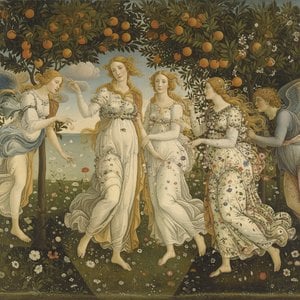
A Tapestry of French and Italian Traditions
In the vibrant landscape of the late fourteenth and early 15th centuries, few artists embodied the cross-pollination of European styles as gracefully as Stefano da Zevio. Born into a lineage of artistry as the son of the French painter Jean d'Arbois, Stefano carried within him a unique heritage that bridged the gap between Northern elegance and Italian innovation. His journey through the artistic hubs of Italy—from the workshops of illuminators in Pavia to the storied streets of Padua—prepared him for his ultimate settling in Verona, where he would leave an indelible mark on the city's visual identity. This movement across regions allowed him to absorb a diverse array of techniques, blending the meticulous precision of Northern traditions with the burgeoning light and grace of the Italian peninsula.The Luminous Splendor of the International Gothic
Stefano’s work is a breathtaking testament to the International Gothic style, a period defined by its courtly elegance and profound attention to detail. His canvases often shimmer with an opulence that captures the eye, utilizing rich blues and radiant gold to create scenes of divine importance. One cannot contemplate his mastery without reflecting on the Adoration of the Magi, a masterpiece housed in the Pinacoteca di Brera. In this work, the artist demonstrates an extraordinary ability to weave narrative through visual storytelling, capturing human emotion amidst a backdrop of intricate naturalism. His style was deeply shaped by contemporaries such as Michelino da Besozzo, whose influence can be seen in the delicate, flowing lines and the soft, ethereal quality of his Madonnas. Through the careful manipulation of tempera and an eye for the subtle gradations of light, Stefano transformed religious iconography into something profoundly intimate and visually arresting.An Enduring Artistic Legacy
The significance of Stefano da Zevio lies not only in the beauty of his individual panels but in his role as a bridge between eras. As an artist who flourished during a time of immense transition, he helped refine the aesthetic language that would eventually pave the way for the Renaissance. His contributions to the religious art of Verona and beyond remain vital components of the 15th-century canon, leaving behind a legacy of grace and light.- The seamless synthesis of French lineage with Italian grace.
- The enduring beauty of his Madonna and Child compositions.
- A lasting influence on the development of Northern Italian painting.
Questions & Answers
Where can I see all artworks by Stefano Da Zevio?
Every work by Stefano Da Zevio on this website can be browsed from the artist's All Artworks page.
Where can I see Stefano Da Zevio's artworks in chronological order?
A timeline of Stefano Da Zevio's works exists: the artist's Artwork Timeline page orders the artworks by creation date.
What other names is Stefano Da Zevio known by?
Stefano Da Zevio is also known as Master of Flémalle, The Master of the Merode Triptych.