The Architect of Geometric Clarity
Born in Nuremberg, Germany, to American parents, Stefan Hirsch possessed a cultural duality that would become the cornerstone of his artistic vision. His early education at the University of Zurich placed him at the crossroads of European avant-garde thought, where the radical energy of Dadaism first began to influence his perception of form and space. This period of intellectual awakening instilled in him a lifelong fascination with the structural essence of reality, a pursuit that would eventually lead him across the Atlantic to redefine the American landscape.The Precisionist Vision
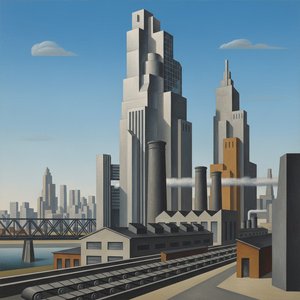
Upon arriving in New York in 1919, Hirsch entered a transformative era of his development. Under the guidance of the esteemed mentor Hamilton Easter Field, he began to master a technique characterized by hard edges, smooth surfaces, and a striking simplification of form. As a pivotal figure in the Precisionist movement, Hirsch turned his gaze toward the burgeoning industrial landscape, capturing the soaring heights of skyscrapers and the rhythmic geometry of factories with an almost clinical objectivity. Yet, beneath this "cool" and "reserved" exterior, his work often harbant an otherworldly tone—a subtle emotional depth that prevented his urban scenes from becoming mere architectural studies.A Versatile Legacy in American Art
The true breadth of Hirsch’s talent was revealed in his refusal to be tethered to a single movement. While celebrated for his precision, he moved fluidly between the gritty narratives of Social Realism, the dreamlike distortions of Surrealism, and the vibrant energy of Mexican Muralism. His subject matter was as diverse as his style, ranging from the quietude of barnyard scenes to the dramatic tension of ruins and circus life. This extraordinary versatility earned him a permanent place in the annals of American art history, with his masterpieces preserved within the halls of:- The Metropolitan Museum of Art
- The Whitney Museum of American Art
- The Phillips Collection
- The Smithsonian American Art Museum
Beyond the canvas, Hirsch was a vital force in the art community, serving as a founder of the Salons of America and an influential instructor at both Bennington and Bard Colleges. His life’s work remains a testament to the power of precision used to explore the profound transitions between the rural past and the industrial future.