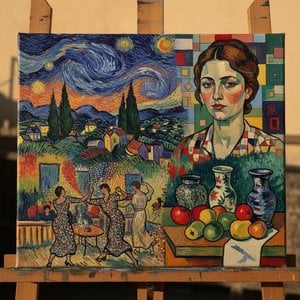
Stanley Cursiter CBE: A Pioneer of Scottish Modernism
Stanley Cursiter (1887–1976) stands as a pivotal figure in the artistic landscape of Scotland, bridging the gap between Impressionism and Futurism while establishing himself as a respected chronicler of Scottish life. Born in Kirkwall, Orkney—a region steeped in Norse heritage—Cursiter’s formative years instilled within him an appreciation for both tradition and innovation, influences that would profoundly shape his distinctive artistic vision. His early education at Kirkwall Grammar School provided a solid foundation before he pursued formal studies at Edinburgh College of Art, where he honed his skills and embraced the burgeoning avant-garde movements sweeping across Europe.Early Influences & Artistic Style
Cursiter’s formative years were marked by exposure to groundbreaking artistic ideas. He absorbed the tenets of Cubism, Futurism, and Vorticism—movements that challenged conventional perspectives on representation and celebrated dynamism and speed. These influences are immediately apparent in his early paintings, characterized by fractured planes, bold colors, and a deliberate distortion of form. Notably, Cursiter’s access to considerable wealth from a young age allowed him to reside at 28 Queen Street, Edinburgh—a prestigious address reflecting the intellectual fervor of the era—and fostering an environment conducive to artistic experimentation. His stylistic evolution mirrored broader trends in European art, demonstrating his adaptability and commitment to pushing creative boundaries.Military Service & Photographic Innovation
Cursiter’s involvement with the British Army during World War I proved transformative, not only personally but also professionally. Serving as an officer in 1st Battalion, The Cameronians (Scottish Rifles), he witnessed firsthand the horrors of trench warfare and endured debilitating conditions—bronchitis and asthma exacerbated by the harsh realities of the front lines. Despite these challenges, Cursiter persevered, transferring to the 4th Field Ordnance Survey Battalion at 4th Army Headquarters and dedicating himself to advancing photographic techniques. His ingenious method of projecting photographic negatives—replicating the tilt present during image capture—revolutionized the rapid assessment of enemy fortifications, dramatically accelerating the process of pinpointing gun emplacements. This accomplishment underscored his intellectual curiosity and his ability to apply scientific principles to artistic endeavors. Furthermore, he became president of Edinburgh Radio Society, reflecting a broader engagement with technological developments of the time.National Gallery Leadership & Artistic Legacy
Cursiter’s career ascended to prominence as Keeper of the National Galleries of Scotland (1919–1930) and subsequently Director (1930–1948), roles during which he championed Scottish art and fostered a vibrant artistic community. He skillfully navigated the complexities of institutional governance while simultaneously nurturing talent and promoting critical engagement with visual culture. His tenure coincided with significant advancements in photographic technology, highlighting his foresight and adaptability. As HM Limner and Painter in Scotland (1948–1976), Cursiter continued to document Scottish life and landscape, producing evocative depictions that captured the spirit of a nation undergoing profound social change. He was recognized for his contributions to Scottish art history and celebrated as an enduring symbol of artistic excellence.Notable Works & Recognition
Cursiter’s oeuvre encompasses a diverse range of subjects—portraits capturing the dignity of individuals and landscapes reflecting the beauty of Orkney's dramatic scenery—each infused with his distinctive stylistic signature. Pieces like “An Orkney Farm” exemplify his meticulous attention to detail and his ability to convey emotion through subtle tonal variations. Similarly, "Stanley Cursiter (1887–1976), Artist, Self Portrait, Director of the National Galleries of Scotland, with his Wife Phyllis Eda Hourston, and his Model, Poppy Low, Chez Nous" offers a glimpse into his personal life alongside his artistic pursuits. His work has been exhibited internationally and remains treasured for its aesthetic merit and historical significance. He was awarded an OBE for his service during World War II and received numerous accolades recognizing his dedication to Scottish art and culture.Questions & Answers
What are the birth city and country of Stanley Cursiter?
Stanley Cursiter was born in Kirkwall, in United Kingdom.
Where are Stanley Cursiter's artworks grouped by technique?
To find all works by Stanley Cursiter in a given medium, use the artist's All Medium page.
Is there a chronological account of Stanley Cursiter?
Stanley Cursiter's career unfolds period by period on the artist's Chronicle page: a horizontal timeline of the artworks, grouped into career-period chapters.