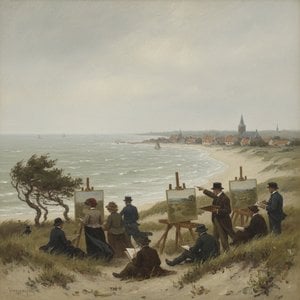
Stanhope Alexander Forbes: A Cornish Impressionist’s Embrace of Everyday Life
Stanhope Alexander Forbes (1857-1947) stands as a pivotal figure in the development of the Newlyn School, a collective of artists who redefined British painting at the turn of the 20th century. More than simply a painter, Forbes was a keen observer of human experience, capturing the rhythms and realities of Cornish life with a remarkable sensitivity and an unwavering commitment to portraying the ordinary. His canvases aren’t grand historical narratives or mythological scenes; instead, they offer intimate glimpses into the lives of fishermen, farmers, children playing on the beach, and women engaged in domestic tasks – subjects often overlooked by earlier generations of artists.
Born in Dublin, Ireland, to a French mother and an English railway manager, Forbes’s early life instilled within him a unique blend of European artistic sensibilities and a deep connection to the natural world. His formal training at Dulwich College and the Royal Academy Schools provided a solid foundation, but it was his time spent studying under Léon Bonnat in Paris that truly shaped his approach – an emphasis on direct observation, tonal modeling, and capturing the fleeting effects of light. This Parisian influence is evident in his early works, characterized by a somewhat academic style, yet already hinting at the looser brushwork and vibrant color palettes that would become hallmarks of his later career.
The Newlyn School and a Rejection of Academic Tradition
Forbes’s relocation to Newlyn, Cornwall, in 1889 marked a transformative moment both personally and artistically. He married Elizabeth Armstrong, another talented painter who shared his passion for plein-air painting and a desire to break free from the constraints of the established art world. Newlyn, a bustling fishing village on the southwestern tip of England, provided an ideal environment for this artistic rebellion. The Newlyn School wasn’t formally organized as a group, but rather a loose association of artists who shared a common ethos – a rejection of stuffy studio practices and a commitment to painting directly from nature.
Influenced by the Barbizon School in France, Forbes embraced the concept of *en plein air*—painting outdoors. This approach allowed him to capture the immediacy of light and atmosphere with unprecedented accuracy. He eschewed idealized forms and carefully constructed compositions, instead favoring a more spontaneous and intuitive style. His paintings are characterized by loose brushstrokes, vibrant colors, and a remarkable ability to convey the sense of movement and energy within his scenes. Forbes’s work stands in stark contrast to the highly polished, meticulously detailed works that were prevalent in the Royal Academy.
Subjects and Style: Capturing Cornish Life
Forbes's subjects weren’t chosen for their inherent grandeur or historical significance; rather, he found beauty and interest in the everyday lives of the people who inhabited Cornwall. Fishermen hauling their nets, farmers tending to their fields, children playing on the beach – these were the figures that populated his canvases. He depicted them not as heroes or villains, but as ordinary individuals engaged in their daily routines. His paintings are imbued with a sense of warmth and humanity, reflecting his genuine affection for the people and landscape of Cornwall.
His style evolved significantly over time. Early works often featured more formal compositions and darker palettes, influenced by his Parisian training. However, as he spent more time in Newlyn, his paintings became increasingly vibrant and expressive, characterized by brighter colors, looser brushstrokes, and a greater emphasis on capturing the fleeting effects of light. He developed a distinctive technique for depicting water – shimmering reflections, dynamic ripples, and a sense of movement that captured the essence of the Cornish coast.
Legacy and Influence
Stanhope Forbes’s contribution to British art is undeniable. He played a crucial role in establishing the Newlyn School as a significant force in the late 19th and early 20th-century art world, influencing generations of artists who followed. His commitment to *en plein air* painting, his focus on everyday subjects, and his distinctive style helped to pave the way for modern British painting.
His wife, Elizabeth Forbes, was equally important in this artistic movement, and their combined efforts established a thriving art school that nurtured countless young talents. Forbes’s legacy extends beyond his own paintings; he fostered a community of artists who shared his vision and helped to shape the cultural landscape of Cornwall. His work continues to be exhibited and admired today, offering a poignant reminder of the beauty and dignity of ordinary life.
Key Works
- A Fish Sale on a Cornish Beach (1975-1999): A quintessential example of Forbes’s ability to capture the energy and drama of a coastal scene.
- Mabel Frances Dickinson (née Norton)..., 1926: Demonstrates his skill in portraiture, capturing the subject's personality with subtle details.
- The Inner Harbour - Abbey slip, Penzance: A masterful depiction of a Cornish harbor scene, showcasing Forbes’s expertise in rendering water and light.
Stanhope Alexander Forbes remains an important figure in the history of British art, his paintings offering a timeless celebration of Cornish life and the beauty of the natural world.
Questions & Answers
What are the birth city and country of Stanhope Alexander Forbes?
Stanhope Alexander Forbes was born in Dublin, in Ireland.
How can I follow Stanhope Alexander Forbes's work year by year?
Stanhope Alexander Forbes's artworks can be seen in chronological order on the artist's Artwork Timeline page.
What are the birthplace and birth year of Stanhope Alexander Forbes?
Stanhope Alexander Forbes was born in Dublin in 1857.