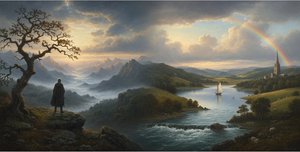
The Father of the Bristol School
In the heart of the nineteenth century, a profound transformation took place within the landscape traditions of England, driven largely by the delicate hand and visionary spirit of Samuel Jackson. Born in Bristol, United Kingdom, Jackson emerged as a pivotal figure in British art history, earning the esteemed title of the "father" of the Bristol School. His journey into the professional realm of art was born of necessity; following the closure of his father's business in 1820, Jackson turned toward drawing, eventually establishing himself as a master of both watercolour and oil painting. His work does not merely depict scenery but breathes life into the topographical essence of his surroundings, capturing the serene and often dramatic atmosphere of the English landscape.
The artistry of Jackson is deeply intertwined with the Romantic movement, characterized by an emotional resonance and a profound connection to nature. His technical prowess was particularly evident in his watercolours, where he utilized light and texture to evoke the shifting moods of the British countryside. A lifelong friend of Francis Danby, Jackson’s work often reflects the subtle influences of his contemporary, blending a sense of atmospheric depth with meticulous detail. This connection helped solidify his place within a group of artists who sought to elevate the depiction of local landscapes into something much more poetic and spiritually evocative.
A Legacy in Water and Light
Jackson’s contribution to the visual record of Bristol is perhaps his most enduring achievement. Through his collaborations with collectors like George Weare Braikenridge, he provided a vital topographical window into the early nineteenth-century appearance of the city. His drawings and paintings of Bristol scenes are not merely records of architecture and geography but are soulful interpretations of a changing urban and natural landscape. From the tranquil vistas of the Floating Harbour to the sweeping views of parklands, his work documents the intersection of human habitation and the natural world with unparalleled sensitivity.
Beyond the borders of his home city, Jackson’s reach extended into the rugged beauty of the wider British Isles. His ability to capture the sublime qualities of nature is seen in works such as his depictions of North Wales, where the interplay of light on lakes and mountains showcases his mastery of the medium. The significance of his career is marked by several key milestones:
- Professional Recognition: His election as an associate member of the Society of Painters in Watercolours in 1823 served as a testament to his standing among the elite artists of his era.
- Topographical Importance: His detailed contributions to the Braikenridge Collection helped make Bristol one of the best-documented English cities of its time.
- Artistic Influence: As a central figure of the Bristol School, he paved the way for a localized movement that emphasized the beauty of regional landscapes through a Romantic lens.
Today, the works of Samuel Jackson remain cherished for their ability to transport the viewer to a bygone era. Whether through the monochrome precision of his early drawings or the lush, atmospheric layers of his later watercolours, he remains a cornerstone of British Romanticism, leaving behind a legacy that continues to illuminate the historical and aesthetic soul of the Bristol School.
Questions & Answers
How did Samuel Jackson's art evolve over time?
Samuel Jackson's career unfolds period by period on the artist's Chronicle page: a horizontal timeline of the artworks, grouped into career-period chapters.
Can I explore Samuel Jackson's works by color spectrum?
Samuel Jackson's works can be explored by color on the artist's Spectral Index page.
Can I browse Samuel Jackson's works by color palette?
To find works by Samuel Jackson in a specific palette, use the artist's By Palettes page.