The Quiet Observer: Henri Rouart and the Impressionist Landscape
Henri Rouart, a name perhaps less familiar than those of his contemporaries in the vibrant Parisian art scene of the late 19th century, nevertheless possessed a remarkable talent for capturing the subtle beauty of the French countryside. Born in Paris in 1833 to a family steeped in industry – his father a prominent manufacturer of military uniforms – Rouart’s path toward artistic expression was initially shaped by a pragmatic education in mathematics and engineering. However, a deep connection with his friend Edgar Degas, fostered during their shared studies at the Lycée Louis-le-Grand, proved pivotal, igniting within him a lifelong passion for painting. This unlikely confluence of disciplines – precision from engineering and artistic sensibility from Degas – ultimately defined Rouart’s unique approach to landscape art. He wasn't driven by grand narratives or dramatic events; instead, he sought to distill the essence of a place, the quiet dignity of rural life, and the fleeting effects of light and atmosphere.
Early Influences and Artistic Development
Rouart’s artistic journey began with a deliberate study of the masters, particularly Jean-Baptiste Corot and Gustave Courbet. He initially sought guidance from these figures, absorbing their techniques for capturing naturalism and atmospheric perspective. However, it was his association with Degas that truly shaped his style. Degas encouraged Rouart to experiment with looser brushwork and a more subjective approach to representation – moving away from strict academic conventions. This influence is particularly evident in his early works, which demonstrate a sensitivity to color and light reminiscent of the Impressionists who were beginning to emerge at the time. Notably, Rouart’s family connections afforded him access to significant art collections, including those of Degas himself, exposing him to a wealth of artistic inspiration and fostering a deep appreciation for both old masters and contemporary movements. He participated in the early Impressionist exhibitions, demonstrating his commitment to this evolving style and solidifying his place within the burgeoning avant-garde.
The Landscape of Melun and Beyond
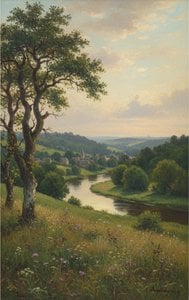
Rouart’s most celebrated works are undoubtedly his depictions of the French countryside, particularly around Melun, a town he frequently visited. These landscapes aren't characterized by dramatic vistas or heroic figures; rather, they offer intimate glimpses into everyday life – farmers tending their fields, children playing in streams, and villagers engaged in simple routines. His brushwork is often delicate and precise, yet imbued with a remarkable sense of atmosphere. The light, particularly the shifting qualities of sunlight on water and foliage, becomes the central focus of his compositions. The painting *Lisière des Bois* (Edge of the Woods), exhibited at the 1886 Salon, exemplifies this approach perfectly. It’s a study in subtle color variations and atmospheric depth, capturing the quiet beauty of a wooded area with remarkable detail and restraint. His work also includes charming portraits of local people, often rendered with a gentle warmth and an appreciation for their dignity.
A Collector's Eye: Rouart's Legacy
Beyond his own artistic output, Henri Rouart was a significant art collector, amassing a remarkable collection that included works by Degas, Corot, Millet, and other prominent artists of the 19th century. Following his death in 1912, his estate was sold at auction, revealing the breadth and depth of his holdings. This sale had a profound impact on the art market, significantly increasing the value of Impressionist paintings and demonstrating Rouart’s astute understanding of artistic merit. His collection included not only contemporary works but also significant pieces from the Old Masters, reflecting a deep appreciation for the entire history of Western art. His legacy extends beyond his own paintings; he played a crucial role in supporting and promoting the work of fellow artists, contributing to the vibrant cultural landscape of Paris during a period of rapid artistic change.
Historical Significance and Lasting Influence
While Rouart may not be as widely recognized as some of his Impressionist contemporaries, his contribution to the development of French landscape painting is undeniable. His quiet observation, meticulous technique, and sensitivity to light and atmosphere established him as a distinct voice within the movement. He represents a more restrained and contemplative approach to Impressionism, prioritizing subtle details and atmospheric effects over bold color palettes or dramatic subject matter. His work serves as a reminder that beauty can be found in the everyday, and that even the simplest scenes can offer profound insights into the human experience. Rouart’s legacy continues to inspire artists today, demonstrating the enduring power of observation, restraint, and a deep connection to the natural world.