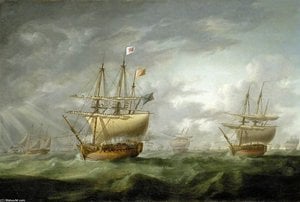
Robert Dodd, 1748 – 1815

Robert Dodd Paintings: The 52 Most Famous Works, Ranked

Robert Dodd's most famous painting is Shipping In The Pool Of London, in the National Maritime Museum, London. With Start of the action between HMS Magicienne and La Sibylle, 2 January 1783 (1784) and Hms 'victory' At Spithead, (1791), it completes the three works everyone recognises. Our catalogue lists 54 works by Robert Dodd; the 52 below are the ones the world looks at most, each with its year, the museum that holds it and why it matters.

Ranked by our popularity score, which combines the searches, visits and orders for each work. Updated November 2026. Every masterpiece on this page can be ordered as a museum-quality, hand-painted oil reproduction or a fine art print, at the size you choose.

Portrait of Robert Dodd
Robert Dodd · 1748 – 1815
Born · died
1748 – 1815, London Borough of Tower Hamlets
Movement
Neoclassicism
Works in our catalogue
54
Most famous
Shipping In The Pool Of London
Most works at
National Maritime Museum

The 10 most famous Robert Dodd paintings

Shipping In The Pool Of London by Robert Dodd
1

Shipping In The Pool Of London

In Shipping In The Pool Of London, Robert Dodd captures a bustling maritime scene centered on the River Thames in London, England. The work presents a moment of industry and movement within the Pool of London, where the water is populated by various types of ships and boats. Some vessels are seen sailing across the river, while others remain moored, creating a sense of a working, living port. This collection…

Hand-painted oil reproduction from $181 43 × 23 cm

Robert Dodd, paintings 11 to 52

Robert Dodd's paintings by period

The subjects Robert Dodd painted most

The four subjects that return most often among these masterpieces, with the finest example of each.

Where to see Robert Dodd's paintings

The 3 museums that hold the most of the paintings on this page.

Museum City Works by Robert Dodd Paintings from this list
National Maritime Museum, LondonNational Maritime Museum London 20 Shipping In The Pool Of London, Start of the action between HMS Magicienne and La Sibylle, 2 January 1783, Greenwich From The Isle Of Dogs
Het Scheepvaartmuseum, AmsterdamHet Scheepvaartmuseum Amsterdam 1 Naval Battle near Kamperduin, 11 October 1797
Museum of Fine Arts, HoustonMuseum of Fine Arts Houston 1 Three Views of "Amity Hall" With a View of Dover and the White Cliffs

Robert Dodd's most famous painting of each decade

  1. 1780s
  2. 1790s
  3. 1800s
  4. 1810s

Questions about Robert Dodd's paintings

What is Robert Dodd's most famous painting?Show the answer

Shipping In The Pool Of London, National Maritime Museum, London. Next come Start of the action between HMS Magicienne and La Sibylle, 2 January 1783 (1784) and Hms 'victory' At Spithead, (1791).

What are the top 10 paintings by Robert Dodd?Show the answer

Shipping In The Pool Of London, Start of the action between HMS Magicienne and La Sibylle, 2 January 1783, Hms 'victory' At Spithead,, HMS 'Victory' at Spithead,, Naval Battle near Kamperduin, 11 October 1797, Battle of Pulo Aura, Straits of Malacca on 15th February 1804, An English frigate escorting a large international merchant convoy, Morning after the battle of the Nile, Venerable and The Defeat Of The Combined Forces Of France And Spain At The Battle Of Trafalgar. The ranking above gives the year and the museum of each.

How many paintings did Robert Dodd make?Show the answer

Our catalogue lists 54 works by Robert Dodd, dated from 1784 to 1815.

Where are Robert Dodd's most famous paintings?Show the answer

Most of them are in National Maritime Museum (London), Het Scheepvaartmuseum (Amsterdam) and Museum of Fine Arts (Houston). The table above lists the museums one by one.

When did Robert Dodd paint the most famous works?Show the answer

In 1790s: 3 of the 52 works on this page date from then, among them Hms 'victory' At Spithead,.

What are Robert Dodd's earliest and latest famous paintings?Show the answer

The earliest on this page is Start of the action between HMS Magicienne and La Sibylle, 2 January 1783 (1784), the latest Morning after the battle of the Nile (1815).

What did Robert Dodd paint most often?Show the answer

Boats (5), Naval battle (5) and British navy (4), among the 52 works on this page.

Which art movement does Robert Dodd belong to?Show the answer

Neoclassicism, as the paintings on this page show.

Which Robert Dodd paintings can I see at the National Maritime Museum?Show the answer

Shipping In The Pool Of London, Start of the action between HMS Magicienne and La Sibylle, 2 January 1783 and Greenwich From The Isle Of Dogs are among the 20 works on this page held by the National Maritime Museum, London.

Can I buy a reproduction of a Robert Dodd painting?Show the answer

Yes. Every painting on this page can be ordered as a museum-quality, hand-painted oil reproduction or a fine art print, in the size you choose, from the painting's own page.

About Robert Dodd

Robert Dodd: A Pioneer of Naval Romanticism

Robert Dodd (1748 – 1815) stands as a significant figure in British art history, particularly within the realm of marine painting and aquatint engraving during the turbulent era of the Napoleonic Wars. Born in London to Alexander Dodd, one of three sons, his artistic inclination was nurtured by his brother Ralph, who pursued a career as an engineer and painter – a familial connection that undoubtedly fostered an appreciation for visual representation and technical skill. He married Mary Fulton in 1772, establishing a family life alongside his artistic pursuits. Dodd’s death in early 1815 marked the end of a productive life dedicated to capturing the grandeur and drama of maritime encounters.
  • Early Life & Training:
  • Dodd's formative years were spent honing his artistic abilities, initially focusing on landscape painting before gravitating towards the captivating world of naval scenes.

The Rise of a Marine Artist

Dodd’s breakthrough came during the French Revolutionary Wars and American War of Independence. Recognizing the potential for dramatic storytelling through visual media, he skillfully employed his talent to depict pivotal battles—most notably “The Battle of Trafalgar,” commemorating Britain's decisive victory against Napoleon’s fleet. This monumental canvas, now housed at the National Maritime Museum, exemplifies Dodd’s mastery of technique and artistic vision. He meticulously rendered ships, rigging, and atmospheric conditions, conveying not merely factual accuracy but also palpable emotion – a hallmark of what historians termed “Romanticism.”
  • Technique & Style:
  • Dodd's distinctive style was characterized by masterful use of light effects. He expertly contrasted radiant sunlight with brooding clouds and smoke, creating compositions that pulsated with energy and dynamism.

Engraving & Artistic Legacy

Beyond his paintings, Dodd achieved considerable renown as an aquatint engraver. Over 100 of his own works were reproduced in exquisite detail by other artists, ensuring the preservation of his artistic vision for posterity. This dedication to engraving underscored his belief that visual art could serve as a powerful tool for documenting history and conveying its emotional impact. Although overshadowed by luminaries like Turner and Constable, Dodd’s contribution to British maritime painting remains invaluable—a testament to his unwavering commitment to capturing the spirit of an era defined by conflict and exploration.
  • Notable Achievements:
  • Dodd's enduring legacy rests on his monumental depiction of “The Battle of Trafalgar,” considered one of the finest naval paintings of its time, and his prolific engagement in aquatint engraving.

Recognition & Artistic Influence

Dodd’s artistic endeavors were recognized by prominent institutions such as the Society of Artists and the Royal Academy, where he exhibited regularly until 1809. His work served as inspiration for subsequent generations of artists, cementing his place within the broader context of British Romantic art—a movement that prioritized emotion and imagination alongside meticulous observation. Robert Dodd’s legacy continues to resonate today, reminding us of the transformative power of visual storytelling and the enduring beauty found in capturing moments of historical significance.