Robert Brough, 1872 – 1905

Robert Brough: The 33 Most Famous Paintings

The Artist at Seventeen Years of Age (1889) is the most famous painting by Robert Brough. Monsignor Charles Tochetti (1897) and Sir James Murray (1850–1933) (1903) are the next two works the world knows best. From the 44 works of Robert Brough in our catalogue, here are the 33 that collectors and museum visitors look at most, with the year, the museum and the story of each.

Ranked by our popularity score, which combines the searches, visits and orders for each work. Updated November 2026. Every masterpiece on this page can be ordered as a museum-quality, hand-painted oil reproduction or a fine art print, at the size you choose.

Portrait of Robert Brough
Robert Brough · 1872 – 1905
Born · died
1872 – 1905, Invergordon
Works in our catalogue
44
Most famous
The Artist at Seventeen Years of Age (1889)
Most works at
Edinburgh College of Art

Top 10: Robert Brough's best-known paintings

The Artist at Seventeen Years of Age (1889) by Robert Brough
1

The Artist at Seventeen Years of Age

1889 · Oil On Canvas

In this 1889 oil on canvas, we find a young Robert Brough looking back at himself. It is a close-up, bust-length portrait that captures the artist at seventeen, a period of profound transition. The grayscale tones and muted palette lend the work a certain melancholy, as if we are witnessing a private thought caught in mid-air. There is a stillness here, a sense of a soul contemplating its own direction…

Hand-painted oil reproduction from $181 28 × 36 cm
Monsignor Charles Tochetti (1897) by Robert Brough
2

Monsignor Charles Tochetti

1897 · Oil On Canvas

In this 1897 portrait, we find ourselves in a quiet, intimate encounter with Monsignor Charles Tochetti. The subject is presented in a close-up, three-quarter view, his presence filling the frame with a sense of settled dignity. There is a profound stillness here, a moment captured where the light catches the deep lines of a life lived with purpose. The background remains dark and indistinct, a deliberate choice that pushes the…

Hand-painted oil reproduction from $181 28 × 36 cm Same size as the original $306 63 × 81 cm Order at original size →
Sir James Murray (1850–1933) (1903) by Robert Brough
3

Sir James Murray (1850–1933)

1903 · Oil On Canvas

The portrait of Sir James Murray, executed in 1903, presents a formal study of the subject in a monochromatic palette. He is positioned slightly to the left of the center, facing forward with a direct gaze directed toward the viewer. The figure is dressed in a dark suit, which provides a solid, structured silhouette against the background. A doorway is visible behind him on the right, creating a receding plane…

Hand-painted oil reproduction from $181 24 × 41 cm Same size as the original $528 86 × 145 cm Order at original size →
Mrs Nicol of Roscobie (1905) by Robert Brough
4

Mrs Nicol of Roscobie

1905 · Oil On Canvas

A seated woman occupies the center of this 1897 oil on canvas, her gaze directed toward the viewer from a position of relaxed formality. She sits within an indistinct interior, the background rendered in soft, blended brushstrokes that lack sharp definition. The composition is anchored by the subject's upper body, while elements of her immediate surroundings provide subtle narrative cues:

Hand-painted oil reproduction from $181 35 × 28 cm Same size as the original $215 51 × 41 cm Order at original size →
John Hay (1871) by Robert Brough
5

John Hay

1871 · Oil On Canvas

In this intimate portrait titled John Hay, the artist Robert Brough turns his attention to the quiet dignity of an older man. The subject is presented with a heavy, prominent beard and mustache that frame a face marked by experience. It is a study of character, captured around about 1871. The sitter's presence is immediate, commanding the space with a sense of introspection and a certain weight of years.

Hand-painted oil reproduction from $181 28 × 36 cm Same size as the original $246 51 × 61 cm Order at original size →

The rest of the Robert Brough ranking, 11 to 33

Fantaisie en Folie (1897) by Robert Brough

The Tate Britain is home to a plethora of captivating artworks, including Robert Brough's Fantaisie en Folie, created in 1897. This oil on canvas painting is a testament…

Bring it home from $181 →

The subjects Robert Brough painted most

The four subjects that return most often among these masterpieces, with the finest example of each.

Where to see Robert Brough's paintings

The 7 museums that hold the most of the paintings on this page.

Museum City Works by Robert Brough Paintings from this list
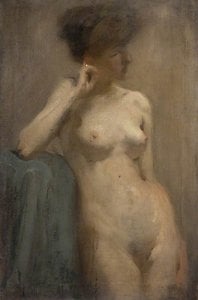
Edinburgh College of Art, EdinburghEdinburgh College of Art Edinburgh 2 Female Nude with Brass Urn, Nude Study Female
University of Aberdeen, АмстердамUniversity of Aberdeen Амстердам 1 John Thomson
Scottish National Gallery, EdinburghScottish National Gallery Edinburgh 1 William Dallas Ross (d.1931)
West Lothian Council, LivingstonWest Lothian Council Livingston 1 John Adrian Louis (1860–1908), 7th Earl of Hopetoun and 1st Marquis of Linlithgow
Mintlaw Discovery Centre, PeterheadMintlaw Discovery Centre Peterhead 1 Reverend Dr James Stewart (1830–1917), Minister of Peterhead (1864–1917) (unfinished)
Dundee Art Gallery And Museum, DundeeDundee Art Gallery And Museum Dundee 1 Mary Dallas Ross
The Fleming Collection, LondonThe Fleming Collection London 1 Fieldworkers

Robert Brough through the decades: one masterpiece for each

  1. 1880s
    The Artist at Seventeen Years of Age (1889) by Robert Brough
    Rank 1 / 33

    The Artist at Seventeen Years of Age

    Age 8 – 17

    In this 1889 oil on canvas, we find a young Robert Brough looking back at himself. It is a close-up, bust-length portrait that captures the artist at seventeen,…

  2. 1890s
    Monsignor Charles Tochetti (1897) by Robert Brough
    No. 2 of 33

    Monsignor Charles Tochetti

    Age 18 – 27

    In this 1897 portrait, we find ourselves in a quiet, intimate encounter with Monsignor Charles Tochetti. The subject is presented in a close-up, three-quarter view, his presence filling…

  3. 1900s
    Sir James Murray (1850–1933) (1903) by Robert Brough
    Rank 3 / 33

    Sir James Murray (1850–1933)

    Age 28 – 33

    The portrait of Sir James Murray, executed in 1903, presents a formal study of the subject in a monochromatic palette. He is positioned slightly to the left of…

Robert Brough's paintings: frequently asked questions

What is the most famous Robert Brough painting?Show the answer

The Artist at Seventeen Years of Age (1889). Next come Monsignor Charles Tochetti (1897) and Sir James Murray (1850–1933) (1903).

At what age did Robert Brough paint The Artist at Seventeen Years of Age?Show the answer

17 years old: The Artist at Seventeen Years of Age dates from 1889 and Robert Brough was born in 1872.

Which are the 10 most famous Robert Brough paintings?Show the answer

The Artist at Seventeen Years of Age, Monsignor Charles Tochetti, Sir James Murray (1850–1933), Mrs Nicol of Roscobie, John Hay, Untitled, Dolce pomum, Mary Dallas Ross (c.1881–1936), Female Nude with Brass Urn and View of Elgin, Moray. The ranking above gives the year and the museum of each.

How many paintings by Robert Brough are there?Show the answer

Our catalogue lists 44 works by Robert Brough, dated from 1889 to 1905.

Where can I see the most famous Robert Brough paintings?Show the answer

Most of them are in Edinburgh College of Art (Edinburgh), University of Aberdeen (Амстердам) and Scottish National Gallery (Edinburgh). The table above lists the museums one by one.

In which period did Robert Brough paint the best-known works?Show the answer

In 1890s: 17 of the 33 works on this page date from then, among them Monsignor Charles Tochetti.

What is the earliest famous Robert Brough painting, and the latest?Show the answer

The earliest on this page is The Artist at Seventeen Years of Age (1889), the latest Mrs Nicol of Roscobie (1905).

What subjects did Robert Brough paint?Show the answer

Man (2) and Portrait (2), among the 33 works on this page.

What did Robert Brough paint on, and with what?Show the answer

Oil On Canvas: 5 of the 33 works on this page.

What Robert Brough paintings does the Edinburgh College of Art hold?Show the answer

Female Nude with Brass Urn and Nude Study Female are among the 2 works on this page held by the Edinburgh College of Art, Edinburgh.

Where can I buy a Robert Brough reproduction?Show the answer

Yes. Every painting on this page can be ordered as a museum-quality, hand-painted oil reproduction or a fine art print, in the size you choose, from the painting's own page.

Robert Brough: biography

The Luminous Legacy of Robert Brough

In the annals of Scottish art history, few names evoke such a poignant sense of fleeting brilliance as Robert Brough. A painter whose life was tragically brief, spanning only from 1872 to 1905, Brough managed to capture the very essence of Victorian Aberdeen with a sensitivity that transcended the rigid academicism of his era. Born near Invergordon in the rugged beauty of Ross and Cromarty, he carried within him a vision that sought to bridge the gap between the venerable traditions of his homeland and the burgeoning modernism sweeping through Europe. His work remains a testament to a soul caught between the structured dignity of the past and the vibrant, emotive possibilities of the future.

Brough’s artistic journey was deeply rooted in the soil of Scottish tradition, yet it was never confined by it. His formal training at the Glasgow School of Art provided him with a formidable technical foundation, most notably through his studies under the influence of the legendary portraitist Henry Raeburn. From this encounter, Brough inherited a profound respect for the psychological depth of his subjects and a mastery of capturing authentic human emotion. However, where his predecessors might have sought a static perfection, Brough pursued something far more elusive: the atmospheric mood. He looked toward the Parisian avant-garde, absorbing the light-drenched lessons of Impressionism and the dreamlike enigmas of Symbolism, weaving these international influences into the fabric of his Scottish sensibilities.

A Symphony of Color and Emotion

As Brough established himself within the artistic circles of Aberdeen, his style underwent a remarkable evolution, moving away from mere representation toward a more expressive, visceral language. He became a master of color, utilizing a palette that could shift from somber, muted tones to sudden, breathtaking bursts of luminosity. His canvases were not merely depictions of people or scenes; they were vessels for feeling. In his portraits, one finds an intimate connection with the sitter, achieved through delicate brushstrokes and a sophisticated use of light that seems to pulse with life.

This mastery is perhaps most evident in his celebrated works, where the boundaries between reality and imagination begin to blur:

  • Dolly Crombie (1896): A stunning oil on canvas that exemplifies his ability to create intimacy. Through a careful arrangement of flowers and soft light, Brough captures a moment of quiet reflection, drawing the viewer into a private, serene world.
  • Fantaisie en Folie (1897): A piece that showcases his imaginative depth, where symbolism and composition invite the observer to ponder the deeper, perhaps more whimsical, meanings hidden within the domestic scene.
  • John Hay (1871): A poignant study of age and character, demonstrating his skill in using expressive realism to convey the dignity of the human experience.

Historical Significance and Enduring Spirit

Though his career was cut short by his untimely death at the age of thirty-two, Robert Brough left behind an oeuvre that continues to resonate with a singular, haunting beauty. He was an artist who refused to be stagnant, constantly experimenting with the interplay of light and shadow to express the inner complexities of his subjects. His ability to blend the formal requirements of portraiture with the emotive freedom of modern movement allowed him to document Victorian society not just as it appeared, but as it felt.

Today, Brough is remembered not merely as a regional painter, but as a visionary Scot who dared to infuse traditional subjects with a modern, luminous spirit. His works, held in prestigious collections such as Tate Britain, serve as vital links to a transformative period in art history. To look upon a Brough painting is to witness the struggle and the triumph of an artist striving to capture the ephemeral—the fleeting light, the passing emotion, and the enduring soul of a changing world.