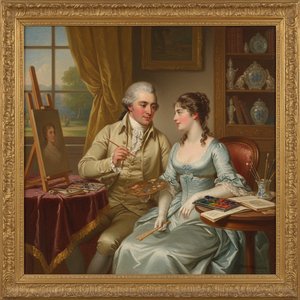
A Life in Miniature: The World of Richard Cosway
Richard Cosway, born in the quiet Devon town of Tiverton in 1742, ascended to become one of the most celebrated portrait miniaturists of his age. His journey began with a precocious talent recognized early on; at twelve years old, he was already demonstrating artistic promise significant enough to warrant a move to London for formal training. He studied under Thomas Hudson and William Shipley, foundational figures who instilled in him not only technical skill but also an entrepreneurial spirit that would define his career. Even before establishing his own business by 1760, Cosway had secured recognition from the Society of Arts, foreshadowing the acclaim he would soon garner within London’s vibrant artistic circles. This early success wasn't merely about talent; it was a testament to ambition and a keen understanding of the burgeoning market for portraiture during the Georgian era.The Regency Era’s Premier Portraitist
Cosway quickly distinguished himself through his exquisite miniatures, a particularly popular art form in an age captivated by elegance and personal representation. His style was characterized by a refined attention to detail, subtle yet luminous color palettes, and an almost uncanny ability to capture not just likeness but the very essence of his sitters. He wasn’t simply painting faces; he was crafting intimate glimpses into character and social standing. This talent brought him to the attention of the aristocracy, becoming their favored portraitist. Notable commissions included portraits of Arthur Wellesley, later the Duke of Wellington, showcasing Cosway's skill in conveying both power and personality. A particularly poignant work is his miniature depicting Midshipman Isaac Smith aboard HMS Endeavour, a captivating snapshot of maritime life that transcends mere portraiture to become a historical document. His ability to capture the nuances of human expression, combined with technical mastery, cemented his reputation as *the* miniaturist of the Regency period.Recognition and Royal Patronage
Cosway’s artistic prowess was formally acknowledged by the establishment when he was elected an Associate Member of the Royal Academy in 1770, swiftly followed by full membership in 1771. This inclusion placed him amongst the leading artists of his day, as immortalized in Johan Zoffany's famous group portrait of Royal Academy members – a testament to his peers’ respect and admiration. However, it was his appointment as Painter to the Prince of Wales in 1785 that truly signified the pinnacle of his career. This wasn’t merely a title; it represented royal patronage, prestige, and access to an exclusive circle of influence. It also allowed him to sign his works with the impressive designation *Primarius Pictor Serenissimi Walliae Principis* – Principal Painter to His Most Serene Highness the Prince of Wales – a bold declaration of his status. He moved in sophisticated circles alongside artists like John Smart and George Engleheart, contributing to a dynamic artistic community that thrived on innovation and mutual inspiration.A Complex Legacy
The personal life of Richard Cosway was as captivating as his art. His marriage in 1781 to Maria Hadfield, herself an accomplished artist, was marked by both collaboration and complexity. Their home became a fashionable salon, attracting prominent figures from the arts and society, fostering intellectual exchange and creative energy. However, later in life, Cosway experienced periods of mental instability that ultimately led to institutionalization. Despite these challenges, his artistic legacy endures. His miniatures are highly valued not only for their technical brilliance but also for the historical insights they offer into the social and cultural landscape of the Regency era. The Witts Family Group, for example, is a masterpiece of composition and character study. Cosway’s influence can be seen in subsequent generations of miniature artists, solidifying his place as a pivotal figure in British art history. He remains a symbol of an age defined by elegance, refinement, and the enduring power of portraiture to capture the spirit of an era.Questions & Answers
Can I explore Richard Cosway's works by subject?
Richard Cosway's works can be explored by subject on the artist's Subject Atlas page.
What are the birthplace and birth year of Richard Cosway?
Richard Cosway was born in Tiverton in 1742.
How many artworks by Richard Cosway are available to browse?
You can browse 85 artworks by Richard Cosway on the All Artworks page.
Where can I see all artworks by Richard Cosway?
Every work by Richard Cosway on this website can be browsed from the artist's All Artworks page.
In which historical period did Richard Cosway work?
Richard Cosway worked in the Early-Modern period. The period situates the artist's activity in history.
What are the birth city and country of Richard Cosway?
Richard Cosway was born in Tiverton, in United Kingdom.
Is there a chronological account of Richard Cosway?
Richard Cosway's career unfolds period by period on the artist's Chronicle page: a horizontal timeline of the artworks, grouped into career-period chapters.
Is there a 3D virtual tour of Richard Cosway's works?
A virtual visit is possible: the 3D Museum page of Richard Cosway presents the artist's works in a three-dimensional gallery.