Marc Chagall: A Life Painted in Dreams
Born Moishe Chagall in Vitebsk, Belarus (then part of the Russian Empire) on July 7, 1887, Marc Chagall’s life was a vibrant tapestry woven with threads of Jewish heritage, artistic experimentation, and profound personal experience. His early years were marked by poverty and hardship within a close-knit family – his father a herring merchant, his mother a teacher – yet these circumstances fostered an enduring connection to his roots and a deep appreciation for the simple beauty of rural life. His formal education was interrupted at a young age, but he found mentorship in a local painter, Jehuda Pen, igniting a lifelong passion for art. This nascent talent blossomed further during his time in Saint Petersburg, where he immersed himself in the burgeoning artistic scene and encountered the revolutionary ideas of the Parisian Avant-Garde – movements like Fauvism and Cubism profoundly shaping his evolving style.
The 1910s witnessed a dramatic transformation in Chagall’s work. A grant from Vinaver enabled him to finally realize his dream of studying in Paris, a pivotal moment that exposed him to the dynamism of the city's art world. He quickly established himself within the circles of artists at La Ruche, including Delaunay, Léger, Soutine, and Lipchitz – figures who challenged conventional artistic boundaries. His early Parisian paintings are characterized by bold colors, distorted perspectives, and a dreamlike quality, reflecting his deeply personal vision and a desire to transcend realistic representation. The Salon des Indépendants provided a crucial platform for showcasing his innovative work, solidifying his position as a leading figure in the modern art movement.
The Russian Years: War, Exile, and Artistic Flourishing
World War I dramatically altered Chagall’s trajectory. With the outbreak of hostilities, he returned to Vitebsk, only to find himself embroiled in the turbulent events surrounding the Bolshevik Revolution. Initially embracing the ideals of social change, he was soon disillusioned by the repressive policies of the new regime and forced into exile in 1922. This period marked a significant shift in his artistic focus, as he turned inward, drawing upon memories of his childhood in Vitebsk and exploring themes of Jewish identity, folklore, and spirituality. His paintings from this era – works like *Promenade*, *Over the Town*, and *Apparition* – are imbued with a potent emotional intensity, reflecting both personal grief and a yearning for connection to his heritage.
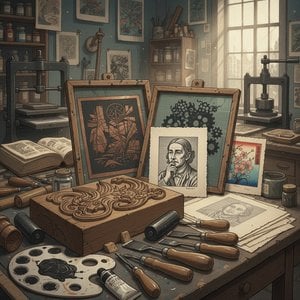
Despite facing considerable hardship and political persecution, Chagall continued to produce an astonishing volume of work during this time. His collaboration with Ambroise Vollard, a prominent art dealer and collector, proved invaluable, providing him with financial support and access to the Parisian art market. Vollard’s influence extended beyond mere patronage; he encouraged Chagall to explore new techniques and expand his artistic horizons, particularly in printmaking. The creation of *Miserere*, an ambitious series of illuminated books based on Dante's *Inferno*, became a defining project of this period, showcasing Chagall’s extraordinary skill as both painter and designer.
A Return to Paris and Later Works
Following the Russian Revolution, Chagall settled permanently in Paris in 1923, alongside his wife, Bella. This return marked a renewed engagement with the Parisian art scene, though he maintained a distinct artistic voice that set him apart from the prevailing trends of the time. His later works are characterized by a greater sense of serenity and lyricism, often depicting scenes of domestic life, biblical narratives, and landscapes infused with symbolic meaning. The influence of Cubism and Surrealism remained evident, but Chagall’s distinctive style – marked by vibrant colors, flattened perspectives, and dreamlike imagery – continued to evolve.
Throughout his career, Chagall consistently explored themes of memory, faith, and the human condition. His art is deeply personal, reflecting his own experiences and emotions as well as universal concerns about love, loss, and spirituality. He remained a prolific artist until his death in 1983, leaving behind an unparalleled body of work that continues to captivate audiences worldwide. Chagall’s legacy extends beyond the realm of art; he is remembered as a symbol of resilience, creativity, and the enduring power of the human spirit.
Key Influences and Artistic Style
Chagall's artistic development was shaped by a confluence of influences. Early exposure to Russian folklore and Jewish traditions provided a rich source of imagery and symbolism. The avant-garde movements of Fauvism, Cubism, and Expressionism ignited his experimentation with color, form, and perspective. The works of Vincent van Gogh, Paul Gauguin, and Henri Matisse served as inspiration for his bold use of color and expressive brushwork. However, Chagall ultimately forged a unique style that blended these influences into a highly personal vision – characterized by dreamlike imagery, flattened perspectives, vibrant colors, and a profound sense of emotion.
His distinctive style is often described as “primitive,” yet it possesses an extraordinary sophistication and emotional depth. Chagall’s paintings are not merely representations of reality; they are expressions of his inner world – a realm where the boundaries between dream and waking life blur, and where symbols and metaphors convey profound meanings.