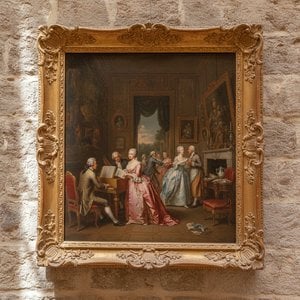
Raffaello Sorbi: A Florentine Painter of Everyday Life
Raffaello Sorbi, born in Florence in 1844 and passing away in the same city in 1931, stands as a significant figure within the late 19th-century Italian art scene. While not always commanding the immediate attention of his more celebrated contemporaries, Sorbi’s contribution lies primarily in his masterful depiction of everyday life – capturing the nuances of Florentine society and the spirit of the Italian countryside with remarkable realism and emotional depth. His work, largely characterized by genre paintings, offers a poignant glimpse into a rapidly changing Italy, blending academic tradition with emerging influences from Impressionism and Symbolism.
Sorbi’s artistic journey began within the rigorous framework of the Florence Academy of Fine Arts, where he studied under Antonio Ciseri, a prominent academic painter known for his historical subjects. This early training instilled in him a solid understanding of technique and composition – a foundation that would later inform his own distinctive style. However, Sorbi quickly moved beyond mere imitation, developing a keen interest in portraying the lives of ordinary people, a departure from the prevalent historical and mythological themes dominating much of academic art at the time. His initial works, such as “Corso Donati mortally wounded is transported by Monks of San Salvi to their Abbey” (1861), already demonstrated his ability to convey dramatic narratives with meticulous detail and a subtle emotional resonance – a hallmark of his future oeuvre.
The Development of a Distinctive Style
Sorbi’s artistic style evolved considerably throughout his career. Initially influenced by the academic traditions he received at the Academy, his paintings gradually incorporated elements of Impressionism and Symbolism. He moved away from the stark realism of his early works, employing looser brushstrokes, brighter colors, and a greater emphasis on capturing fleeting moments and subjective impressions. This shift is particularly evident in his later genre scenes, which often depict intimate domestic settings or lively outdoor gatherings. His subjects weren’t grand historical figures but rather the common people of Florence – merchants, artisans, farmers, and their families – rendered with an affectionate eye and a deep understanding of human nature.
Notable among Sorbi's significant works are paintings like “Riccarda Donati kidnapped from the Convent of Santa Chiara” (1863), depicting a dramatic scene of abduction, and “St Catherine of Siena before an angry Florentine mob after concluding peace with the Pope” (circa 1870). These pieces showcase his ability to combine historical accuracy with emotional intensity, capturing the drama and passion of the events depicted. He also produced numerous smaller works – studies of animals, portraits, and scenes from everyday life – often sold through the prestigious Goupil Gallery in Paris, catering to a discerning international clientele.
Themes and Influences
Sorbi’s work is deeply rooted in the social and cultural context of 19th-century Italy. The unification of Italy was still a relatively recent event, and Florence remained a vibrant center of artistic and intellectual life. Sorbi's paintings reflect this atmosphere of change and uncertainty, capturing both the beauty and the challenges of a nation forging its identity. His interest in depicting ordinary people also speaks to a broader social trend – a growing awareness of the lives and experiences of those outside the elite circles of society.
While he was influenced by academic traditions, Sorbi’s work also reveals connections with other artistic movements. The loose brushwork and emphasis on capturing fleeting moments in his later paintings echo Impressionistic techniques, while his depictions of emotional intensity and symbolic imagery align with Symbolist aesthetics. Furthermore, the influence of Redon is noticeable in some of his works, particularly those depicting animals and landscapes.
Legacy and Significance
Raffaello Sorbi’s legacy lies not in grand monuments or revolutionary innovations but rather in his quietly compelling portrayal of everyday life. His paintings offer a valuable window into the social and cultural landscape of 19th-century Italy, capturing the beauty, the struggles, and the spirit of a nation undergoing profound transformation. Though often overshadowed by more prominent figures of the era, Sorbi’s work continues to be appreciated for its realism, emotional depth, and enduring charm. His paintings are now housed in various collections across Europe, testament to his lasting contribution to Italian art.